
I’m excited to serve as the new CEO of PDK and to have the opportunity to write about leadership here in Kappan. In the spirit of learning and leading together, I will be interviewing major education figures, rising stars in education, and some of our student leaders to get their perspectives about the current happenings in education.
I am starting with John B. Gordon III, the superintendent of schools in Suffolk, Virginia. I’ve known John for several years and had the honor of working with him when I was superintendent and he was chief of schools in Chesterfield, Virginia. Every time I hear John’s inspiring personal story, I get more energized to maximize my own impact on public education at such a critical time.
Q: To kick things off for our readers, would you please share a little about your life and education journey?
A: I am a native of Richmond, Virginia, and a proud graduate of Hermitage High School, with degrees from the University of Virginia and Virginia Commonwealth University and a doctorate in Educational Leadership and Policy Studies from Virginia Tech.
I was an elementary school teacher in Maryland and a high school history teacher and championship basketball coach in Virginia before I went into administration. As an administrator, I served as a dean of students and an assistant principal before becoming the first African American principal of The James Monroe High School in Fredericksburg, Virginia. I’ve also served as director of administrative services in Fredericksburg and chief of schools in Chesterfield County. I also was the first African American chairman of the Virginia High School League. I have served as the division superintendent of Suffolk Public Schools for the past four years.
Q: What is it like being a superintendent in schools today?
A: Being a superintendent of schools has changed so much in the last five years. Superintendents were charged with changing the entire field of education during the COVID-19 pandemic. Then we had to lead a depleting workforce, often in a politically divided school community, while still keeping kids first in everything that we do.
Mentors like you, David Melton, and David Sovine told me that being in this role definitely has a political side to it, but what was happening when I started in education is nothing like what we are experiencing now. I think we can all agree that schools have taken on even more responsibility related to the need to strive for equity in all decisions, to address the social issues that impact our children, and to prepare our students for the “new” world they live in. And, as we do all this, we must continue to build the bridge between local, state, and federal leaders so they truly understand what our schools need to be successful. This job is not 24-7, it is 25-8.
Q: Many of our readers are Educators Rising students, teachers, principals, professors, and superintendents. What advice do you have for our future and current leaders on how to make our schools the most impactful places for young people?
A: All educational leaders must ensure that student voice is a part of the discussion. When I was the principal at The James Monroe High School (I always add The to make us stand out), I implemented a principal’s roundtable to make sure student leaders were a part of the decision-making process. The roundtable included the class presidents at all grade levels, the student council president, the captain of the football team, the captain of the cheerleaders, the president of the National Honor Society, and any others I needed to include to ensure that I had all groups represented. Before I made any major decision, these students were the last group I spoke with.
I have carried that same idea forward with the superintendent’s roundtable, which has one student leader (chosen by the principal) from all the secondary schools in the district. These kids are brutally honest, and they give me so much information and insight on how schools operate.
For example, in the superintendent’s roundtable, the students have discussed with me their perspective on safety. These student leaders have informed me of where there are blind spots in our school’s security cameras. They’ve also shared their opinions on school lunches, including their favorite menu choices, and on what areas of the school need improving as a part of our capital improvement plan. Hearing from students allows me to see the schools through their eyes and make adjustments based on their feedback. It also motivates and empowers other students to want to either be on the superintendent’s roundtable or to take a leadership role in the school so that they can have a voice in decisions.
Q: In the recent PDK Poll we released in our September issue, we heard that Americans across the country want educators to remain strongly involved in decision making about our schools and curriculum, but we know it is imperative to have parents’ voices at the table as well. How do you balance this to ensure that parents are involved and helping to lead decisions alongside our students and educators?
A: In education, parents must be our partners. We need parents to reinforce at home what students learn in school. And, at the same time, schools should be an extension of the home. This is how it used to be in the 1970s and 1980s, when I was in school and the school community was more tight-knit. In those days, your schoolteacher may also be your Sunday school teacher, or your coach at school may also be your coach for Little League. We have kind of gotten away from that over the past couple of decades. I think some adults made education more about them, than about the kids.
A good way to balance all of this is to increase the opportunities for communication and collaboration. The communication cannot just happen when something bad is going on in the classroom or be limited to the automated school messenger or robocall. The communication must be “two-way” so that both schools and families can engage and provide feedback to each other. Both the school and the student’s family (not just parents) need multiple opportunities to be in the same space at the same time. School movie nights, fairs, intramurals, sporting events, and entertaining fundraisers are always a good start. The key is making sure that the leadership is split evenly among school staff and student families. Schools should encourage families to get involved by providing recognition for volunteers at other school events. Everyone likes to see their name in lights!
Q: You have sparked tons of innovation in Suffolk. What initiatives are you most excited about, and how are they having an impact on your community?
A: Do we have enough space to include them all? But seriously, I think I am most proud of our recent book, STEM Century: It Takes a Village to Raise a 21st Century Graduate: The Suffolk (VA) Edition. This book is the first of its kind where a school division is offering a road map for all school divisions and school communities to not only improve student achievement in science, but also provide students with the STEM skills that make them more hirable. There are hundreds of thousands of computer science employment opportunities going unfilled.
School curriculums have not caught up to the growing demand in artificial intelligence, computer programming, and robotics. We must rewrite our instructional model so that STEM education is taught in all subjects, and students must drive the lessons based on their interests and goals. I believe that our partnership with (STEM education provider) 21stCentEd is the vehicle to make that belief a reality.
I feel it is my job to provide students with a first-class education that allows them to become anything they want. The partnerships we have with Amazon, Nike, Pepsi, and others are models for how businesses can support the school division. These partnerships allow our school community to know that we are working with global companies that support our school division and our city. Amazon has opened up their factories to allow our students to not only tour, but also to work toward internships and other employment opportunities, which ties in well with our work in STEM and preparing more students for fields that have large employee vacancies. Our partnership with Nike confirms to our entire school community that we want our student-athletes to have top-of-the-line equipment and apparel. Having the “swoosh” on their gear incentivizes more of our kids to participate in extracurricular activities. The partnership with Pepsi makes our schools more self-sufficient because we allow all schools to keep all of the money from their vending machines, concession sales, and so on. Being associated with these successful global brands sends the message to the average person that the district is successful, too. If the school division were not top-notch, these great companies would not be our partners.
In all our efforts we make sure our school community understands that we want the very best for our students and staff. This is the process of becoming the premier school division in the country. Check that, the world!
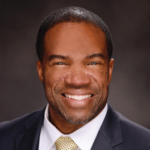
John B. Gordon III has been in public education for 27 years and is the division superintendent of Suffolk Public Schools in Virginia. He is the author of The Teacher’s Lounge: The Real Roles of Educators in Your Schools (Clovercroft, 2019). He is also the president of Schools That Inspire, LLC, an educational consulting company that believes that we can inspire a generation . . . one student at a time.
This article appears in the October 2023 issue of Kappan, Vol. 105, No. 2, pp. 60-61.

ABOUT THE AUTHOR

James F. Lane
James F. Lane is CEO of PDK International.