In this week’s newsletter: Schools are tackling literacy reform. Widespread student absenteeism gets new White House (and Youngkin) attention. A new book challenges a vaunted charter network’s origin story. A CNN reporter demonstrates how to interview a teachers union president. And an ed reporter fact-checks Gannett’s much-derided Taylor Swift reporting job announcement.
ABSENTEEISM GOES POLITICAL
The big story of the week
The big story of the week is newfound political attention towards widespread reports of persistent student absenteeism.
The situation is increasingly clear. Analyzing NAEP scores, the Department of Education’s National Center for Education Statistics and the White House Council of Economic Advisers said absenteeism accounted for up to 45% of declines in reading and math scores. Last year, absenteeism rates were down in many places from the year before, but they remain high and disproportionately impact students in high-poverty schools (The 74, CT Mirror).
Now, elected officials and politicians are starting to take notice. The Biden White House surprised some observers (including me) when it released a statement calling for an “all-hands-on-deck approach” to addressing student absenteeism (The Hill, K-12 Dive). Virginia Governor Glenn Youngkin has launched an absenteeism reduction task force (Washington Post).
Be prepared for more elected officials and candidates to jump in over the coming weeks, each with his or her own perspective on how best to address the situation.
More big stories of the week:
📰 TACKLING LITERACY: Schools and districts are revamping their approaches to teaching kids to read (ABC News, New York Magazine). Revamping literacy instruction is no easy endeavor, requiring consideration of English learners (Sahan Journal) and students with dyslexia (The City). Meantime, one of the nation’s top education schools is distancing itself from a now-discredited literacy program (New York Times, Gothamist/WNYC).
📰 MISSING LAHAINA: As Lahaina schools remain closed, students have been bussed to other schools across the island. Parents are begging officials to reopen their schools — some are taking it into their own hands and opening up their own learning hubs (NPR, KITV Island Television). Meantime, Hawaii education officials are under fire after announcing they haven’t been able to get in contact with 500 families after the devastating fire — and then saying the number of students listed as missing or killed is too small to release (The 74, USA Today).
📰 FAILING OLDER STUDENTS: The newly released second annual State of the American Student report from the Center on Reinventing Public Education details how schools are “failing the COVID generation,” especially older students who have the least amount of time to catch up (EdWeek, The 74, USA Today, EdSource). While test scores are beginning to go up in some places, the report points out just how far students have to go — for 8th graders, it’ll take almost a school year’s worth of extra instruction to catch up (Seattle Times).
📰 TEACHERS STRIKE IN VEGAS: Four schools in Las Vegas canceled classes this week due to a teacher shortage and a dispute between the teachers union and the Clark County School District (Las Vegas Review-Journal, The Hill). A number of teachers have called out sick the past few weeks, prompting a judge to call it “very clearly a strike” — although the union denies this — and deeming it illegal (AP). The district and union have been negotiating a new contract since March to address issues like pay, benefits, and working conditions (AP).

LITERACY AWARENESS IN FORT WORTH
The best education journalism of the week
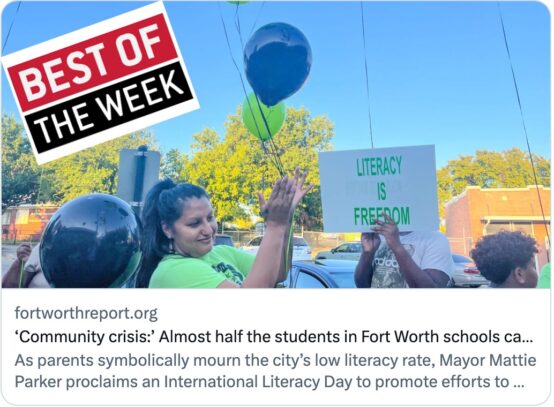
This week’s best education story is the Fort Worth Report’s ‘Community crisis:’ Almost half the students in Fort Worth schools can’t read at grade level by reporter Dang Le, addressing what is arguably the most important thing going on in K-12 education right now.
Of particular merit, the piece describes the now-familiar process through which parents come to the belated understanding that classroom grades, honor roll recognition, and positive reports from teachers aren’t necessarily indicative of reading skill progress.
“I guess I was just, in a way, making it easier for me, because I was just going through what they were telling me,” says one parent.
The piece also describes the role of a local parent advocacy group persuading parents to bring their children in over the summer to be assessed — often with eye-opening results — and what school officials say they are going to do to remedy low reading skills among students.
Here are some other great education coverage this week:
🏆 There’s a hidden crisis among California’s rural kids. Would this teen make it? (LA Times)
🏆 Virginia Went to War Over History. And Students Actually Came Out on Top. (Politico)
🏆 The conservative push for “school choice” has had its most successful year ever (Vox)
🏆 A culture of silence (NJ.com) 8/29
🏆 HISD’s renewed focus on phone bans delights some parents, teachers (Houston Chronicle)
See also WESA Pittsburgh , Oregonian
🏆 Switching off: Sweden says back-to-basics schooling works on paper (AP)
🏆 The Invention of a Neighborhood (New Yorker)
NO THANKS TO ‘READING WARS’ FRAME
Our latest columns and commentary
In this week’s new column — the second in our month-long series on covering literacy reform — former reading researcher Molly Ness points out how misleading and unhelpful it is for news stories to employ the ubiquitous “reading wars” frame when they report on literacy instruction.
Focusing on the so-called reading wars “creates a binary conflict and an unintended hierarchy that is perpetuated in too much education coverage,” writes Ness.
Upcoming pieces in our literacy coverage series include columns from the Boston Globe’s Mandy McLaren and APM Reports’ Emily Hanford. In last week’s column, longtime Milwaukee education journalist Alan Borsuk described the need for reporters to “make sure serious education issues [like literacy] are getting the attention they deserve.”
📣 CALLOUT FOR CONTRIBUTORS 📣
Got something to say about the education beat? Of course you do. The Grade welcomes self reflections, personal essays, and commentary about education journalism, especially from current and former education journalists. Reach out to us here or at thegrade2015@gmail.com.
‘SCIENCE OF MATH’ TAKES HOLD
Coverage of promising school innovations & signs of progress
💡 In addition to being thoroughly reported, this piece about an attempt to replicate Wisconsin’s experiment with self-paced vocational programs stands out for its vivid characters, including a former basketball recruit and a SoCal professor braving a Midwestern snowstorm (CalMatters).
💡 The fledgling “science of math” movement draws a critical, nuanced comparison to its literacy counterpart in this story — part of a collaborative series — about how teachers can apply research in the classroom (Hechinger Report).
💡 This parent-focused piece about two Colorado Springs school systems that cover families’ back-to-school expenses highlights the different funding sources used by each, helpfully showing how other districts could replicate the program (Colorado Sun).
Read more about the importance of covering promising innovations and preliminary successes.

PEOPLE, JOBS
Who’s going where and doing what
🔥 Career moves: Yana Kunichoff is leaving the Arizona Republic after two years. Nikki Ross is leaving the Naples Daily News, with her future plans to be announced Monday. Wisconsin Post-Crescent education reporter AnnMarie Hilton is leaving after two years to report on state policy and politics for the nonprofit Maine Morning Star. Former education reporter Kenya Hunter will cover public health from Atlanta for AP. And a final congrats to WBUR education editor Suevon Lee and others named to Poynter’s BIPOC leadership academy.
🔥 Books: Bettina Love’s book “Punished for Dreaming: How School Reform Harms Black Children and How We Heal” was published this week, including a book launch at Teachers College. Among other things, Love challenges the much-repeated KIPP origin story about how two young white teachers came to rely on Harriett Ball’s classroom strategies. Also released was Chalkbeat editor Cara Fitzpatrick’s book “The Death of Public Education.” Check out the latest interviews and reviews in The 74, the New York Times, Chalkbeat, and the Seattle Times.
🔥 Job openings: The Hechinger Report is hiring an executive editor, with a salary of $150,000 a year. The Oklahoman is hiring an education reporter. Signal Ohio is hiring an Akron education reporter and Cleveland K-12 reporter. Check previous editions of this newsletter for more jobs that may still be open.

APPEARANCES, EVENTS, & NEW RESOURCES
What’s happening and new research
⏰ Segments & podcasts: CNN’s Abby D. Phillip interviewed Chicago teachers union president Stacy Davis Gates about her controversial decision to send one of her children to private school. ABC News ran a lengthy segment on schools tackling the literacy crisis. PBS NewsHour ran a Sunday segment on chronic absenteeism. Washington Post investigative reporter Emma Brown was on CBC News podcast “Front Burner” to discuss the origins of the parental rights movement in the U.S.
⏰ Local appearances: WNYC’s The Brian Lehrer Show revealed that listeners want to know about much more than “just” parental rights. The local NPR station also invited NYC Schools Chancellor David Banks to discuss the new school year and former education reporter Eliza Shapiro to talk about her latest New York Times story on the child care affordability crisis. NY1 education reporter Jillian Jorgensen was on the station’s podcast “Crosstown with Pat Kiernan” talking about the changes NYC students are facing going back to school.
⏰ Events: The Hechinger Report is hosting a LinkedIn Live event on Sept. 20 with reporter Ariel Gilreath to talk about how teachers can conquer their math anxiety. And in case you missed it, former education reporter Jessica Huseman (now the editorial director for Votebeat) and others answered questions about what a pro-democracy newsroom looks like.
⏰ New series: The LA Times has a new series called “Learning in Peril” where they “explore the trials, myths, and realities” of rural, conservative California through its schools. And the Hechinger Report is partnering with other newsrooms for a new series on teaching math.
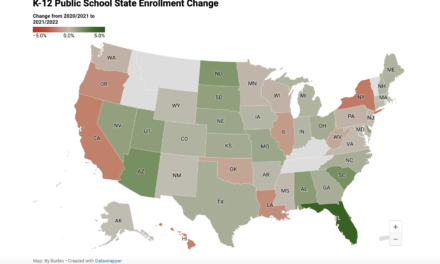
⏰ Research: According to Gallup, 38% of U.S. parents with kids in K-12 grades fear for their children’s safety at school. According to the Seattle Times, only Utah, North Dakota, Arizona, and Tennessee expect to see an increase in public school enrollment. A new Brookings paper on SROs in schools shows that their presence increases suspensions, particularly for Black students and students with disabilities. Since the pandemic, children living in poverty were nearly four times as likely to be suspended as their peers, according to The Guardian. Schools are the least economically integrated institution in America, according to The Economist.
⏰ Journalism resources: Check out Katie Kutsko’s latest installment in her source-tracking series for the American Press Institute about how to amplify underrepresented voices. API also has a great resource guide for journalists on mental health. If you’re interested in learning more about investigative journalism, sign up for this five-week Poynter seminar in October with ProPublica’s Alexandra Zayas. And lastly, check out a new analysis from the Center for Innovation and Sustainability in Local Media on who consumes local news and which media they prefer.
THE KICKER

That’s all, folks. Thanks for reading!
Reply to this email to send us questions, comments or tips. Know someone else who should be reading Best of the Week? Send them this link to sign up.
Using Feedly or FlipBoard or any other kind of news reader? You can subscribe to The Grade’s “feed” by plugging in this web address: http://www.kappanonline.org/category/the-grade/feed/.
Read more about The Grade here. You can read all the back issues of The Grade’s newsletter, Best of the Week, here.
By Alexander Russo with additional writing from Colleen Connolly, Will Callan, and Greg Toppo.
ABOUT THE AUTHOR

Alexander Russo
Alexander Russo is founder and editor of The Grade, an award-winning effort to help improve media coverage of education issues. He’s also a Spencer Education Journalism Fellowship winner and a book author. You can reach him at @alexanderrusso.
Visit their website at: https://the-grade.org/