Teacher preparation programs must commit to valuing the backgrounds, experiences, and cultural assets of preservice and early-career BIPOC educators.
Despite wide acknowledgment that the teaching profession needs to better reflect the increasing diversity of the U.S. student population, a paltry number of BIPOC (Black, Indigenous, people of color) teachers and teacher candidates enroll and persist in teacher prep programs. Many college students and career changers are reluctant to choose a path that does not provide a livable wage, especially in high-cost urban areas. In some states, college graduates hoping to become teachers must enroll in graduate programs, pass multiple standardized exams or portfolio reviews, and complete a year of unpaid student teaching to earn their teaching credential. Oftentimes, potential teachers from minoritized backgrounds are not only making choices that will impact their own financial future, but also carrying the added responsibility and duty to uplift parents, siblings, and other family and community members. For them, the material and logistical barriers are simply too high.
These barriers certainly contribute to the challenge of building a more diverse teacher workforce, but the unfortunate and uncomfortable truth is that potential BIPOC educators who are able to surmount these barriers often find that their teacher prep programs are not aligned to their needs. In ways both obvious and subtle, these teacher candidates receive messages from their prep programs that challenge their sense of belonging, agency, and worth. Many times, their strengths go unnoticed.
For example, metrics for determining teacher readiness often fail to capture the significant cultural understandings that contribute to working successfully with BIPOC students. Instead, many teacher preparation spaces focus on managing the “challenges” associated with educating K-12 students of color, implying that those challenges are rooted in the cultures, families, and communities to which BIPOC teachers likely belong.
Our journeys as teacher educators and former classroom teachers who have witnessed both affirming and disempowering teacher prep practices illustrate these points.
Jalene’s journey
Growing up in a family of Black educators and living in the urban neighborhoods where my parents taught gave me a clear understanding of the importance and transformative potential of K-12 education in my community. Although I didn’t initially want to be a teacher — in fact, I resisted it for a period — I maintained an appreciation for the profession. About three years after completing my undergraduate degree (in a non-education field), and after exploring other career options that left me unmotivated and unfulfilled, I recognized my educator “calling.” In fall 2002, I was hired as a substitute at a small middle school in a gateway city just outside Boston, Massachusetts.
The following year, I was brought on as a middle school math and science teacher in Boston Public Schools, the district where my parents were teachers and where I had received my own middle and high school education. At the time, I was on a licensure waiver and had just enrolled in a part-time master’s degree program that would allow me to earn my initial teaching license.
My formal training as an educator was unremarkable. In the part-time master’s program, I took methods courses that taught me basic lesson structure and pedagogical strategies. This was followed by a practicum experience in my own classroom of 6th graders where I already was the teacher of record, supervised by program faculty and mentored by a school-based colleague. There was negligible discussion of students’ cultural assets, nor was attention paid to the centrality and relevance of culture and out-of-school experience to the learning process. There was no recognition of the cultural assets — or funds of knowledge — that I, as a Black educator rooted in a predominately Black community, brought to my role. I benefited from the technical instructional knowledge that my formal training provided, but the assets that allowed me to authentically connect with my students and build a community of learners came to me from outside my preparation program.
Several years later, as a graduate student with 10 years of classroom teaching under my belt, I found myself in a lecture hall observing an undergraduate course for prospective educators. The lecture involved an exploration of urban students’ cultural backgrounds and their implications for K-12 teaching and learning. I distinctly remember the vulnerability I felt as the only Black individual in the room of about 50 when I heard the instructor musing on the achievement gap between urban (Black/brown) students and their white counterparts. To this instructor, a large contributor to this phenomenon was the devaluing of education among Black and brown families as well as a cultural disposition toward focusing on the “wrong things.” At the time, I was a seasoned teacher in her 30s with enough life experience to prevent that comment from rocking my emotional and psychological core. Even so, I still struggled to stay engaged for the remainder of the lecture. It was uncomfortable for me, as I imagine it would have been for any Black or brown person in that space — especially for a young aspiring teacher of color. For once, I was thankful there were none in the room.
Cliff’s journey
As an immigrant from Hong Kong and a second-generation college graduate, I didn’t feel the weight of aiding and supporting my parents that many educators of color feel. I could choose a career that fed my passion for addressing social inequities through education. That passion was cultivated when I served as a tutor in two urban public Title I schools in southeast San Diego whose student bodies were almost entirely BIPOC students.
Little did I know at the time, but two years tutoring and mentoring youth for 10 hours a week in eight different teachers’ classrooms sowed in me the ideological, dispositional, and technical seeds I needed to become a transformative, critical educator. My mentor teachers, who varied in their experience, ability, and racial and class backgrounds, provided me with a lens for understanding the importance of learning from students and their communities, building strong relationships, maintaining high expectations, developing a classroom community, and approaching my students with humility about my understanding of their cultures.
During these 800 hours in the classroom, I facilitated discussions, redirected focus, and learned to embody the role of a warm demander who uses snappy comebacks, direct instructions, intentional and subtle facial expressions, hand gestures, and body language in everyday interactions with students. I learned that my experiences as an immigrant and English as a second language (ESL) student were assets that helped me connect with my Latinx, Black, Southeast Asian, and Polynesian working-class students. I learned from veteran BIPOC educators, who were cultural fixtures in their communities, that my Asian American identity served as a powerful bridge with my minoritized students.
A parent of a school-age child in a teacher candidate’s local district may offer more profound insights about teaching and learning and the social dynamics of the community than a 20-year-old, peer-reviewed article about a school 2,000 miles away.
In these ways, my previous experience as a tutor provided insights that far exceeded what most of my classmates in my teacher education program had. I didn’t have to read an article to know what it feels like to be asked to be the spokesperson for your race, to feel excluded because of your cultural practices and traditions, to be placed at the bottom of the social hierarchy, and to have assumptions made about you because of your race or ethnicity. Although culture is fluid and ever-changing, my students and I shared experiences of structural and racial microaggressions and under- or misrepresentation of our cultures; we also came from communities with great cultural wealth that could be leveraged in the classroom, but often wasn’t (Kohli, 2012; Yosso, 2005).
When I became a full-time humanities high school teacher in East Oakland, California, I would often draw from these commonalities to create pan-racial solidarity and encourage my students to resist, support, and unite in our common struggles in the face of racial, political, and socioeconomic oppression. This served to break down the false teacher-student dichotomy. I didn’t see my students as “other people’s children” but as nieces, cousins, family, and friends from my community.
The current landscape
Nationally, students from minoritized backgrounds — whether in terms of race, gender, sexuality, family income, or immigration status — are some of the fastest growing populations in U.S. schools (Culbertson & Kaufman, 2021; Ensor, 2019; National Center for Education Statistics [NCES], 2020, 2022). At the same time, the proportion of white students in schools is trending downward, from 54% of the total U.S. student population in 2009 to a projected 43% by 2030, during which time the number of BIPOC students is expected to increase by 11% (NCES, 2022).
As recently as 2018, nearly eight of 10 teachers in K-12 public schools in the U.S. identified as white (Schaeffer, 2021). Numerous studies, however, have demonstrated the powerful impact a Black teacher can have for Black students (Gershenson et al., 2018; Klopfenstein, 2008; Papageorge, Gershenson, & Kang, 2020). Other studies have found that teachers of color have a positive impact for all students, especially students of color (Bristol & Martin-Fernandez, 2019; Easton-Brooks, 2019; Kohli, 2018; Philip, 2013). Unfortunately, in the past two decades, the number of teachers of color has only increased by around 5% (NCES, 2021), suggesting that we will continue to operate with a dearth of impactful teachers of color for decades to come. However, these projections do not have to become a predictor of our future. We can take proactive and conscientious steps to remedy this situation.
Rethinking teacher education
How can teacher preparation programs ensure candidates are able to build trusting relationships with students, use deep understandings of historical and local cultures to design relevant and responsive lessons, or recognize the subtle cultural nuances in a student’s background to provide just-in-time support? Our recommendation is to prepare educators in ways that uphold BIPOC teacher candidates’ cultural knowledge and critical perspectives (Stovall & Mosely, 2022).
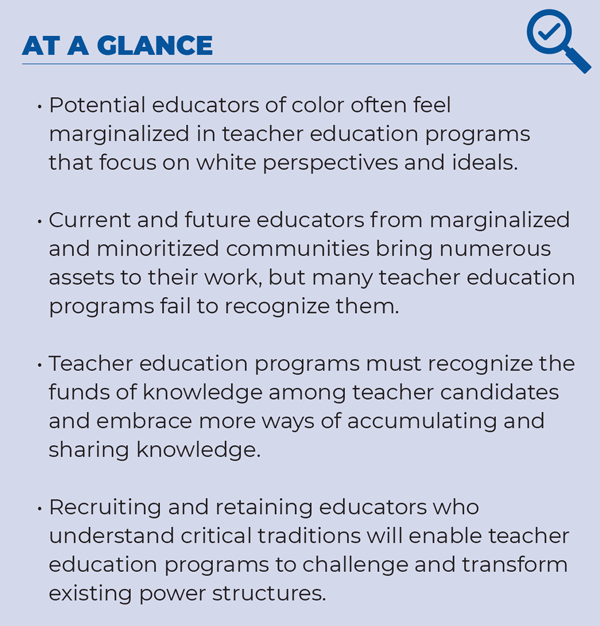
When we speak of criticality and critical perspectives, we are referring to the long traditions of critical theory, critical pedagogy, critical literacy, and critical praxis that argue for the need to reveal, critique, and challenge existing dominant power structures in society, language, institutions, and ideologies. An approach to teacher preparation that centers the assets of prospective educators of color and fosters criticality would address many of the challenges we currently face.
For example, when we take a critical approach to teacher preparation, we see that many preparation programs require teachers to fit into a predetermined box — often at the expense of some of their unique assets. The result is forced assimilation and conformity to practices rooted in a dominant institutional ideology that mandates a one-size-fits-all approach to instruction, student-teacher relationships, and classroom behavior management. Because these boxes are often constructed by decision makers who prioritize their own values and assumptions about what an effective teacher looks like, if we do not come to these institutions with a critical perspective, we run the risk of devaluing skills and characteristics that fail to neatly align with the dominant (white) culture. When we think about the outdated, and sometimes oppressive, approaches still evident in many teacher preparation programs, we can more clearly understand how to evolve.
A funds of knowledge approach
In many ways, methods for educating and preparing prospective teachers should mirror our expectations for instructional practice in K-12 classrooms. By engaging in the same pedagogies they want future teachers to employ, teacher educators can model and embody what productive, affirming instructional and relationship-building practices look like. If we are asking teacher candidates to use culture-informed practices and draw on diverse traditions of learning in K-12 classes and schools, then teacher prep programs must do the same.
Since its conceptual emergence in the 1990s, the funds of knowledge approach to pedagogy encourages teachers to reframe their lessons so that students are centered as arbiters of valued and useful knowledge in the classroom. These funds of knowledge students carry include the “historically developed and accumulated strategies (skills, abilities, ideas, practices) or bodies of knowledge that are essential to a household’s functioning and well-being” (Gonzaléz, Moll, & Amanti, 2005, p. 92).
In teacher preparation programs, teacher educators could use a mix of informal conversations and more formal inquiry exercises to ask prospective teachers about their experiences and lives outside school (Navarro et al., 2019). The funds of knowledge gathered through this process could then inform curriculum development and practical instruction, foster relationship-building and belonging within teacher candidate cohorts, and serve as a model for engaging similarly with K-12 students.
When we take a critical approach to teacher preparation, we see that many preparation programs require teachers to fit into a predetermined box — often at the expense of some of their unique assets.
One of the beautiful things about employing funds of knowledge as an instructional approach is that it repositions teachers as learners as they seek out information about students and their lives outside school. In the teacher preparation space, this would require a shift away from the predominant assumption that teacher candidates (especially BIPOC teacher candidates) enter their prep programs with little to no relevant knowledge or skills that contribute to effective teaching practice. The bidirectional learning opportunities embedded in the funds of knowledge approach would broaden teacher educators’ capacity as informed, receptive, and collaborative instructors. In short, investigating, understanding, and then leveraging funds of knowledge among BIPOC teacher candidates presents an opportunity for teacher educators to uncover and adjust for any ways that white middle-class ideologies, attitudes, experiences, perspectives, and traditions run counter to the actual needs of BIPOC students and educators.
The work of scholars such as Kris D. Gutiérrez (2008) demonstrates that the transformative potential of funds of knowledge is best realized within a collaborative third space. In education, the third space is a site of instruction where students’ home and school worlds merge and where they are able to critically examine society and create new realities (Gutiérrez, 2008). A key element of the classroom third space is the fostering of criticality, which serves as an impetus for positive change. As we explore what needs to change and how, we must incorporate many voices, including those of the teachers and students who will inherit the responsibility of leading the system. Because funds of knowledge pedagogy allows for multiple perspectives and experiences, including those that have been historically marginalized, it represents an opportunity to amplify the perspectives of prospective educators of color who have deep, nuanced understandings of the lives and educational experiences of young people of color.
Centering diverse sources of knowledge
To combat the prevalence of ideologies rooted in white supremacy (Carter Andrews et al., 2021; Matias, Nishi, & Sarcedo, 2017; Salazar, 2018), leaders in teacher education programs must critically examine and transform curricula that privilege white attitudes, perspectives, and knowledge traditions. In addition to uplifting the voices of BIPOC teacher candidates in the classroom, instructors must include in their syllabi research, scholarship, and nontraditional forms of wisdom from critical scholars, researchers, teachers, scientists, artists, technologists, and community workers from a variety of historically marginalized and minoritized backgrounds. For example, instead of simply presenting Maslow’s hierarchy of needs, an instructor could challenge the individualistic, hierarchical theory of motivation by also sharing Indigenous worldviews (Bear, Choate, & Lindstrom, 2022; Hart, 2010; Smith, Tuck, & Yang, 2018). See the list on the left for a few examples of the many curricular resources available that draw on the wisdom of BIPOC communities while adhering to state and national standards in various disciplines and grades.
Resources outside state-sanctioned, textbook-issued curricula can be important models and resources for beginning teachers. Using non-text-based resources, such as podcasts, videos, music, art, and online discussions, disrupts the inherent power dynamics in knowledge production. A parent of a school-age child in a teacher candidate’s local district may offer more profound insights about teaching and learning and the social dynamics of the community than a 20-year-old, peer-reviewed article about a school 2,000 miles away.
Recruiting and retaining critical educators
It’s difficult to make transformative, systemic change without the right people leading it. The type of teacher preparation that we are advocating requires leaders who have experience with and a commitment to the various critical traditions that will enable them to challenge and transform existing power structures.
We have each personally experienced what happens when a few dynamic, pre-tenured faculty, program staff, or instructors are hired to supposedly change a program or institution firmly rooted in long-standing, outdated, and white-dominant teaching styles, approaches, and ways of knowing. It should not come as a surprise when these new hires leave within a few years. To combat this, an institution needs to strategically enact cluster hires so that multiple staff members are brought on board at all levels, but particularly at the department or program chair level, to bring about the needed change. Traditional and alternative teacher education programs should seek out educators with a proven history of applying critical approaches to teacher preparation and who are able to combat institutionalized bias. Additionally, to enrich field-based and practicum experiences, programs should pursue partnerships with districts that are committed to recruiting and retaining BIPOC educators.
Institutional leaders who want to make transformative changes to the current power structures must prioritize hiring instructors, supervisors, cooperating teachers, and staff — both white and BIPOC educators — who have a critical perspective, even above those who may have more experience. It is insufficient or even dangerous to assume that simply hiring more BIPOC faculty or instructors will be enough to bring about change. If, despite their racial and ethnic background, these educators uphold white supremacist ideologies and fail to challenge dominant ideals (such as the belief that students can pull themselves up by their bootstraps, that the U.S. is a meritocracy, and so on), their racialized identities may provide an extra layer of credibility in the eyes of those with limited experiences in BIPOC communities, making it even more difficult to uproot the dominant ideologies they embrace.
Our voices matter
In taking on the important work of transforming teacher education and aligning programs to the needs of BIPOC educators, current faculty, leaders, and instructors must engage in critical self-study and identify institutional blind spots and barriers. We believe a powerful starting place for many education leaders would be recognizing the numerous assets our teacher candidates carry the moment they choose this as their life’s work.
The cultural and social capital that critical BIPOC educators possess is deep and wide. Our life experiences are often shaped by our experiences as racialized people, immigrants, English learners, or free lunch recipients, yet we have navigated, resisted, and survived the dominant culture, systems, and institutions to earn our rightful place within the academy. We have maintained a strong sense of our racial and cultural identities and are committed to the development of a critical, justice-
oriented, and diverse teacher workforce. Making the education system work for educators like us will benefit not just future educators, but also the students they teach.
References
Bear, R., Choate, P.W., & Lindstrom, G. (2022). Theoretical research: Reconsidering Maslow and the hierarchy of needs from a first nations’ perspective. Aotearoa New Zealand Social Work, 34 (2), 30-41.
Bristol, T.J. & Martin-Fernandez, J. (2019). The added value of Latinx and Black teachers for Latinx and Black students: Implications for policy. Policy Insights from the Behavioral and Brain Sciences, 6 (2), 147-153.
Carter Andrews, D.J., He, Y., Marciano, J.E., Richmond, G., & Salazar, M. (2021). Decentering whiteness in teacher education: Addressing the questions of who, with whom, and how. Journal of Teacher Education, 72 (2), 134-137.
Culbertson, S. & Kaufman, J.H. (2021, September 20). Surges in undocumented and asylum-seeking children prompt need for better K-12 policies. Rand Corporation.
Easton-Brooks, D. (2021). Ethnic-matching in urban schools. In H.R. Milner IV & K. Lomotey (Eds.), Handbook of Urban Education (2nd ed., pp. 234-252). Routledge.
Ensor, K. (2019, October). Addressing the needs of LGBTQ students. Minnesota School Counselor.
Gershenson, S., Hart, C.M., Hyman, J., Lindsay, C., & Papageorge, N.W. (2018). The long-run impacts of same-race teachers (No. w25254). National Bureau of Economic Research.
González, N., Moll, L.C., & Amanti, C. (2005). Funds of knowledge: Theorizing practice in households, communities, and classrooms. Lawrence Erlbaum Associates.
Gutiérrez, K.D. (2008). Developing a sociocritical literacy in the third space. Reading Research Quarterly, 43 (2), 148-164.
Hart, M.A. (2010). Indigenous worldviews, knowledge, and research: The development of an Indigenous research paradigm. Journal of Indigenous Social Development, 1 (1A).
Klopfenstein, K. (2005). Beyond test scores: The impact of Black teacher role models on rigorous math taking. Contemporary Economic Policy, 23 (3), 416-428.
Kohli, R. (2012). Racial pedagogy of the oppressed: Critical interracial dialogue for teachers of color. Equity & Excellence in Education, 45 (1), 181-196.
Kohli, R. (2018). Behind school doors: The impact of hostile racial climates on urban teachers of color. Urban Education, 53 (3), 307-333.
Matias, C.E., Nishi, N.W., & Sarcedo, G.L. (2017). Teacher education and whiteness and whiteness in teacher education in the United States. In Oxford Research Encyclopedia of Education.
National Center for Education Statistics. (2020). Number and percentage of public school students eligible for free or reduced-price lunch, by state: Selected years, 2000-01 through 2019-20. Digest of Education Statistics. U.S. Department of Education, Institute of Education Sciences.
National Center for Education Statistics. (2021). Characteristics of public school teachers. Condition of Education. U.S. Department of Education, Institute of Education Sciences.
National Center for Education Statistics. (2022). Racial/ethnic enrollment in public schools. Condition of Education. U.S. Department of Education, Institute of Education Sciences.
Navarro, O., Quince, C.L., Hsieh, B., & Deckman, S.L. (2019). Transforming teacher education by integrating the funds of knowledge of teachers of color. Review of Education, Pedagogy, and Cultural Studies, 41 (4-5), 282-316.
Papageorge, N.W., Gershenson, S., & Kang, K.M. (2020). Teacher expectations matter. Review of Economics and Statistics, 102 (2), 234-251.
Philip, T.M. (2013). Experience as college student activists: A strength and liability for prospective teachers of color in urban schools. Urban Education, 48 (1), 44-68.
Salazar, M.D.C. (2018). Interrogating teacher evaluation: Unveiling whiteness as the normative center and moving the margins. Journal of Teacher Education, 69 (5), 463-476.
Schaeffer, K. (2021, December 10). America’s public school teachers are far less racially and ethnically diverse than their students. Pew Research Center.
Smith, L.T., Tuck, E., & Yang, K.W. (Eds.). (2018). Indigenous and decolonizing studies in education. Routledge.
Stovall, J.L. & Mosely, M. (2022). “We just do us”: How Black teachers co-construct Black teacher fugitive space in the face of antiblackness. Race Ethnicity and Education, 1-20.
Yosso, T.J. (2005). Whose culture has capital? A critical race theory discussion of community cultural wealth. Race Ethnicity and Education, 8 (1), 69-91.
Curricular resources centering diverse ways of knowing
- Traditional Ecological Knowledge (TEK), an environmental science-based curriculum: www.californiasalmon.org/curriculum-tek
- Intersectional Black Panther Party History Project: https://iphistoryproject.org/iphpteachbpp/
- Chicana/o Studies, California’s Coachella Valley Unified School District course curriculum for high school: https://bit.ly/ChicanoStudiesCurric
- Ethnomathematics Curriculum Textbook: Lesson Plans in Symbolic Reasoning and Quantitative Literacy from the University of Hawai’i: https://bit.ly/EthnomathematicsCurric
- Center for Middle Eastern Studies, standards-aligned content for K-12 educators from the University of Texas at Austin: https://bit.ly/MiddleEastCurric
- Asian American Studies K-12 Framework, from the Asian American Research Initiative: https://asianamericanresearchinitiative.org/asian-american-studies-curriculum-framework/
- Resources for Abolitionist Teaching, from the Abolitionist Teaching Network: https://abolitionistteachingnetwork.org/resources-for-agitators
This article appears in the May 2023 issue of Kappan, Vol. 104, No. 8, pp. 12-18.

ABOUT THE AUTHORS

Jalene Tamerat
Jalene Tamerat is a doctoral student at Boston University, Boston, Mass.
Clifford Lee
CLIFFORD LEE is professor of education and program director of the Educators for Liberation, Justice, and Joy Teacher Education program at Mills College at Northeastern University, Oakland, CA.