Black boys share their experiences of creating safe spaces in schools to counter antiblackness.
It has been 15 years since Pedro Noguera published his groundbreaking work, The Trouble With Black Boys, in which he argued that disparate outcomes in health, employment, income, and well-being begin, for Black men, when they are boys in school. Noguera (2008) wrote:
The trouble with Black boys is that most never have a chance to be thought of as potentially smart … The trouble with Black boys is that too often they are placed in schools where their needs for nurturing, support, and loving discipline are not met. Instead, they are labeled, shunned, and treated in ways that create and reinforce an inevitable cycle of failure. (p. xxi)
Much of the research about schooling for Black boys and young men focuses on disparities in outcomes such as test scores (Assari et al., 2021); graduation rates (Kafele, 2012; National Center for Education Statistics, 2022); and discipline rates (Chu & Ready, 2018; Skiba, Arredondo, & Rausch, 2014; Skiba & Losen, 2015). However, structural inequality and endemic antiblackness impact Black boys throughout their schooling experiences in ways statistics alone do not capture (Wint et al., 2022).
Antiblackness in schools
Antiblackness is the unique form of racism Black people experience, in which they are cast “in opposition to all that is pure, human(e), and White” (Dumas & Ross, 2016, p. 417) and therefore never recognized as fully (or even potentially) human (Dumas, 2016). Although students are constantly being told that education is the pathway to improved life chances, antiblackness prevents Black children from having equal access to educational opportunity, which means schools become places of Black suffering (Dumas, 2014). Michael Dumas (2014) writes that Black suffering occurs “as a result of inequitable access to social and educational opportunities” and, as a result, it:
is deemed not a legitimate form of suffering but the inevitable result of failure — on the part of the individual and/or the group — to take full advantage of schooling, either as a result of laziness or lack of innate ability. (p. 8)
While individual teachers and students participate in antiblackness, it is schooling structures, such as academic and disciplinary policies, that sustain it. Intentional or not, antiblackness maintains that Black students and families are to blame for negative outcomes, rather than examining how the structures within schools enshrine racism. Over time, this has created what Gloria Ladson-Billings (2006) calls an educational debt, which she argues is owed to students who have been historically marginalized in U.S. schools and continue to suffer as a result.
Given this context, how do Black boys resist racism and refuse antiblackness in school? To find answers to this question, we reviewed data from six focus groups that two of us conducted with more than 60 Black boys and young men in a variety of high school settings across a large midwestern state. We believe that discovering the perspectives (Flennaugh, 2016) of Black boys about their schooling experiences is an important step toward humanizing education for Black boys and young men (Warren, Andrews, & Flennaugh, 2022).
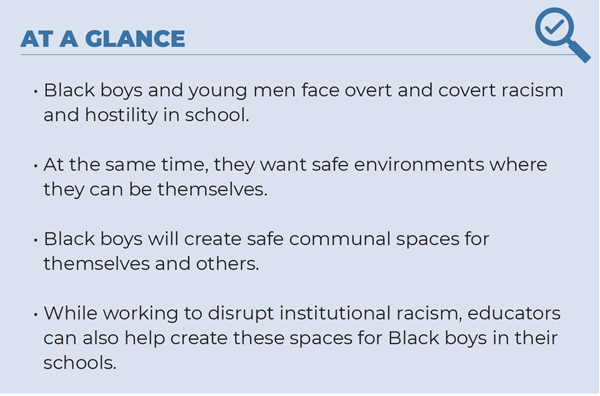
From the focus groups, we learned that Black boys and young men want school environments where they can be emotionally and psychologically safe. In the absence of such environments, they will create communal spaces (Warren & Coles, 2020) to meet this need. We also learned that, like all students, Black boys need teachers who are culturally aware and relevant (Ladson-Billings, 1995, 2021). They want to trust and confide in their teachers, and they want to be their full and authentic selves at school without fear of judgment. These findings create a roadmap to help educators work toward reducing in-school suffering now, as we simultaneously work to eliminate structural antiblackness and build better futures for Black boys and young men in schools.
‘They see the stereotypes. They don’t know us for us’
Black boys interviewed expressed frustration with the myriad stereotypes and microaggressions (Solorzano, Seja, & Yasso, 2000) they faced from both white and Black students. Their experiences in predominantly white schools suggest that they exist within a liminal space in between, where their full authentic selves never seem to be enough. They shared several examples of different instances in which their mere presence was objectionable. For many of them, the school cafeteria served as a central site for antiblack microaggressions. “Some of them [white students] are really scared of us,” Quentin (all names are pseudonyms) said:
One time there were these white girls sitting there [in the cafeteria]. I came over and I sat down, and they all looked at me. They just kept staring. And then some more Black students came and they [the white girls] were like “oh no” and got up and left. We were on a whole other bench in a separate area.
Anthony had a similar interaction with white students in the cafeteria. One day, Anthony and his friends were seated in the middle of the lunch tables. While they were eating, a large group of white students sat at the table as well, filling in the remaining seats. Soon after, other white students arrived. Anthony remembered:
They stood around us and looked at us. And every time we looked at them, they would turn their heads away. If that was me and I knew their lunch was over, I would say, “Hey, can we sit here next to our friends?” or whatever.
But these students did not do that. Instead, they waited for Anthony and his friends to leave, and then hurriedly sat down. “That’s because they really are scared of us,” Terrance said:
I was talking to this one classmate, and upfront, she told me that she used to be afraid of Black people. When I asked her why, she said she did not know. They just scared her. They see the stereotypes. They don’t know us for us.
While Quentin, Anthony, and others identified the cafeteria as the most obvious site of antiblackness at school, their experiences with racism did not end there. Black boys experienced various types of racial microaggressions (Sue et al., 2007), as well as more systemic racial macroaggressions, throughout the building during the school day. Black boys’ attempts to survive and learn in such environments inhibits both their learning and their sense of belonging at school. Hence, the need to reimagine Black futures for Black boys and young men in schools.
‘You are really afraid to just be yourself because of what they think of you’
Black boys shared different examples of the racialized judgment they faced for simply being themselves. According to Devon, “you are really afraid to just be yourself because of what they think of you.” Several of the Black boys interviewed shared this sentiment. “You’re afraid to be yourself because you have to please everybody,” replied Justin.
Black boys shared stories of not quite fitting in among Black or white schoolmates and being critiqued for defying monolithic expectations of Blackness, for reasons ranging from their behavior to the types of clothes they wore. For example, Corey said other Black students often call him “ghetto” for not dressing and speaking like them. James expressed that other Black students told him he dresses white. Maxwell shared that one of his white friends told him that they thought he would be “really ghetto” when they first met, but that he “actually was one of the whitest dudes they have ever met.” Although this comment bothered Maxwell, he did not say anything about it.
There seemed to be a common understanding that being friends with some white students required navigating microaggressions. Khalil stated:
That’s just how it is now. I have learned that having white friends is hard. You are going to have to hear some stuff you don’t want to hear. Go through some stuff you don’t want to go through. They are going to essentially get comfortable and ask you some things that might make you mad. That might rub you the wrong way. And some people can deal with that. I can’t. I get tired of questions like, “Can I feel your hair? Why is your hair different from every other Black person around here?” Questions like, “Why do you dress like us?” At that point, I’d rather hang with who I’m comfortable with being around. If you look at my inner circle, it’s probably like eight people I hang out with, and almost all of them are Black.
While Maxwell seemed resigned to the daily indignities that come with friendships with white peers, Khalil chose to associate mostly with Black friends. Having to weigh the attitudes of white peers regarding their identity and feelings is a common experience for these Black boys as they navigate antiblack schooling spaces.
Marcus observed a difference in the interactions he had with white students in middle school compared to high school. He had more white friends in middle school than he had Black friends, but in high school “racism started escalating,” and white students “started doing offensive stuff and asking certain questions.” Consequently, like Khalil, Marcus decided that he would “rather be with people who understood him.” Beverly Daniel Tatum (2017) describes a similar phenomenon among elementary and middle school students: Elementary students generally see no problem associating with students from various racial backgrounds. However, by middle school, their experiences with race and racism begin to influence who they choose to associate with.
Although students are constantly being told that education is the pathway to improved life chances, antiblackness prevents Black children from having equal access to educational opportunity, which means schools become places of Black suffering.
Boys like Khalil and Marcus become increasingly aware of the antiblack racism permeating their school environment over the course of their school careers. They resist by refusing to stay friends with peers who don’t share their understanding of the racist school context and who could dehumanize and objectify them as a result. Refusing to remain friends with such peers is also a way Black boys exert their agency to protect their identity and their psychological and emotional well-being.
‘All the white kids are looking at me’
Other Black boys recounted experiences of being the only Black student in a class and having to make sense of the microaggressive acts of their classmates and teachers. For instance, Derrick expressed the irritation he felt during his American literature class when he had to sit and listen to his white teacher read aloud excerpts from To Kill A Mockingbird, a book that liberally uses the n-word. Every time the teacher mentioned the word, he recalled how all the white students would look at him. “I’d just sit there like, what do I do? Because all the white kids are looking at me like what are you going to do? She just said the n-word.” Dorinda J. Carter Andrews (2012) describes this phenomenon as “all eyes on me.”
Carlos echoed similar experiences with white teachers and classmates. In a class where the teacher encouraged students to “feel free” using the n-word when reading a passage aloud, he attempted to exert his agency by refusing to say it when it was his turn to read. He believed that if he set the example, his white classmates would follow suit. Instead, Carlos said that when a white student read after him, the student seemed to say the word “with pride.” Reflecting on that incident, Carlos said that reading the n-word in context of literature was the “perfect opportunity” for white students to say it. But he still believed that if he skipped over the word, white students should do the same. According to Black male students, preventing white students from saying the n-word was more complicated than modeling expected behavior or simply requesting them to stop. Robert shares his experience asking his classmates to stop using the word:
I tried that. And their response is, “we hear your friends use that all the time, so how come we can’t say it? We are just reading the book.” I just hate that. And you are going to get stuck because what do you say when they ask why they can’t say it? And then you have to go through all the history [of the word]. It just turns into a big argument, you never get anywhere, and they will still say something stupid like, “that time is over.”
In these examples, we see Black boys refusing to participate in their own dehumanization in the classroom, but we also see the racial opportunity costs (Chambers et al., 2014) that they must contend with when striving to be academically successful under such circumstances.
In these cases, racism is an environmental stressor (Carter Andrews, 2012) for Black boys. If the teachers were aware of the historical and contemporary realities Black students and their communities faced, they might have designed a lesson that was more culturally responsive to those realities. These examples also represent the types of systemic macroaggressive schooling practices that, in tandem with the interpersonal microaggressions of school peers, perpetuate the antiblack, racist educational violence Black boys experience in schools.
Black boys creating spaces to evade antiblackness
To escape the antiblackness they experienced in school, Black boys spoke of creating their own spaces where they would congregate and socialize with like-minded students. Black students created these identity-affirming Black education (Carter, 2007; Warren & Coles, 2020) counterspaces anywhere in the school they felt comfortable and safe. Deandre described these spaces as “spots where we could chill, do homework we didn’t do last night, and just talk and laugh. At one point, there would be different groups in these spots after each class period.” Although these spaces consisted mostly of Black students, interviewees stressed that, as long as they were free to be themselves without explanation, they were open to including anyone who showed them mutual respect and acceptance. For example, Corey describes an Indian student who would often socialize with Black boys in these spaces:
I mean he’s not Black, but he dresses just like us and everything. He’s pretty much like one of us. He’s been one of my best friends since like 1st or 2nd grade and we have all been cool for a long time.
However, this was an exception, as most non-Black students, especially white students, avoided these spaces. Eric explained that white students “watched us from afar. It was like there was a certain line. And that’s just how they see it. . . . I’ve heard my white friends say all the time, ‘There is a certain line that we will not go over.’”
Although Black boys saw these spaces as a place where they could feel emotionally and psychologically safe, they were not immune to the antiblack racist comments made about these spaces. White students would often refer to these spaces as Africa or the jungle. In one incident that the Black boys found especially offensive, a white student took a selfie in front of one of these spaces and posted it to social media with the caption “Selfie in the Jungle.”
School staff, teachers, and administrators have a responsibility to foster a school environment where every student, especially those who have been historically marginalized, feels a sense of safety and belonging.
White students rarely respected Black boys’ individual efforts to shield themselves from these occurrences. Therefore, they chose to create their own spaces to protect themselves and each other from the constant barrage of antiblack racism they experienced elsewhere in the school. These students’ stories show that Black boys experience insufficient belonging and safety elsewhere in the building. Thus, school staff, teachers, and administrators have a responsibility to foster a school environment where every student, especially those who have been historically marginalized, feels a sense of safety and belonging. Creating an anti-racist school environment within an antiblack education system and society is difficult. However, there is much educators can do right now, following the lead of Black boys who already are creating safe spaces within otherwise hostile school cultures.
Creating Black education counterspaces
Focus group interviews with Black boys show us that educators must acknowledge that antiblackness is systemic and imbued in every aspect of schooling and society, while also seeking practical, short-term strategies that can reduce the immediate harm Black boys experience in schools. To ensure Black boys receive the academic, social, and emotional support they need to thrive rather than just survive in schools, educators must support them in curating their own Black education spaces (Warren & Coles, 2020) and counterspaces where their identities are affirmed (Carter, 2007).
In these spaces, students are free from micro- and macroaggressions, insults, and invalidations (Sue et al., 2007). Therefore, they are free to be themselves. In these spaces, Black boys can safely practice self-determination, self-actualization, and self-efficacy (Warren and Coles, 2020) and experience education as a practice of freedom (hooks, 1994). Black boys are providing educators with a roadmap for creating educational spaces where students are safe, are valued, and feel like they belong.
References
Assari, S., Mardani, A., Maleki, M., Boyce, S., & Bazargan, M. (2021). Black-white achievement gap: Role of race, school urbanity, and parental education. Pediatric Health, Medicine and Therapeutics, 12, 1-11.
Carter, D.J. (2007). Why the Black kids sit together at the stairs: The role of identity-affirming counter-spaces in a predominantly White high school. The Journal of Negro Education, 76 (4), 542-554.
Carter Andrews, D.J. (2012). Black achievers’ experiences with racial spotlighting and ignoring in a predominantly white high school. Teachers College Record, 114 (10), 1-46.
Chambers, T.V., Huggins, K.S., Locke, L.A., & Fowler, R.M. (2014). Between a “ROC” and a school place: The role of racial opportunity cost in the educational experiences of academically successful students of color. Educational Studies, 50 (5), 464-497.
Chu, E.M. & Ready, D.D. (2018). Exclusion and urban public high schools: Short- and long-term consequences of school suspensions. American Journal of Education, 124 (4), 479-509.
Dumas, M.J. (2014). “Losing an arm”: Schooling as a site of Black suffering. Race Ethnicity and Education, 17 (1), 1-29.
Dumas, M.J. (2016). Against the dark: Antiblackness in education policy and discourse. Theory into Practice, 55 (1), 11-19.
Dumas, M.J. & Ross, K.M. (2016). “Be real Black for me”: Imagining BlackCrit in education. Urban Education, 51 (4), 415-442.
Flennaugh, T.K. (2016). Mapping me: Mapping identity among academically high-performing Black males. Teachers College Record, 118 (6), 1-32.
hooks, b. (1994). Teaching to transgress: Education as the practice of freedom. Routledge.
Kafele, B.K. (2012). Empowering young black males. Educational Leadership, 70 (2), 67-70.
Ladson-Billings, G. (1995). Toward a theory of culturally relevant pedagogy. American Educational Research Journal, 32 (3), 465-491.
Ladson-Billings, G. (2006). From the achievement gap to the education debt: Understanding achievement in U.S. schools. Educational Researcher, 35 (7), 3-12.
Ladson-Billings, G. (2021). I’m here for the hard reset: Post pandemic pedagogy to preserve our culture. Equity and Excellence in Education, 54 (1), 68-78.
National Center for Education Statistics. (2022). Public high school graduation rates. Condition of Education. U.S. Department of Education, Institute of Education Sciences.
Noguera, P. (2008). The trouble with Black boys: And other reflections on race, equity, and the future of public education. Jossey-Bass.
Skiba, R.J., Arredondo, M.I., & Rausch, M.K. (2014). New and developing research on disparities in discipline. Discipline disparities: A research-to-practice collaborative, 1-12.
Skiba, R.J. & Losen, D.J. (2015). From reaction to prevention: Turning the page on school discipline. American Educator, 39 (4), 9.
Solorzano, D., Ceja, M., & Yosso, T. (2000). Critical race theory, Racial microaggressions, and campus racial climate: The experiences of African American college students. The Journal of Negro Education, 69 (1/2), 60-73.
Sue, D.W., Capodilupo, C.M., Torino, G.C., Bucceri, J.M., Holder, A.M.B., Nadal, K.L., & Esquilin, M. (2007). Racial microaggressions in everyday life: Implications for clinical practice. American Psychologist, 62, 271-286.
Tatum, B.D. (1997/2017) Why are all the Black kids sitting together in the cafeteria? And other conversations about race. Basic Books.
Warren, C.A. & Coles, J.A. (2020). Trading spaces: Antiblackness and reflections on Black education futures. Equity and Excellence in Education, 53 (3), 382-398.
Warren, C.A., Andrews, D.J.C., & Flennaugh, T.K. (2022). Connection, antiblackness, and positive relationships that (re)humanize Black boys’ experience of school. Teachers College Record, 126 (1), 111-142.
Wint, K.M., Opara, I., Gordon, R., & Brooms, D.R. (2022). Countering educational disparities among Black boys and Black adolescent boys from pre-K to high school: A life course-intersectional perspective. The Urban Review, 54 (2), 183-206.
This article appears in the April 2023 issue of Kappan, Vol. 104, No. 7, pp. 18-24.

ABOUT THE AUTHORS

Darius O. Johnson
DARIUS O. JOHNSON is an assistant professor in the College of Education and Human Development at Georgia State University, Atlanta.
Briana Markoff
BRIANA MARKOFF is a doctoral student at Michigan State University, East Lansing.
Dorinda J. Carter Andrews
DORINDA J. CARTER ANDREWS is a professor and chairperson in the Department of Teacher Education at Michigan State University, Lansing.