Years ago, one October morning, my 5th graders found their desks rearranged into three distinct sections. The majority of desks were by the front board, a fair number in pods were in the middle, and a pod of just three was in the back of the room. This was the beginning of our “gamified” classroom system.
As students made their way to their seats, they began trying to guess the meaning of the new arrangement. I gave them a hint, telling them that the students in each of the three “zones” of the room had something in common. This was a puzzle to them. What they had in common was not academics, not interests, not anything visibly noticeable. Eventually, my students were able to guess the quality they shared: work ethic. The students who turned in all their work, tried every problem, asked questions (privately or in front of the class), and genuinely gave their all during classes were the three in the back of the room.
Yes, it was only three. I choose the hardest-working students, regardless of grades. And I had placed them in back as a reward.
I then pointed out that the treasure box was missing. Widely used across the school at the time, the treasure box contained small prizes that students could choose as rewards for doing well in class. The students were a little disappointed in the loss of the treasure box until I explained that I wanted to try something new. I wanted to recognize and reward my students for effort rather than achievement, and not with trinkets, but with trust.
Getting in the zone
Under the new system, the class was split into three zones. The majority of the students, those in what I called Level 1, had a somewhat erratic work ethic. They were seated in the front and would receive direct instruction and guidance on the subject areas and on effective work habits, social skills, and the like. Their school days would look similar to how things had been in the past.
Students in Level 2, seated in pods, showed a more consistent and responsible work ethic. They would not be required to listen to direct instruction but could work together on lessons and would have some leeway to work ahead, although never on a different subject than the rest of the class. If they had time left over after the lesson, they could read or engage in enrichment activities. (This was already a typical routine when students finished work early.) I would work with them as needed when the students in Level 1 were engaged in independent work.
Those in the very back of the room, students in Level 3, would receive a checklist of items every morning and have resources laid out for them. They would have the freedom to listen to direct instruction or not, use any resources on the list that would help them understand lessons, and help each other on all assignments (not quizzes or tests). I would check in with these students periodically, answer their questions, and generally trust them to do their work for the sake of learning. Whenever these students finished their work for the day, they would be free to play educational games, read, tutor other students, or engage in any productive activities they chose.
I wanted to recognize and reward my students for effort rather than achievement, and not with trinkets, but with trust.
The idea of such freedom piqued student interest, inevitably leading to the question of how to “level up” into the next group. For that, I had created a rough draft of a rubric explaining that students may move to the next level after a week of consistently turning in their completed homework, completing every in-class assignment, keeping their desk area organized, and meeting several other minor requirements. The students added their own ideas, some jumping in before I’d asked for feedback, and we finalized the rubric together.
Students were assured that once they had reached a new level, they would be on that level for every subject area in our classroom and could not be leveled down. I was nervous to make that guarantee, but I wanted students to feel that once they mastered the skill of self-management and earned my trust, they would not lose that trust. It turned out most students needed time to learn self-management, but once they did, I never saw a reason to move them down a level.
Making learning happen
Once a clear rubric was made, the next question arose: How would students learn effectively with so much freedom? Some of my students doubted their ability to learn, even with my help. But my underlying goal was for all students to learn how to become learners and teachers. I wanted to see if I could create a classroom where I could become a facilitator in the true definition of the word.
Often, teachers act as facilitators only after presenting traditional lessons using direct instruction, delivered to all students. Yet not all students need direct instruction on all lessons. Treating all students as if they do leads to boredom. I wanted students to choose direct instruction when they needed it and to be free not to choose it when they didn’t. This required students to develop self-awareness so they could understand how to learn on their own and when that would work for them. They had to have a strong work ethic and knowledge of how to learn, both of which I helped students develop with direct instruction and daily practice in autonomous learning.
Self-directed learning in my gamified classroom required a mastery-oriented approach. Mastery learning doesn’t work well without students’ active engagement in the process. I have seen mastery learning devolve into an occasional second try on tests, “test corrections,” or a bit of extra practice before moving on, even if some students still not haven’t mastered the material. I have sometimes taught in this way myself, lamenting that we have too much material to “get through” to spend time making sure every student understands it before moving on.
True mastery is a lot of work for teachers, especially as students have more autonomy. Students may require many resources and options to master material, not just two or three chances to take a test. Students should have several attempts to try to master material before they see a quiz or test, with more options available between assessment attempts. The greatest resource for students might be fellow students, as they work together to solve problems, find answers to questions, or informally quiz each other.
Assessing and motivating
In our new classroom system, I embedded at least one textbook resource and one supplement into daily lessons for each subject area and a 5- or 10-question quiz with nearly every lesson. I found or created three versions of each quiz, so students had three tries. The highest score would be recorded in the gradebook.
Students in Level 3 took quizzes in designated areas, so I could tell even while giving direct instruction when they were quizzing. When done, they would come to me for feedback. I used an answer sheet and printed gradebook page I kept on my clipboard to quickly grade, record, and return their quizzes to them.
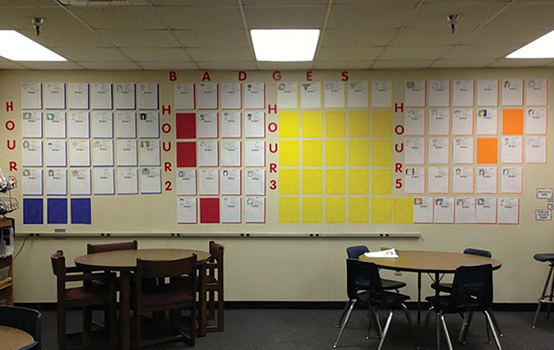
While I still gave unit tests and other assessments, quizzes determined whether students earned mastery badges. Their goal was 100%, which would earn them a “badge” to show that they had mastered the material. The badge was a sticker that went on the wall next to their avatar, a cartoon image that each student created to represent themselves. (To honor confidentiality, the avatar was used in place of names.)
Recognizing student achievement with badges instead of treasure-box rewards was meant to build intrinsic motivation. Because each new concept meant a new chance at a badge, students were not discouraged if they did not receive a badge the first time they took a quiz or for every concept. They knew they were likely to earn badges on related concepts because of the extra effort they’d put into learning previous concepts.
My students did not mention missing the treasure box. But they soon suggested new recognition-based motivators. For example, they suggested students who helped others or went the extra mile should get “awesomeness points.” I did not give these points — students gave them to each other for whatever reasons they thought were suitable. The points would be recorded on a star chart. To make sure they were not just assigning points to friends, one student suggested that students giving awesomeness points write down their reasons on a slip of paper that I would review to give final approval before putting the star on the chart. In practice, this turned into a way to build self-esteem.
Reviewing the year
How well did this system work? In some ways, wonderfully. Students completed more homework and in-class work and averaged higher scores in class and on benchmark tests, and the classroom atmosphere was one of positive engagement. However, I had difficulty keeping up with students. They were able to complete the work on the checklists at a rate much faster than I had seen before. To keep themselves occupied if new work wasn’t ready, they came up with the notion of creating challenges for each other. They created puzzles and hid them in books in the classroom library or around the room, with their name on the paper. If a student found a puzzle, they could complete it and show it to the puzzle creator who could then award awesomeness points for attempts or successful completion of the puzzles.
Some students feared leveling up to the highest group because they worried about the workload. While I reassured them that no one had to do more work than was officially assigned for the day, the classroom culture had shifted . Students went beyond being actively engaged and began racing to complete work. I had to slow my students down in favor of “deep” learning even when they felt ready to move on quickly with shallow learning so they would earn more badges. Additional readings, peer-share discussions, and higher-level questions helped, as did sometimes postponing quizzes to the beginning of the next day’s lessons.
The workload was heavier not just for students, but for me. I worked harder in that year than ever before. I created extra resources for students to aid them in self-learning. I hunted for resources to keep my system focused on mastery and never on busywork. I had to track which students were learning which topics and keep students from veering so far from one another that I would be unable to keep up with them. The level of work lessened the next year because I could reuse materials. Standards, however, change often, and I soon changed grade levels, making the effort of restarting the system seem monumental.
Despite the work, the system worked well enough that I continued using it the next year for the same grade level. Other teachers also used the model to some degree. But it was never quite as successful as it was in that first year. I may have been lucky to have an extraordinary class, but the fact that my students and I developed the system together may be what made it work so well.
I have left teaching since, but I have seen that companies are creating “gamified” platforms for instruction, and researchers are sharing strategies for teachers to put into practice. But it is not companies or researchers who will create the future of education. Teachers today are trying out new ideas, sharing what works, and changing what doesn’t. As today’s teachers discover and create systems that work in their classrooms, they will inevitably create the change we all want to see in education.
And that deserves some awesomeness points.
Classroom photo courtesy of author
This article appears in the December 2022/January 2023 issue of Kappan, Vol. 104, No. 4, pp. 54-56.

ABOUT THE AUTHOR

Kasandra Singh
Kasandra Singh is a former teacher and a freelance curriculum writer based in Chandler, AZ.