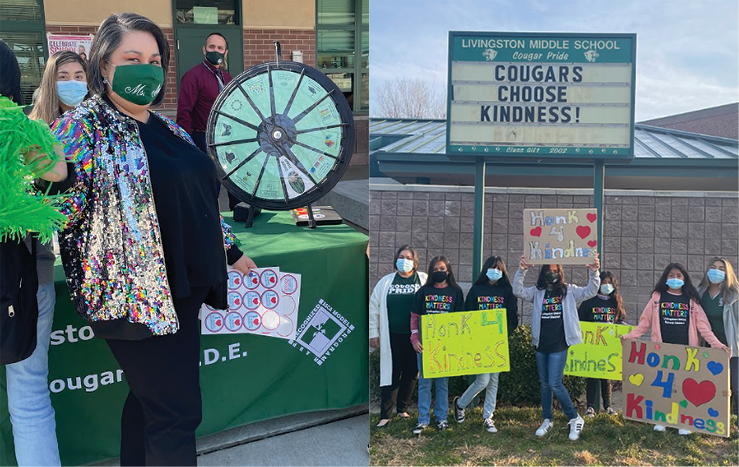
Most mornings, Alma Lopez can be found in front of Livingston Middle School, greeting her students with smiles and green pompoms. When she started this practice, Lopez, the school counselor, would get wary looks or half-hearted smiles from the students. Now, many students say good morning first. When students get to school before her, they’ll ask, “Where is Ms. Alma and her pompoms?” Some students even join her now on the sidewalk. “I know it’s making a difference because they want to be a part of it,” she says of her morning routine. “They want this opportunity to be a little silly, smile, and welcome their peers.”
Livingston Middle School is a Title 1 school in California’s Central Valley, with 850 students in 6th, 7th, and 8th grades. Most families in this rural community are farm laborers or food production workers. Livingston Union School District serves about 2,500 students, 80% of whom are Latinx. “We are a majority-minority district,” says Lopez, who has been a counselor at Livingston Middle for 16 years, “with a very high English learner population.”
While it looks lighthearted and fun, Lopez’s practice has a deeper purpose. From her vantage point, she can observe her students and note their behavior, demeanor, and even their absence. “I can say, ‘you weren’t here yesterday, but I’m glad you’re here today.’ It lets them know that I noticed, and I cared enough to notice.”
Attention to students’ mental and emotional needs is only one part of the role of a school counselor. However, considering the physical and emotional growth and changes of early adolescence, middle school counselors must be especially attuned to their students’ mental health, especially after the disruptions of the pandemic.
Lopez, the American School Counselor Association’s 2022 School Counselor of the Year, recently spoke with Phi Delta Kappan about her students’ social and emotional state during the pandemic, the long-term impact of isolation on tweens, and what middle-grade students need from adults.
Phi Delta Kappan: What happened in your school at the start of the pandemic? What challenges did your students and families face?
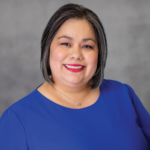
Alma Lopez
Lopez: In this community, we have a lot of multigenerational families, and our homes are filled with grandmas, grandpas, aunts, and uncles. When the pandemic hit, it hit everyone hard, especially the senior community, so there was a lot of worry and fear about grandma and grandpa. My students had a multitude of losses. They first lost their social and physical connections to one another. Imagine living with your grandma and not being able to give her a hug because you’re scared you might pass something to her. Then there was the loss of work. My families worked out in the fields, and they worked in food production plants, so when the school first shut down, they shut down too. The plants were able to open back up quickly because the workers proved to be our essential workers. That was a huge risk; parents going off to work and they might get sick and bring something back home to at-risk elderly or little kids who couldn’t get the vaccine. There was loss of income and a loss of food, and loss in some cases of shelter. It was a tough time in our community, and there was a lot of fear. People did die.
As a district, we were able to figure out how to get the meals going, so the school became a hub where families could come by on Mondays and get food for the week. That was something our district knew — as a high-needs district, that we’ve got to help, and so we did. Then we were able to figure out the education piece. The middle school already had a one-to-one electronic device program, but the devices were all in the building. We set up days for families to come and pick up their Chromebooks and, if needed, hot spots, which a lot of our families did need because we are in a rural setting.
I’m most excited that we were able to keep our comprehensive counseling program going. We have worked hard in this district to have a program that’s accessible to every student in the building. When we shut down, we had a plan for the year. How could we do this virtually? We had to figure out the Google Meet and Zoom platforms, but we were able to continue going into the virtual classroom and provide counseling instruction to all students. We started to focus on stress management and coping skills. We also had virtual recess. We knew that if we were in school, kids would have a break and be able to socialize, but we’re not in school, so what can we do? We created these virtual opportunities, sometimes led by the school counselor, and sometimes led by our yard supervisors. We gave them ideas for virtual games, like Jeopardy, Minute to Win It, and scavenger hunts, things that they could do to connect during that virtual recess time and space if they wanted to.
We created a similar space for our caregiver community. Once a week, they could drop in at a certain time and connect with a school staff member, usually a school counselor, or sometimes a school administrator. We did something similar for our staff. We partnered with outside mental health agencies to further support those students and families that needed a little more than the school was able to offer at that time.
Kappan: What are some of the developmental needs of middle school students?
Lopez: Middle school is a beautiful time of rapid growth and changes. It’s scary for the kids, and it’s scary for the parents at times, but it’s also so exciting. It’s this period where the brain is developing so quickly, the bodies are changing so quickly, and our cognitive abilities as young adolescents are changing and developing. We are exploring all our interests; we’re finding out, I like this, I don’t like this. We are trying to find out, who am I in this environment, who am I in that environment, and who really am I? All these changes are happening, and sometimes our bodies look a lot different. That can be frustrating because we see this 12-year-old who maybe looks a little older than that, but they’re 12. You can tell once you start talking to them. Those changes are very visible.
It’s a confusing time, but also an amazing time when young people are exploring their interests. As adults, we have this unique opportunity to help them to explore and to develop into healthy human beings if we give them what they need. We know that they need rest, they need healthy meals, and they need social relationships. They need to know we care for them before they will care about anything we are saying. There’s some healthy conflict that’s occurring as the young person is trying to figure out who they are becoming, but the parent role and the adult in the life of an adolescent are still important. They are trying to set those values for themselves, figuring out, who am I, and who am I becoming, and how do I want to be seen in this world?
I am optimistic because I see kids helping each other and being kind to each other.
At the same time, their bodies are growing, their minds are changing, and they are being introduced to lots of different ideas from their peer circle. They are becoming much more aware of what’s going on in the world. I’ll have kids come in and say they are watching the news, and they ask, “How does this happen? What can I do to help change certain things that are happening in the world?” And they feel so deeply. They really live their feelings out. When someone’s hurt, they are so empathetic. When they see someone is homeless, they want to help. So many kids come to me and say, “What can we do? Can we create grooming packets so that if I see someone who is homeless, I can help?” We get a new student in the building, and 20 kids want to come help that new student. They are living their feelings out. Some of that is fun and exciting, but there are some dark and sad moments, too. They really hurt when someone loses a loved one. During the pandemic, a lot of people lost significant family members. Young people were able to support one another in amazing ways. They felt sad with their friends, and they wanted to be there and support them.
Kappan: How did the isolation of the pandemic affect middle schoolers?
Lopez: We had kids who had last been in the building in 4th grade, and they were transitioning into 6th grade. Usually, we would have a transition for them. They’d come to the school, they’d see the building, they practice with their lockers, and they’d meet some friends. But that didn’t happen. The loss of some of those significant milestones that happen in middle school really did impact our students. They were coming into this social time in their life, and those social opportunities were not there in the same way. I think it stunted a little bit of their growth.
Last year when we returned to the building, we saw an increase in behavior challenges across the board. We saw kids who were awkward and not sure what to do or what to say as they were building friendships or ending friendships. They were stuck on the screen for so long. When we came back into the building, we were still required to wear masks, but even when the mask mandate ceased, we had a lot of kids still wearing their masks, like a security blanket to help them out. We noticed an increase in horseplay and horseplay going a little too far. We ended up with an increase in physical altercations that we had to help our students work through and resolve.
They were challenged just feeling like they were part of any group. In middle school, we all want to belong and be a part of something. During the pandemic, the somethings weren’t there — no band practice, no soccer teams, no after-school clubs. When they were coming back to school, I noticed some kids jump right back in, and they were ready to go. But a lot of kids are still hesitant to jump in there. They’re not sure if they want to try out for the team and possibly be rejected. I do think that our middle schoolers struggled with missed opportunities for transition and healthy socialization, which has created a lasting impact on them. They are struggling a little longer. It’s already hard enough, but when you miss certain opportunities, of course, it’s going to be harder a little longer. But I am optimistic because I see kids helping each other and being kind to each other. They are trying to invite one another into their social circles a little earlier because they know what it felt like last year to not be included. The kids are trying to be more inclusive.
Kappan: What do middle school students need from adults?
Lopez: What middle schoolers really need are adults to respect them, hold them accountable, and extend grace when it’s needed. We need to respect that these tweens are human beings, and in middle school, they are developing. They have these thoughts and ideas, and we need to listen to them and respect them. Don’t just say, “you’re a kid.” Say, “OK, tell me more about it.” Also, we need to hold them accountable. And sometimes, grace is needed. When your kiddo comes home, and they had a social conflict at school, we need to lean in and understand that that’s hard stuff. They’re 12, and they just lost a friend because their friend didn’t want to join the soccer team with them, or they don’t have the same lunch period anymore. Being able to understand that and not belittle it but allow them to have whatever feelings they have about a situation is important. Coach or guide them through it, but don’t give them the answer because the only person who knows the answer to their problem or their concern is really them. It’s also important to provide opportunities for young people to connect and socialize. They lost those opportunities during the pandemic, so we’ve got to provide them now in as many spaces as possible.
This article appears in the October 2022 issue of Kappan, Vol. 104, No. 2, pp. 22-24.
Photos courtesy of Alma Lopez