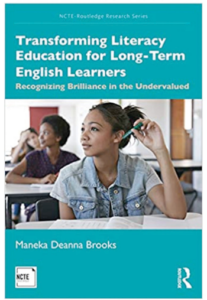
 Transforming Literacy Education for Long-Term English Learners: Recognizing Brilliance in the Undervalued
By Maneka Brooks (Routledge, 2019).
I had a professor in graduate school who always reminded us that behind every statistic and label, there was a person. This simple idea ran counter to much of the thinking at the time, particularly as No Child Left Behind had us constantly disaggregating data and subsequently reducing our students to categories or groups. But as she knew — and I needed (and need) reminding — labels assume homogeneity, promote deficit thinking, and fail to acknowledge the rich and varied experiences of students.
Labels persist, unfortunately, and their use continues to do damage to many of our students — a message central to Maneka Brooks’ book, Transforming Literacy Education for Long-Term English Learners. In this slim volume, which she wrote to “humanize reading instruction for English-speaking bilinguals” (p. 15), Brooks addresses head-on the damage we do when we underestimate the strengths of long-term English learners and when we conflate their English-language proficiency with their intelligence and literacy engagement.
This book is both scholarly and practical. Brooks deftly interweaves recent and varied research and theory alongside classroom vignettes, and she invites readers to reflect on their own practices. But the real strength of her book — how she ultimately moves her readers to reject one-dimensional labels — is its foregrounding of the literacy experiences of five Latina high school students (Destiny, Eliza, Lizbeth, Jamilet, and Valeria) — as they navigate the texts and literacy expectations in their biology and English classes. Their stories are the heart of the book, and Brooks describes, in rich detail, these students’ experiences, reflections, and linguistic and literacy behaviors. For a researcher to enter into adolescents’ lives and gain their trust is no small feat, and the rich portraits that Brooks provides not only make for easy (and invested) reading, but also accomplishes her goal of providing a more humanizing perspective. I needed to read this book.
Kristin Conradi Smith’s latest for Kappan
ABOUT THE AUTHOR

Kristin Conradi Smith
Kristin Conradi Smith is an associate professor of reading education at William & Mary, Williamsburg, VA.