
April 1974
In the pages of Kappan, the conversation about how schools can best serve children with disabilities stretches back for decades, since long before the 1975 passage of the Education for All Handicapped Children Act, which later came to be known as the Individuals with Disabilities Education Act (IDEA). Much of the discussion has revolved around where to educate these children. In December 1939, Meredith Darlington and Ruth Wendell (“Crippled and isolated children”) explained the dilemma:
Many crippled children can attend the regular school with the physically normal pupils satisfactorily. The closer the crippled child can be kept to the physically sound child, the fewer will be the adjustments for the crippled child when he finds himself ready to compete with others in obtaining employment. There are others, however, who are so incapacitated that attendance at a regular school would not only result in a hardship for the pupil, but expose him to undue physical risks. (p. 168)
Authors have generally seemed to agree that educating children with and without disabilities together is ideal when possible. But for which children is it actually possible? Are there times, Kappan authors have wondered, when a special classroom or even school is the best option for children with disabilities? What kinds of special education programs and services are most effective, and to what extent can their practices be implemented in the general education classroom?
The October 1940 issue on the “Education of exceptional children” laid some groundwork by describing existing programs designed to support students with various physical, mental, and emotional disabilities. In the issue’s introductory essay, Ernest Newland (“Early identification”) observed that “the education of exceptional children is, after all, nothing more than a sound educational practice which is applied in certain special instances, but which is applicable to all children” (p. 34).
Out of the shadows
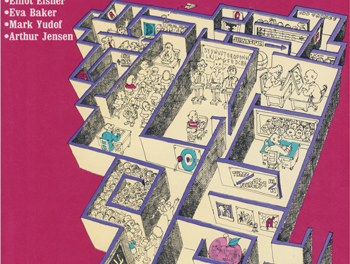
Unfortunately, the 1940s did not mark the beginning of an era of great improvements in educating children with disabilities. In fact, when Kappan took another deep dive into the topic more than three decades later, in its April 1974 “Special issue on special education,” Sally Rogow and Charlotte David (“Special education: Perspectives, trends, and issues”) noted that the education community had been relatively silent as children with disabilities and their teachers had been largely shunted to the side:
The progress made in recent years is like a sharp beam of light, exposing the dusty corners and never-to-be-uttered-thoughts about the exceptional child. Put away in the basement, or in a prefab building behind the school, both children and their teachers have been segregated from normal school life. As integration is interpreted to mean communication between special educators and their colleagues in the school, it will be easier to bring the special child within the scope of normal school activities and increase his ability to participate with his peers. (p. 515)
“The education of exceptional children is, after all, nothing more than a sound educational practice which is applied in certain special instances, but which is applicable to all children.” — Ernest Newland, October 1940
But Rogow and David were heartened by recent interest in their newly “respectable” field that “has reached maturity and has been recognized as a sister discipline with the educational spectrum” (p. 516). In the same issue, James Gallagher (“Phenomenal growth and new problems characterize special education”) explained that things were looking up, as more funding was being dedicated to special education and more state courts were acknowledging the rights of children with disabilities to receive an appropriate education. And, indeed, the passage of the Education for All Handicapped Children Act the following year was a sign that interest in children with disabilities had reached the halls of Congress.
Still, Gallagher and other authors were concerned that special education had become a place to “dump” minority children and children who were considered too difficult to manage. Also in the April 1974 issue, David Kirp (“The great sorting machine”) wrote that the growth of special education programs might actually be prompting schools to segregate those students even more:
The ready availability of special programs for children with hard-to-pin-down “handicaps” provides teachers with a way of opting out of teaching those who cause trouble in the classroom. The trouble is real enough, but the teacher doesn’t want the responsibility of overcoming it. Difficult children become someone else’s responsibility. (p. 524)
He urged schools not to pretend that all students are the same but to “identify less category-bound, more flexible means of handling the particular difficulties of individual children . . . that, in turn, may involve major changes in instructional approach for all students” (p. 524).
Leonard Zneimer (“Is there a future for the residential school in education?”) had a different concern about the growth of special education programs. He argued some students with serious mental disabilities may benefit from more separation than their local schools could provide:
Hundreds of youngsters who have been unable to function in the home, school, and community have blossomed in an atmosphere where pressures are minimized, love and acceptance are maximized, peer relationships are normalized, they do not see themselves as “different” from those around them, and they are able to function in the internal school “community” and the external local “community” with a sense of worth and dignity. (pp. 550-551)
For these children, Zneimer explained, residential options, where students receive education and treatment alongside similar peers, should remain available.
The rise of mainstreaming and inclusion
With the passage of the Education for All Handicapped Children Act, the idea that children with disabilities should be taught in an environment as close as possible to the regular classroom became law, and children in special education programs were increasingly “mainstreamed” into general education classes for some portion of the school day. But, according to Mara Sapon-Shevin (“Another look at mainstreaming: Exceptionality, normality, and the nature of difference,” October 1978), these programs tended to put the onus on students and teachers from special education programs to adapt to the general classroom. She called for a more cooperative model that could accommodate a wide range of abilities in a way that allows all students to learn essential skills while acknowledging that every individual child need not have every skill or perform at the same level.
“We find it difficult to understand how taking an inclusionary stance in the case of every child with special needs is any more acceptable than taking an exclusionary stance would be.” — Richard Smelter, Bradley Rasch, and Gary Yudewitz, September 1994
By the 1990s, some schools were attempting to move from mainstreaming to inclusion, in which special education students do most or all of their learning in general education classrooms. But as Richard Smelter, Bradley Rasch, and Gary Yudewitz (“Thinking of inclusion for all special needs students? Better think again”) explained in the September 1994 Kappan, what true inclusion looked like was unclear, even among its advocates. Further, the authors worried that inclusion would fail to address some students’ needs:
Someone once said that, if one extreme is unacceptable, then so is the other. We find it difficult to understand how taking an inclusionary stance in the case of every child with special needs is any more acceptable than taking an exclusionary stance would be. Both are preconceived mental constructs that assume that only one solution exists to the various challenges faced by children with special needs. This is analogous to your family physician’s prescribing in advance the same medication for every illness that you and your family contract. (p. 36)
Skepticism about inclusion seemed to be the prevailing mood in the mid-90s, with multiple articles across multiple issues describing the problems schools were having implementing these programs.
In March 1995, with a new reauthorization of IDEA on the horizon, Douglas and Lynn Fuchs (“What’s ‘special’ about special education?”) made a case for continuing to offer some special education services in resource rooms and self-contained classrooms, asserting that “We are not alone in viewing the mainstream as incapable of accommodating all children, all of the time; indeed, this is the perspective of a majority of the disability community” (p. 524). The special education field is not perfect, they acknowledged, but its services were still necessary:
Many times we have tried to shake our field by its shoulders with regard to its assessment practices, state reimbursement formulas, reintegration efforts, and overidentification of students. But such concerns — as well as other legitimate problems raised by full inclusionists, detracking advocates, school administrators, and others — should not be construed as evidence that special education cannot work. It can and does work — it is special — in many places. And it is unique in ways that general education is not and probably never can be. (p. 529)

March 2005
By the end of 1995, authors were starting to take a more positive view of inclusion, without ruling out the need for some separate services. In a special section on inclusion in December 1995, Dianne Ferguson (“The real challenge of inclusion: Confessions of a ‘rabid inclusionist’”) described how her son Ian, who had multiple severe disabilities, thrived when he was given opportunities to leave his self-contained classroom and participate in classes with non-disabled peers. But Ferguson’s research showed that Ian’s experience with inclusion was not universal:
Too much inclusion as implemented by special education seems to succeed primarily in relocating “special” education to the general education classroom along with all the special materials, specially trained adults, and special curriculum and teaching techniques. The overriding assumptions remain unchanged and clearly communicated. (p. 284)
Ian’s experience in the general classroom did not require him to do all the same things as his classmates. For example, when he joined his peers to play Parcheesi, they asked him to be the person who dumps the dice from the cup, something he could happily achieve while being part of the group. The point, in Ferguson’s view, was that he was a full member of the classroom community, not merely existing in the same space.
An expansive view of special education
Dianne Ferguson’s experiences and research led her to advocate for a remaking of education that allowed all students to have the flexibility Ian was given to learn in different places and in different ways, according to his skills and needs:
The greater the number and variety of students learning in various locations with more varied approaches and innovations, the less likely that any student will be disadvantaged by not “qualifying” for some kind of attention, support, or assistance. If all students work in a variety of school and community places, the likelihood that any particular students will be stigmatized because of their learning needs, interests, and preferences will be eliminated. (p. 285)
Murray Shulman and James Doughty (“The difficult dichotomy: One school district’s response”), also in the December 1995 issue, concurred, arguing that their experiences making resource rooms available to nondisabled students in Bangor, Maine, showed that “the split between regular and special education may be an unnecessary state of affairs for education” (p. 294).
Ten years later, Wayne Sailor and Blair Roger (“Rethinking inclusion: Schoolwide applications,” March 2005) also took an expansive view, but their focus was on bringing special education services to the general classroom:
Under emerging schoolwide models, students with IEPs are not removed from general education classrooms to receive one-on-one therapies and tutorials or to go to “resource rooms.” Following the logic of integration, all services and supports are provided in such a way as to benefit the maximum number of students, including those not identified for special education. (p. 506)
Whether they qualify for special services or not, all students have their own particular needs, so, perhaps, the question of how to educate students with special needs is really a question of how to educate all students, of all abilities.
This article appears in the March 2022 issue of Kappan, Vol. 103, No. 6, pp. 5-7.

ABOUT THE AUTHOR

Teresa Preston
Teresa Preston is an editorial consultant and the former editor-in-chief of Phi Delta Kappan and director of publications for PDK International, Arlington, VA.
Visit their website at: https://prestoneditorial.com/