As public schools quickly went remote during the pandemic, some families turned to already established online learning options.
The worst pandemic since the 1918-20 flu outbreak, COVID-19 has at this writing killed more than 600,000 Americans and 3.8 million worldwide, and thoroughly disrupted everything, including schooling. In spring 2020, U.S. education largely moved online, and literature has already emerged addressing how the pandemic has affected previously in-person schools. But what about the schools that were already online?
As of the 2017-18 school year, 501 full-time virtual schools enrolled approximately 297,000 full-time students; just under half of all virtual schools (46.5%) were charter schools, but they accounted for 79.1% of enrollment (Molnar et al., 2019). Many virtual schools provide instruction for students in grades K-12 and are often selected by parents because of flexible scheduling or in reaction to bullying and academic issues at previous in-person schools (Beck, Egalite, & Maranto, 2014).
How has the shift to remote learning in in-person public schools affected enrollments in these charters? In other words, when parents realized their children would be learning online, did they choose to send them to a school that had an already established virtual program? How did that change the schools’ overall makeup? And what might the shift to virtual learning across much of the nation mean for cyber charter schools’ place in the school choice landscape, even after the pandemic is over?
COVID-19 and schools
Considerable research has already addressed how the pandemic affected brick-and-mortar schooling, much of which moved online in spring 2020 and remained online into at least part of the 2020-21 school year, especially in cities and in more politically liberal areas (Hartney & Finger, 2020; Marshall & Bradley-Dorsey, 2020). A November-December 2020 national survey of parents indicated that only 28% of U.S. traditional public school students were receiving instruction in person, with 19% receiving hybrid instruction and a majority receiving schooling completely online (Henderson, Peterson, & West, 2021).
Parents appeared to give their schools’ online instruction mixed reviews. One national parent survey found that most parents of school-age children approved of how their previously in-person schools handled online schooling, with private and charter schools receiving somewhat more positive ratings than traditional public schools (Carpenter & Dunn, 2020). Additional survey research indicated that during the pandemic, nationally, 51% of parents with children in physical schools were very satisfied with “instruction and activities provided,” and only 3% were very dissatisfied. In comparison, only 23% in fully online schools and 21% in hybrid schools were very satisfied, with 9% of online only and 11% of hybrid very dissatisfied, leading analysts to speculate that more parents will choose in-person options as they become available. But this parental dissatisfaction with hybrid and online learning may reflect relatively ineffective implementation of hastily prepared online learning options in traditional schools (Henderson, Peterson, & West, 2021).
Indeed, in a national survey during the initial transition to remote instruction in spring 2020, teachers overwhelmingly (92.4%) indicated that they had never taught online before the pandemic, and few received any training in online pedagogy from their schools or school districts (Marshall, Shannon, & Love, 2020). And research has emerged showing reduced learning in mathematics and reading during the pandemic, with greater declines for low-income students (Dorn et al., 2020). Were the challenges schools and families encountered during the transition to remote learning great enough to lead them to seek out already established cyber options, with teachers who were experienced with online instruction?
Choosing cyber charters
It does appear that, during the difficult transition in spring 2020, some parents chose to enroll their students in cyber charters. As of September 2020, reports from our fieldwork indicated double-digit growth in cyber charter enrollments in many states. In Pennsylvania, for example, traditional public schools lost about 52,000 students from March 2020 to December 2020, while cyber charter enrollments rose from 38,000 to an estimated 61,000 students (Sorensen, 2020). Pennsylvania cyber charters likely would have grown even more were it not for state funding restrictions on their growth.
Anecdotal evidence indicates that some cyber charter schools saw changes not just in the number of students but in the type of students served during the pandemic. A cyber charter leader in Pennsylvania noted that “in both December [2020] and January [2021] half our students had perfect attendance. That has never happened before” (personal communication, Feb. 16, 2021). A leader at another cyber charter in a different state stated, “We definitely enrolled higher-performing students who are more traditional than our usual student populations, and something that’s been interesting is that they don’t take advantage of the flexibility in the same way that other students typically have. They’re showing up to teachers’ live lessons, etc. and getting the work done, because they’re not used to things being optional/flexible. So, it’s actually causing us to rethink some of our core practices” (personal communication, April 20, 2021).
To get a fuller sense of these changes, we used data from a multistate cyber charter network to compare students who enrolled in cyber charters during COVID-19 in March-June 2020 (n=2,708) with those who enrolled in the same pre-COVID time periods in 2018 (n=2,002) and 2019 (n=2,229). Our findings provide important baseline data for additional research into the long-term effects of COVID on this part of the school-choice landscape.
Similar demographics, different outcomes
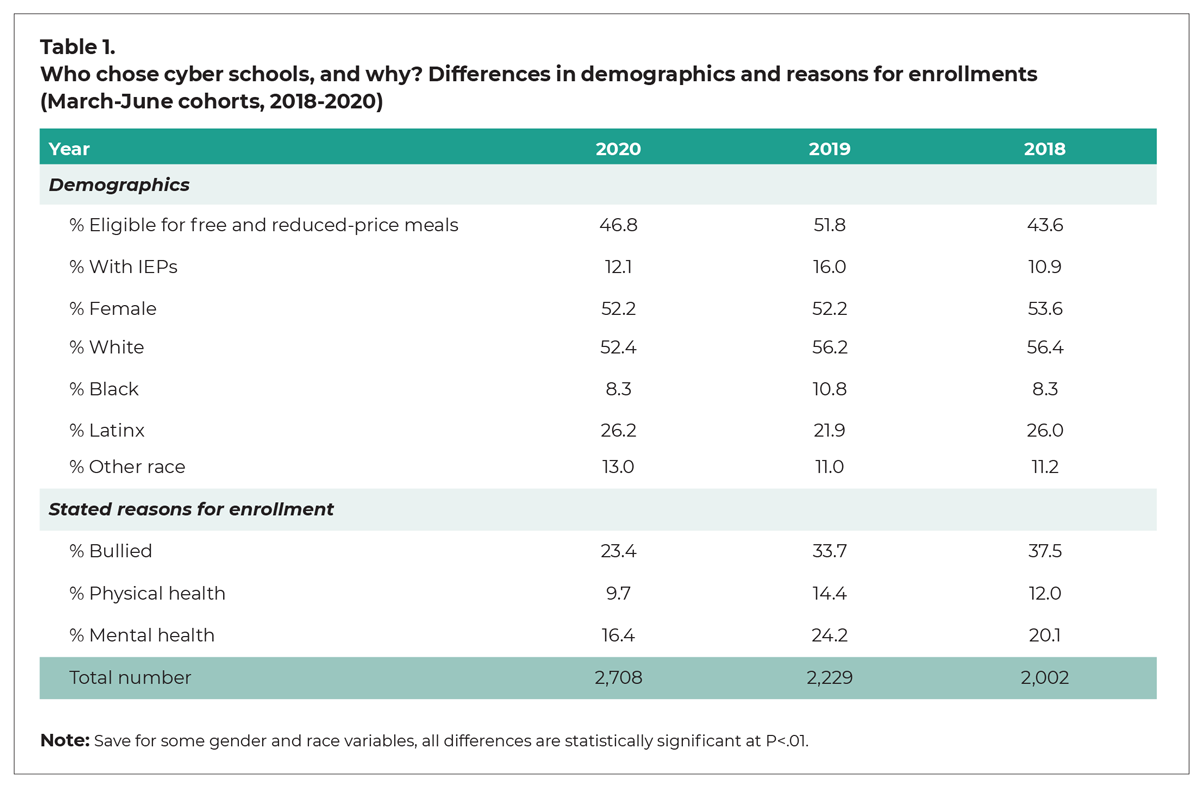
As Table 1 shows, more students enrolled in the network in spring 2020 than during the same period in the previous two years, but we found few notable demographic differences between students enrolling in the 2018, 2019, and 2020 cohorts. The 2020 (COVID) cohort had essentially the same percentage of males and females as previous cohorts. Similarly, the 2020 cohort was 3.7% less white, 2.5% less Black, and 4.4% more Latinx than the 2019 cohort. Demographic differences between the 2020 and 2018 cohorts were even smaller. These demographic differences are statistically significant, but only marginally different, and they do not clearly demonstrate a more privileged 2020 cohort, which is indeed somewhat less white and more Latinx than in 2019.
Other variables tell a somewhat different story. Compared to the 2019 cohort, the 2020 cohort had 3.9% fewer students with individualized education programs (IEPs) or 504 plans (12.1% for 2020 and 16% for 2019) and 5% fewer (46.8% compared to 51.8%) qualifying for free and reduced-price meals, suggesting a somewhat more privileged income and disability status. Again, differences between 2020 and 2018 entrants were somewhat smaller.
Other comparisons found greater differences. On entry to the charter network, schools asked parents their reasons for leaving their previous schools. Their answers suggested that students entering during COVID had fewer social problems and better health at their past school than previous cohorts. Compared to 2019 counterparts, 10.3% fewer (23.4% to 33.7%) parents of students entering in 2020 cited bullying in their previous schools as a reason for enrollment, with 7.8% fewer citing mental health concerns, and 4.7% fewer noting physical health concerns. Again, differences between 2020 and 2018 entrants were somewhat smaller, with the exception of bullying, for which 14.3% fewer parents mentioned bullying in 2020.
Differences in stated reasons for enrolling suggest that despite a lack of notable demographic differences, one might consider the 2020 cohort somewhat more privileged than pre-COVID entrants, at least regarding these students’ ability to navigate schooling. This is borne out by the 2020 class’ performance, as indicated in Table 2: This class had a significantly higher grade-point average than the two previous classes for its first months in the school (March through June), and the class scored significantly better on both performance (grade in a course that includes assessments and portfolios) and participation (the extent to which to the student is on track to complete a course by the due date) metrics than the other two cohorts. They also completed significantly more curriculum-based assessments (CBAs) — one-on-one meetings with a teacher to monitor progress and formulate instructional intervention plans (Hintze, Christ, & Methe, 2006). (We lacked standardized test score data because many states didn’t test during the pandemic.) We know of no changes in the cyber network’s operations likely to explain these differences; therefore, differences in the type of student entering in 2020 seem likely to account for the class’s better performance.
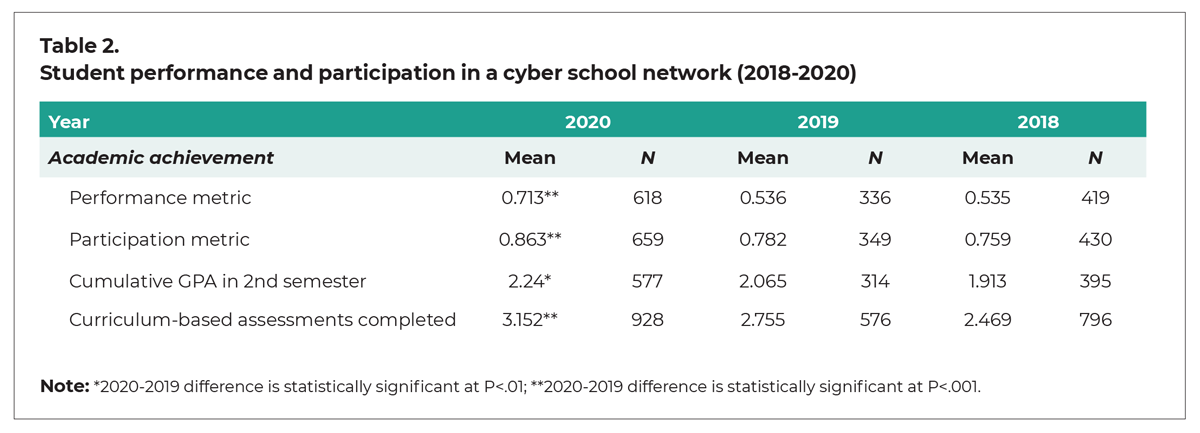
Previous empirical work has found that cyber schools have lower levels of academic value added than both charter and traditional public in-person schools (e.g., Woodworth et al., 2015) and that this cannot be explained by artificial testing conditions (Beck, Watson, & Maranto, 2018; Kingsbury, Maranto, & Beck, 2020). Notably, some work suggests that lower cyber charter performance may, in part, reflect student composition, with students who struggle in in-person settings disproportionately choosing cyber options, while being relatively more in need of the in-person support that virtual schools have difficulty providing (Ahn & McEachin, 2017). The improvement in student performance when enrollments changed at the cyber network we studied provides further support for this finding.
Normalizing cyber?
The data we collected show that just as COVID-19 affected traditional public schools, it also affected cyber schools, but in different ways. Previous research indicated that many parents who chose cyber schools did so out of serious dissatisfaction at their in-person schools, often due to social factors like bullying and difficulty keeping up, particularly when students had special education or 504 designations (Beck, Egalite, & Maranto, 2014). These factors may be among the drivers of the relatively weak academic performance found in many studies of cyber schools (Ahn & McEachin, 2017). Yet, during COVID, cyber schools may have enrolled a greater percentage of students who were succeeding at in-person schools but who were dissatisfied by their traditional public schools’ adjustments to COVID.
Our results are from a single cyber charter network, albeit a large one operating in a number of states. That said, if future research yields similar findings, the cyber school classes of 2020 and 2021 may prove relatively more successful than previous classes. Yet, we must add the caveat that while COVID-era entrants to cyber schooling may be more proficient academically than previous cyber students, we do not know how these students compare with those who remained in traditional schools. And as in-person schools reopen and return to normality, the newer cyber students may return to traditional education options. The fact that many surveyed parents give higher marks to in-person schooling when it is available suggests that cyber charters may retain only a modest portion of their enrollment increases, and possible performance boosts, after the COVID-19 pandemic (Henderson, Peterson, & West, 2021).
Only time will tell if the families who decided on a cyber charter as an alternative to their regular schools’ offerings during COVID decide to remain in these schools after COVID. The pandemic and accompanying shift to remote learning may have led families to make a choice they’d never previously considered. Will that choice be a onetime emergency option, or will it bring about long-term change in the enrollment and achievement patterns in cyber schools?
References
Ahn, J. & McEachin, A. (2017, February). Student enrollment patterns and achievement in Ohio’s online charter schools. Educational Researcher, 46, 44-57.
Beck, D., Egalite, A., & Maranto, R. (2014). Why they choose and how it goes: Comparing special education and general education cyber student perceptions. Computers & Education, 76, 70-79.
Beck, D., Watson, A., & Maranto, R. (2018). Do testing conditions explain cyber charter schools’ failing grades? American Journal of Distance Education, 33, 46-58.
Carpenter, D. & Dunn, J. (2020). We’re all teachers now: Remote learning during COVID-19. Journal of School Choice, 14 (4), 567-594.
Dorn, E., Hancock, B., Sarakatsannis, J., & Viruleg, E. (2020, December). COVID-19 and learning loss: Disparities grow and students need help. McKinsey and Company.
Hartney, M.T. & Finger, L.K. (2020). Politics, markets, and pandemics: Public education’s response to COVID-19 (EdWorkingPapers). Annenberg Institute at Brown University.
Henderson, M.B., Peterson, P.E., & West, M.R. (2021). Pandemic parent survey finds reverse pattern: students are more likely to be attending school in person where COVID is spreading more rapidly. Education Next, 21 (1).
Hintze, J.M., Christ, T.J., & Methe, S.A. (2006). Curriculum‐based assessment. Psychology in the Schools, 43 (1), 45-56.
Kingsbury, I., Maranto, R., & Beck, D. (2020). Road weary? Testing whether long commutes to testing sites explain deficient cyber charter school academic performance. Journal of School Choice, 14 (4).
Marshall, D.T. & Bradley-Dorsey, M. (2020). Reopening America’s schools: A descriptive look at how states and large school districts are navigating fall 2020. Journal of School Choice, 14 (4).
Marshall, D.T., Shannon, D.M., & Love, S.M. (2020). How teachers experienced the COVID-19 transition to remote instruction. Phi Delta Kappan, 102 (3).
Molnar, A., Miron, G., Elgeberi, N., Barbour, M.K., Huerta, L., Shafer, S.R., & Rice, J.K. (2019). Virtual Schools in the U.S, 2019. National Education Policy Center.
Sorensen, K. (2020, December 21). COVID-19 in Pennsylvania: Enrollment at cyber charter schools up nearly 60 percent. KDKA Pittsburgh.
Woodworth, J.L., Raymond, M.E., Chirbas, K., Gonzalez, M., Negassi, Y., Snow, W., & Van Donge, C. (2015). Online charter school study. Stanford University, Center for Research on Education Outcomes.
ABOUT THE AUTHORS

Robert Maranto
ROBERT MARANTO is the 21st Century Chair in Leadership in the Department of Education Reform at the University of Arkansas and has served on both district and cyber charter school boards. He is a coauthor of Homeschooling in the 21st Century: Research and Prospects .
Dennis Beck
DENNIS BECK is an associate professor of educational technology at the University of Arkansas.
Tom Clark
TOM CLARK is the president of Tom Clark Consulting.
Bich Tran
BICH TRAN is a Ph.D. student in the Department of Education Reform at the University of Arkansas.
Feng Liu
FENG LIU is a senior researcher at the American Institutes for Research.