Q: The writing is on the wall that teachers, including me, will be returning to the school building in the next month. I teach 6th grade, which has been identified as a priority group, so I know I will be among the first educators to return. One of my biggest concerns relates to how we’ll be teaching our classes. Some principals in my district have told their teachers that they’ll just continue to teach everyone over Zoom — a continuation of what they’ve been doing, but teaching this way from inside the school building. My principal wants us to “do better” (his words), by standing at the front of the class and teaching as we did before the pandemic, only in a way that allows the kids who need to Zoom in to participate fully. He doesn’t care that teachers across the country have been saying this type of hybrid program is ineffective and exhausting. Nothing makes me more irritated than taking directions from someone who has never done something, and he’s the furthest thing from an expert! Anyway, I don’t have a choice, so I want to do this as well as possible. I’m especially worried about the kids learning virtually. How can I decrease the odds that they’ll feel disconnected and excluded? And how I can manage this whole ridiculous balancing act without collapsing from exhaustion? Spoiler alert: It may be too late for me.
A: I’m glad you used the phrase “decrease the odds,” because there’s no way to ensure that all your virtual learners will feel connected and included at all times. Set realistic expectations and anticipate a learning curve. The good news is that while you’re in the first wave of teachers in your district to return, others elsewhere have been teaching in hybrid programs. You don’t need to start from scratch.
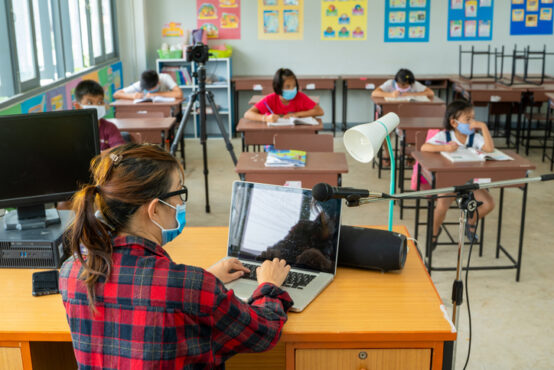
Let’s start by acknowledging the ideal versus the real. In an ideal world, you’d have a special camera that tracks voices; a microphone so you wouldn’t have to repeat everything students in the room say; speakers to amplify the remote learners’ voices, and a screen to project their images so classmates feel their presence. Now for the real world: Let’s assume that, like most educators, you don’t have any of the above. So, you need to make sure to stand in front of the camera so your Zooming students can see you, and you should monitor the chat regularly so they’re able to ask questions and participate actively in conversation. It’s easy to fall into the trap of only calling on kids in the room, particularly since they tend to respond quicker, so be intentional about alternating who you call on. You can ask a student in the room to keep an eye on the chat and let you know if someone has a question.
As for your energy level, know that a typical lesson could require twice as much talking and double the volume, especially if you’re contending with background noise from air purifiers or open windows. Be sure to drink plenty of fluids and try to structure your lessons in a way that allows you to rest your voice periodically.
The more technology you incorporate, the more potential for lost instructional time. Simple and low tech often works best. Know yourself, your skills, and your comfort level. Kids want to feel seen, and they want to interact with one another. If your district allows unsupervised breakout rooms (or you have an extra adult on hand), it’s a great way to group together the in-person and remote learners. Your students also may be more likely to turn on their cameras in smaller groups, which will enhance everyone’s sense of belonging.
Virtual learners may feel more apprehensive about participating, so check in with them periodically one-on-one. Find out how they’re most comfortable sharing information with the group. You might find, for example, that it’s helpful to use anonymous Google docs to collect feedback and ideas, or to give students an “alter ego.” I know one math teacher who assigns each kid the name of a famous mathematician so no one knows who has offered a specific answer, a tactic that’s emboldened a few risk-averse students. Encourage remote learners to use headphones so they have more privacy and fewer distractions at home, and be sure to build in time for humor — especially when everything goes wrong. You’re going to be learning right alongside your students, and there are going to be some train-wreck days. Last, virtual learners tend to lose steam before in-person students, so incorporate group movement and brain breaks when you notice kids are getting fidgety, rather than singling anyone out.
These ideas just scratch the surface, so experiment to see what works for you. Talk to your colleagues and support one another through the transition. You all bring different strengths to the table, so share best practices and celebrate small successes. As you’re focusing on your students’ comfort, make sure you’re mindful of your own needs, too. The pandemic is an endurance event, and your tank is already empty. Whether you take a mental health day, go to bed earlier, or get outside during daylight hours, do what you need to do to pace yourself. One of the best things you can do for your students — whether they’re in the room or on Zoom — is manage your own anxiety and allow time for recovery.
For more Career Confidential: http://bit.ly/2C1WQmw
Have a question that you’d like Career Confidential to answer? Email contactphyllisfagell@gmail.com. All names and schools will remain confidential. No identifying information will be included in the published questions and answers.
ABOUT THE AUTHOR

Phyllis L. Fagell
Phyllis L. Fagell is the school counselor at Landon School in Washington, D.C., a therapist at the Chrysalis Group in Bethesda, Md., and the author of the Career Confidential blog. She is also the author of Middle School Matters and Middle School Superpowers, available at https://amzn.to/3Pw0pcu.