Building students’ social-emotional and citizenship skills will enable them to take action on issues they care about now and in the future.
Students everywhere are filled with complaints and concerns about the world around them. Perhaps they dislike the unpalatable or unhealthy food in their school cafeteria. Perhaps they’ve observed bullying on the playground or online, or have witnessed gang activity in their neighborhood. Or perhaps they’ve seen news stories about racial injustice, discrimination against members of the LGBTQ+ community, or climate change, and believe strongly that something has to change. However, most young people also believe they have no way to influence such matters, and they do not know what they would do if they were given an opportunity to solve the problems they see.
Inspiration alone can’t move students to take concrete and effective steps to confront the problems they see in their schools, communities, and the wider world.
Every now and then, however, young people do manage to take action in ways that seem to make a real difference in the world. For example, youth activists Foyin Dosunmu, Jeffrey Jin, and Erika Alvarez organized protests against racial injustice in their community of Katy, Texas, after the deaths of Breonna Taylor, Ahmaud Arbery, and George Floyd (Zaveri, 2020). Others, such as the gun-control advocates from Marjory Stoneman Douglas High School, LGBTQ+ activist Sameer Jha of the Empathy Alliance, and environmental activist Greta Thunberg, have led major, high-profile efforts to raise awareness about and confront serious social problems.
These young people can and often do serve as inspiring examples for their peers. And yet, inspiration alone can’t move students to take concrete and effective steps to confront the problems they see in their schools, communities, and the wider world. Inspiration does not automatically translate to agency. If students want to become engaged civic actors, then they need to know how and where to get started — and that tends to require adult support and guidance.
Why teach social action?
As John Dewey (1897) wrote more than 120 years ago, “[E]ducation is a process of living and not a preparation for future living” (p.78). That is, we should help our students develop their capacity to study and address complex, real-world problems in the moment, as they arise. It makes little sense to require children to be passive and obedient throughout their school years, in the expectation that this will somehow prepare them for active citizenship at some later date. Rather, school ought to be a place where children observe the world around them and learn, through practice, to respond to the problems they see — whether those problems have to do with the quality of the food served in the cafeteria or with something more global in scale, such as the threat posed by climate change. As Grace Rivetti, a school counselor in Cranford, New Jersey, recently put it:
Educators are well positioned to help instill values that can awaken social transformation. The goal is for schools to be a safe haven, where students are free to exchange thoughts and receive feedback on their ideas without fear. (SmartBrief, 2019)
Rivetti’s comments remind educators that we must continually strive to honor the innate desires of our youth to be and lead the change they wish to see in the world, and to give them ways to share their ideas and seek out solutions to societal problems.
In our roles as a former high school social studies teacher and social-emotional learning (SEL) consultants, we have wrestled with how to integrate academic standards with learning experiences that foster civil discourse and civic leadership. We have encountered many who think those are mutually exclusive aims, but we know this to be inaccurate. In fact, an initiative in the New Jersey schools shows how teaching students to engage in transformational social action aligns with other important efforts related to social studies instruction, citizenship, SEL, and equity.
In June 2020, the New Jersey State Board of Education approved social studies standards that balance the goals of building student knowledge and practicing the skills of citizenship and leadership (New Jersey Department of Education, 2020). These coherent grade 2-12 standards, which will be in place in all New Jersey schools by fall 2022, can provide an example to other states.
Enter STAT: Students Taking Action Together
One program that is helping New Jersey schools balance these priorities is STAT: Students Taking Action Together, a project of Rutgers’ Social-Emotional and Character Development Lab (www.SECDlab.org/STAT). Funded by the Einhorn Family Charitable Trust’s Helping People Get Along Better Fund, STAT is a set of instructional strategies that can be merged with schools’ existing content to build students’ skills in empathy, perspective taking, emotion regulation, problem solving, effective communication, and civic engagement (Elias & Nayman, 2019). Specifically, STAT helps students analyze important social problems (both historical and current, and including both local community- or school-related problems and problems found in literature); engage in civil discourse (meaning respectful, and not deferential, communication), and formulate action plans. (See Table 1 for a summary.) Our mailing list of educators using STAT currently numbers more than 1,000. We are in the process of completing an evaluation of STAT, and preliminary findings indicate that, while it is predominantly used in middle schools, teachers and counselors from grades 5-12 are finding they can incorporate STAT seamlessly into their instruction and group work.
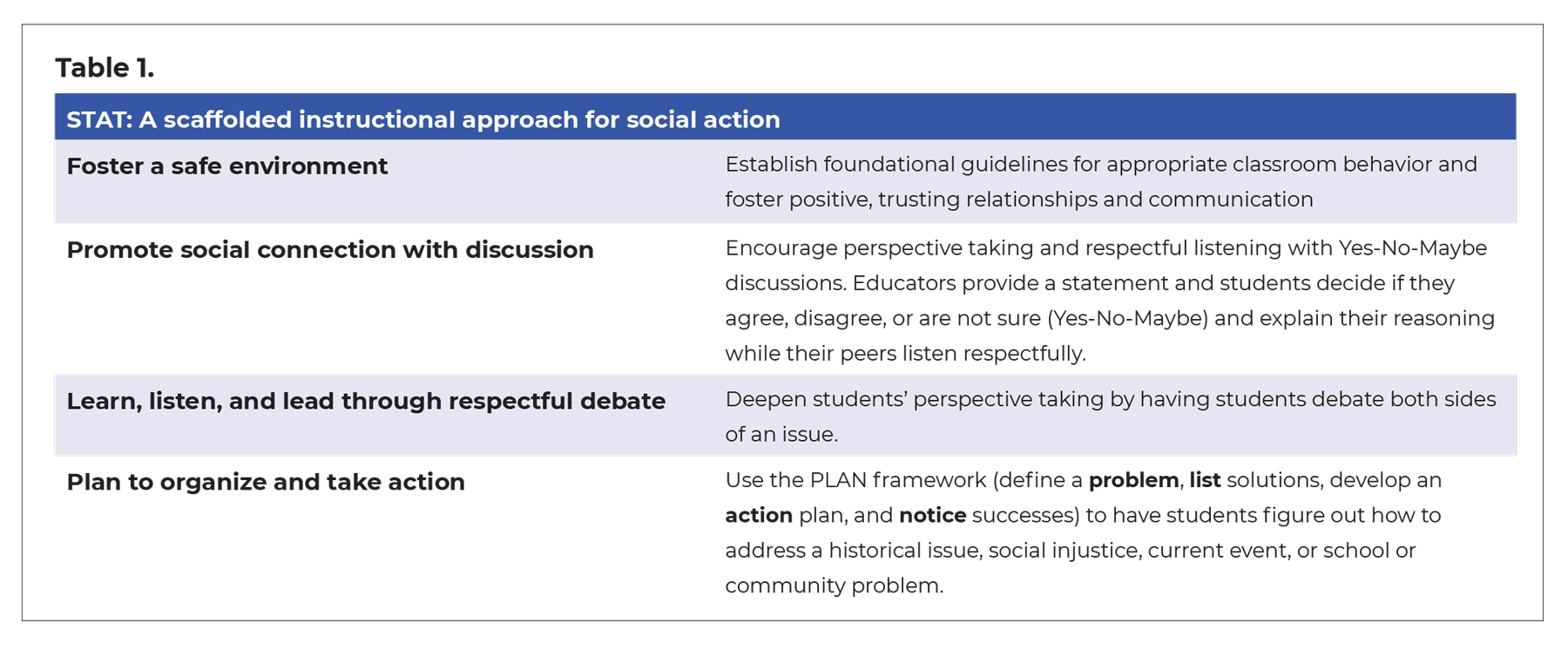
These strategies do not have to be introduced in a specific order, but we suggest implementing them in the order presented because they are ordered developmentally based on the number of skills and skill integration required, as well as the length of time needed to implement the strategy. Before using the strategies, teachers should ensure norms are in place to allow for full participation by all students.
Foster a safe environment to elevate student voice
Classroom discussions about social issues can quickly go off the rails and create ill will without clear parameters for listening and speaking. Establishing norms is a foundational STAT activity, cultivating a space in which all students are given opportunities to express themselves, developing the often-overlooked skill of talking in a clear, respectful way with those who hold different points of view, and then listening as they react and share their views (Linsky et al., 2018).
To help ground students in these norms, STAT recommends these four guidelines (though teachers and students can certainly add more if they see a need to do so):
- Listen with your eyes and ears.
- Treat your classmates the way you would like to be treated.
- Wait for others to finish speaking before you speak (because what they say is just as important as what you want to say).
- Work to understand others’ points of view (asking yourself, “Why might they have that opinion?”).
Reviewing and practicing the norms for classroom discussion at the beginning of the STAT program serves to establish and reinforce to students that this is a space where everyone’s contributions will matter and that it is important to listen to others’ perspectives. Taking time to integrate norms early on fosters a safe and trusting environment where every student can freely express their views on issues that arise in the social studies classroom, whether related to historic events, current events, or concerns facing the school. The norms provide a framework such that even if students wish to express extreme views, they must do so in terms and tones that are non-pejorative and that take the form of I-messages, not pronouncements. We have found also that once students experience such discussions, not only do they begin to participate more freely, but they also take ownership of the classroom environment, often reminding themselves and their classmates about their group norms and urging them to stay respectfully engaged.
Promote social connections through discussion
When students feel connected to their classmates, they begin to feel a sense of responsibility to each other, and this, as Dewey taught, becomes a building block for wider civic engagement. One way to build community in the classroom is by assigning students to express themselves in a way that requires them to exercise self-control, empathy, and perspective taking, all of which are needed for respectful listening and civil dialogue.
For example, STAT’s Yes-No-Maybe strategy encourages students to communicate their own views clearly and appropriately and to withhold judgment while listening to their peers’ opinions. In this activity, teachers share a prompt related to a historical event (“I would have protested against what England did to the colonies” in a unit on the American Revolution or “Leaders should rule with a strong hand” during a unit on ancient Rome) or current issue or dilemma (“It’s good for schools to have metal detectors at their doors” or “It’s OK to keep money you find in the school hallway”). Students indicate whether they agree (yes), disagree (no), or are unsure (maybe) by going to a specific part of the room. In their groups, they share the reasons for their opinions and then one or two students from the group share with the entire class. (Sample lessons and a video example are available at www.secdlab.org/demo-page.)
Learn, listen, and lead through respectful debate
Getting comfortable with sharing strong points of view on controversial issues can be a challenge for any adolescent, but it also poses rich potential for students’ learning and leadership. During a debate, emotions often run high and can override the best of intentions to keep an open heart and mind. The STAT instructional strategy of Respectful Debate provides students the opportunity not just to research and think through their own positions but to practice regulating their emotions to keep listening actively to what their peers think (instead of just waiting to state their own opinion), and to learn how to express and advocate for their opinion in the face of disagreement or counterargument, while also considering alternative points of view. In Yes-No-Maybe, the focus is on respectful listening and summarizing; Respectful Debate builds on that by adding an imperative for arriving at a broadly informed consensus in order to take action.
STAT teachers use dilemmas related to the curriculum content or everyday problems students encounter in their lives to spark respectful debate within the classroom. Statements should be ones that students are likely to have divergent opinions on, such as these used by New Jersey teachers: “A country should never go to war” or “When classmates act in ways that show unhealthy hygiene, you have an obligation to say something to them.” (For the latter statement, students’ answers before the COVID-19 pandemic might have been quite different than they are today.)
To ensure that all students feel safe participating, teachers should establish clear procedures and ground rules. For instance, they might have students begin by working with peers to research the arguments for and against a particular position, making sure to include sources that argue a different position from their own, as well as ones that take a more nuanced stance, discussing arguments on all sides. Studying a range of perspectives will help students learn to avoid mischaracterizing the position they are arguing against. During debates, students should respectfully listen to their classmates, paraphrase any opposing arguments, and check for understanding. (This helps further students’ perspective taking, empathy, emotion regulation, communication, and critical thinking skills.)
Plan to organize and take action
The lessons students learn from previous activities all come together in the final STAT exercise, which asks students to use a systematic strategy to guide action using the four-step PLAN framework:
P: Describe the problem.
L: Brainstorm a list of possible solutions and pros/cons for each.
A: Develop and act on an action plan to solve the problem.
N: Notice successes as part of an ongoing feedback and refinement process.
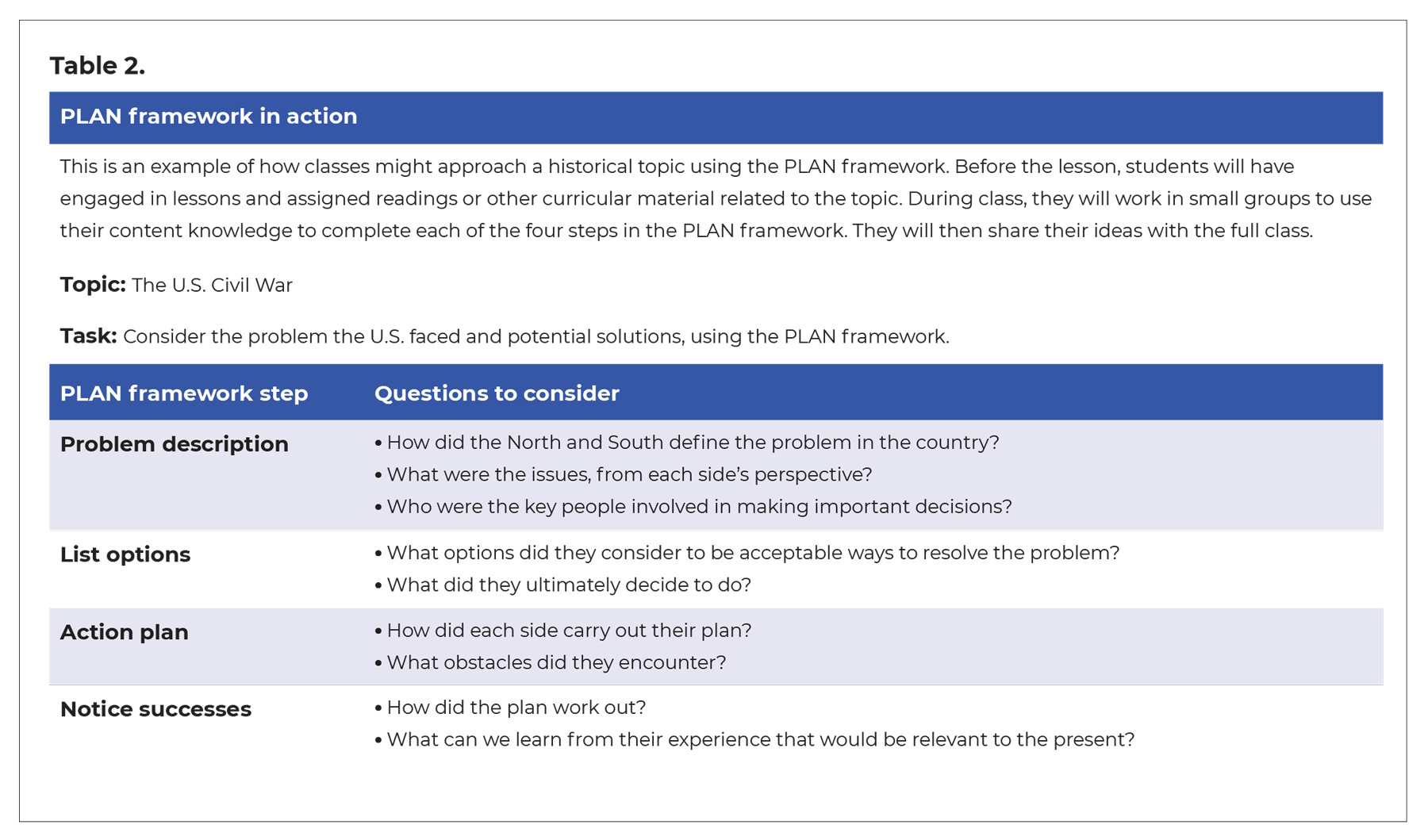
The PLAN framework is designed to help students take a problem-solving approach to issues of concern (anything from how to be more inclusive of new students or those with disabilities to how to manage worries about family members who are essential service providers during the COVID-19 pandemic). But PLAN can also be integrated with academic content (Nathan, 2020) and applied to current and historical events (Elias & Bruene, 2005). For example, in social studies classrooms, students might engage in variations of the questions, “What if we could go back in the past and respond to this problem differently?” and “Why did the people of the past make the decision they made?” The lesson in Table 2 shows how students can build on their learning about the U.S. Civil War to explore the various paths the country might have taken instead of going to war. As students create their action plan, they must follow the speaking, listening, and perspective-taking guidelines they have learned, anticipating and responding to the positions of those in their audience.
Beyond social studies
In addition to helping students build citizenship skills in social studies classrooms, the STAT strategies support the development of relationship skills, such as listening and considering others’ perspectives, that are part of many schools’ SEL programs. For example, school counselor Andrea Sadow uses STAT principles in the classroom and in individual counseling sessions with upper elementary students at Washington Elementary School in Summit, New Jersey. She has seen the positive effect on students, telling us, as part of our evaluation research, that “In the classroom, unprompted, I have started to hear students using the phrase, ‘I respectfully disagree.’ ”
School counselor Grace Rivetti, who serves as a STAT ambassador to many teachers in her school, finds ways to bring STAT instructional strategies into every grade level and encourages teachers to embed STAT into various subject areas. In language arts, for example, students take the perspective of various characters in the stories they read and use PLAN to figure out how characters can resolve their conflicts. The strategies have also been useful for peer mediation, Rivetti said, adding that “students can understand other points of view even if they don’t agree, and show mutual respect — they take it seriously.”
The STAT process enables teachers to deliver on Dewey’s call for schools to foster agency and activism among students for the lives they live today and will live in the future. Intentionally nurturing safe environments for free expression, peer connection, leadership, and organized social action engenders in students the citizenship skills required for a healthy democracy. As Brazilian philosopher Paulo Freire (1970) explains, “Education doesn’t change the world. Education changes people. People change the world.” Educators have a role to play in empowering students to become productive citizens who can change the world in positive ways. This is the moral imperative of our time.
References
Dewey, J. (1897). My pedagogic creed. School Journal, 54, 77-80.
Elias, M. & Bruene, L. (2005). Social decision making/social problem solving for middle school students: Skills and activities for academic, social, and emotional success. Champaign, IL: Research Press.
Elias, M. & Nayman, S. (2019). STAT (Students taking action together): Using social-emotional competencies to build civility and civic discourse. NJEA Review, 92 (4), 26-30.
Freire, P. (1970). Pedagogy of the oppressed. New York, NY: Bloomsbury Press.
Linsky, A.C.V., Hatchimonji, D.R., Kruzik, C.L., Kifer, S., Franza, N., McClain, K., Nayman, S.J., & Elias, M.J. (2018). Students taking action together: Social action in urban middle schools. Middle School Journal, 49 (4), 4-14.
Nathan, L. (2020). Joyful learning at scale: Immersing students in the arts. Phi Delta Kappan, 101 (8), 8-15.
New Jersey Department of Education. (2020). New Jersey student learning standards — social studies. Trenton, NJ: Author.
SmartBrief. (2019, Summer). Civility and society: How to boost civil discourse in K-12 classrooms (A SmartBrief Update). Washington, DC: Author.
Zaveri, M. (2020, July 23). I need people to hear my voice: Teens protest racism. New York Times.
ABOUT THE AUTHORS

Laura F. Bond
LAURA F. BOND is the interim K-8 curriculum and professional development supervisor in Robbinsville Township Public Schools, Robbinsville, NJ.
Maurice J. Elias
MAURICE J. ELIAS is a professor of psychology, director of the Social-Emotional and Character Development Lab , cofounder of the Collaborative Center for Community-Based Research and Service, and codirector of the Academy for SEL in Schools , all at Rutgers University, New Brunswick.He is the author of Nurturing Students’ Character: Everyday Teaching Activities for Social-Emotional Learning .
Samuel J. Nayman
SAMUEL J. NAYMAN is the STAT project director at the Rutgers Social-Emotional and Character Development Lab and a social-emotional learning consultant at Rutgers University.