

Getty Images
Homelessness is a growing issue among high school students, yet many teachers have no idea how to support students experiencing it.
They could’ve seen the signs. [Helen starts to cry.] Like, I was wearing the same three outfits I had worn since freshman year. It’s not like I was wearing new clothes. It’s not like I had new shoes or anything. I was wearing the same freaking shoes. My coach could’ve said something . . . . [Helen starts crying harder] I don’t know, I think I’m dumb because I don’t know what I would’ve done [if they offered help]. There’s signs, you know, like not showing up every day. Like something is wrong you know — it’s not because the kid is a lost cause. [School faculty and staff should] never put a kid down. Never just assume a situation and just always try to hear them out. Like, you don’t know what’s going on in other people’s lives, like literally, so don’t assume anything. Just make it known that you can help and that you want to help. Make it known that they’re not going to be a burden if they reach out to you.
Twenty-year-old Helen (a pseudonym) is one of many young people to navigate high school while homeless. Student homelessness is a growing problem, particularly among high school students. I met Helen, a young woman from Southern California, three years ago, when she was a first-year student at one of California’s elite universities. I was immediately struck by her maturity — she was forthright and focused with aspirations of becoming an immigration lawyer:
I want to be there for other people because I didn’t have people there for me. You don’t make that much money, compared to other forms of law, but you still help people, you know. I don’t have to be making hundreds of thousands to give a crap. As long as I have a roof over my head, I’m fine . . . I just feel like I have this kind of perspective that could change [things]. I have this voice that could, like, make people see something differently, maybe.
Helen navigated homelessness without access to professional help and during a time when she was disconnected from her family. Her experience drives her to want to help others, and she hopes will give her insight on how to best to so.
Helen’s family struggled with homelessness throughout her childhood and adolescence. At age 15, she was kicked out of her mother’s house after her mom discovered that she was sexually active. Helen had to live with her aunt two cities over. To get to school, Helen took four buses, and when she did not have money for the bus or was too tired — which was often — she didn’t go to school at all. When she was 16, her mother invited her to move back in, with the requirement that she split the cost of the two-bedroom apartment they would share. Helen worked three part-time jobs to pay rent, but eventually fell behind on the payments and her mother kicked her out again. During 11th and 12th grade, she couch-surfed between her aunt’s place and a friend’s house — none of the adults at her school ever knew.
Today, Helen’s story is one of resilience and triumph. Despite experiencing homelessness, she was an engaged student and received good grades. She earned a scholarship and became the first person in her family to go to college. Even still, when she recalls the lack of support she received from teachers and staff, she grows emotional to the point of tears. No one ever asked her how she was doing, she said, and no one noticed what she believed to be glaringly obvious — she was experiencing homelessness and needed help.
While it may seem that the adults at Helen’s school were negligent, it is also possible that they simply did not know the signs of homelessness or how to help. I say this based on personal experience. Like Helen, I, too, experienced homelessness during my K-12 education, but even so, when I became a high school teacher, I had no idea how to recognize the warning signs, and I knew nothing about the federal policies designed to support homeless students. I didn’t even learn the official public school definition of student homelessness until years later, when I entered a doctoral program.
Over the last four years, I’ve spent dozens of hours interviewing and listening to 10 young people (17-24 years old) for a study examining the experiences of formerly homeless high school youth. Speaking to Helen, and others like her, has taught me a great deal about how high school teachers and staff can better support students experiencing homelessness. Put simply, educators can become much more effective at helping these students by 1) learning about the scope and scale of the problem, 2) becoming knowledgeable about relevant policies and resources for students experiencing homelessness, and 3) listening to the needs of young people experiencing homelessness.
Crisis and response
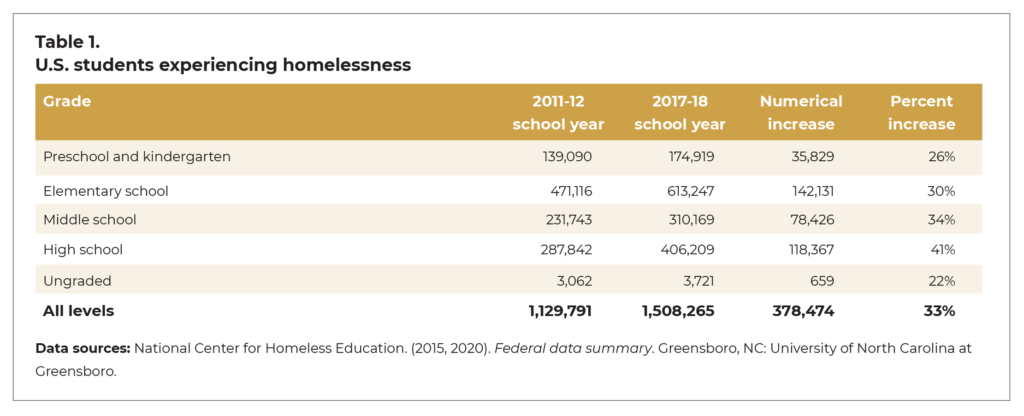
Since I met Helen, in 2017, the number of students experiencing homelessness in the United States has increased by 378,000, bringing the total to a record high of 1.5 million (National Center for Homeless Education, 2020). The increase, however, has been most prominent at the high school level. Between the 2011-12 and the 2017-18 school years, homelessness among high school students increased 41%, while the overall increase in student homelessness across all school levels was 33% (see Table 1).
Youth experiencing homelessness are more likely to experience food insecurity (Chery & Rickelle, 2008), to miss school due to safety concerns (Brown, Duffield, & Owens, 2018), and to leave school before earning a diploma (Murphy & Tobin, 2011). Reduced graduation rates are particularly common among homeless youth of color (Edwards & Howard, 2019). Not graduating high school increases the likelihood of experiencing homelessness in adulthood by 346% (Morton et al., 2018).
For more than 30 years, the federal government has tried to respond to these challenges. Passed by Congress in 1987, and reauthorized under the Every Student Succeeds Act in 2015, the McKinney-Vento Homeless Assistance Act (42 U.S.C. §11431) aims to support the academic achievement of students experiencing homelessness. The law defines homelessness as lacking a “fixed, regular, and adequate nighttime residence” and includes children and families who are living in shelters, motels or cars, or those temporarily living with relatives or other adults. The policy mandates that once students are identified as homeless, the school district becomes legally responsible for ensuring that their homeless conditions do not interfere with their ability to access an education comparable to that of their peers with more stable housing.
What specific interventions does the law mandate? McKinney-Vento attempts to stabilize the education of students experiencing homelessness by ensuring that they have the right to stay at their school of origin. As such, students experiencing homelessness must be granted access to transportation to and from school and school-related activities. The policy also requires that each district has a designated homeless liaison. The liaison is responsible for identifying students experiencing homelessness and ensuring that they receive support. Since its conception, McKinney-Vento has significantly improved educational access for these students. However, many teachers, students, and families are still unfamiliar with the law (Miller, 2011).
For instance, when I showed Helen a summary of McKinney-Vento and asked her if she had heard of it, she gave me a quick, resounding “No.” Her confusion reminded me of how I felt when I first learned about the law two years after I stopped teaching. Despite some limitations, McKinney-Vento is a powerful tool. When teachers and staff know the law and understand how it is implemented in their district, they are better equipped to grant their most vulnerable students access to available school and district resources.
A pressing need: Informal support from teachers
The formal supports outlined in McKinney-Vento work best when coupled with informal support from caring teachers and school administrators. What does care look like? When I asked Helen what she would do as a teacher to help students in her situation, she said that she would be proactive, letting them know she was there:
The beginning of class I would tell them, “If you guys are ever experiencing something like this, just know that we are here for you.” Letting people know you can talk to them, you know. [Helen starts to cry] Not just be like “I’m here to babysit you” or like “I have a family of my own to get to, kind of thing,” which I heard a lot. They didn’t care, they didn’t want to be there, they’re there because they work there.
Homelessness is isolating, and many young people do their best to avoid disclosing the experience. Their reluctance, however, is often associated with a lack of trust and social-emotional support. If students feel safe, they are more likely to tell a trusted adult at school what’s going on.
While Helen could not personally identify a caring teacher in her own life, she recognized the importance of teachers. This was a consistent theme throughout my interviews. Again and again, formerly homeless youth shared that the care and informal support they received from teachers was critical to their ability to graduate high school. They described forging impactful relationships with teachers who demonstrated care to all students, cultivated a positive classroom, and made themselves available outside of class.
Demonstrating care for all students
While educators may be tempted to lower requirements for students experiencing homelessness, the young people I interviewed spoke passionately about their desire for rigorous academic instruction. For them, school represented hope. They believed that if they were truly prepared to succeed, they would be able to avoid homelessness in the future. Thus, they spoke highly of teachers who challenged them academically. They highlighted teachers who dedicated time to providing additional tutoring to ensure that they were truly making progress toward college. The teachers who made them feel most cared for, they told me, were those who provided this combination of demanding instruction and additional support for all of their students (Aviles de Bradley, 2011; Edwards, 2019). While the combination of academic rigor and support is a recipe for success for all adolescents, it is especially powerful for youth experiencing homelessness. For Helen, for example, the prospect of attending college kept her in school during times she contemplated just working to make ends meet in the short term.
Another important manifestation of care is showing interest in students’ lives outside school. Formerly homeless youth highlighted teachers who intentionally built meaningful relationships with them. They told me that the teachers who mentored students, who offered advice after class, or who simply took the time to ask about their lives outside school helped shift their academic trajectory. Again, this type of care is beneficial for all students. However, a meaningful student-teacher relationship can be particularly important for unaccompanied youth experiencing homelessness as they often lack parental guidance (Aviles de Bradley, 2011).
Cultivating positive relationships
Strong friendships are important for students experiencing homelessness and are critical to helping them stay engaged in school through graduation (Edwards, 2019). Helen, for example, credits her best friend Natalia for her involvement in student government and the softball team, and for her decision to apply for college.
Friends also tend to be important sources of material support, such as food and shelter. Many of the youth with whom I spoke shared that they wouldn’t have attended high school if their friends (and their friends’ parents) hadn’t provided them a safe place to sleep. A nightly residence was especially helpful when friends lived close to school. For Helen, the days she slept over at Natalia’s house were among the few occasions that she arrived at school on time.
Teachers cannot force students to be best friends like Helen and Natalia, but they can create positive, humanizing classrooms that facilitate such friendships. Teachers should be proactive about fostering classroom environments that allow young people to grapple with fears, anxiety, grief, and other feelings, and where they can discuss the real-world challenges they face. When the classroom is a place that fosters dialogue and solidarity, students are much more likely to form the kinds of positive peer relationships that can sustain them in times of crisis (Howard et al., 2019).
Being available outside class
Teachers are typically the only school staff who have consistent daily interactions with students. Thus, they are best positioned to notice when students are struggling (Brubacher et al., 2016; Sedlak et al., 2010). As Helen points out, there are some clear indicators that a student may be experiencing housing insecurity, including chronic absenteeism, tardiness, and sharp declines in grades or behavior. However, these conditions are also associated with poverty in general and, therefore, aren’t always signs of homelessness. Teachers who observe these signs should be vigilant of students and seek opportunities to check in. However, they can’t be certain about what’s going on unless students tell them. Thus, the best method for identifying students experiencing homelessness is to cultivate conditions that allow them to feel safe enough to disclose their status. The formerly homeless youth I interviewed shared that access to teachers during noninstructional times (i.e., lunch, between classes, after school) was critical to getting them to share. They perceived teachers who opened their classrooms as investing in them as people, not just as students. In their view, a math teacher explaining the quadratic equation was merely doing his job, but a teacher who spent time talking to them during lunch or after school was invested in their lives.
By making themselves accessible outside of instructional times, teachers communicated to students experiencing homelessness that their problems are not a burden and that if they wanted to talk, someone would listen.
Ready to listen and act
Unfortunately, homelessness is not going away. In fact, it is only becoming more pervasive. The economic hardship associated with the COVID-19 pandemic has put millions of families at risk of being evicted from their homes.
It is essential that educators establish meaningful, caring relationships with students so that they feel comfortable disclosing housing instability. Once students disclose, educators must be ready to connect them to essential resources. These are some immediate next steps a teacher could take:
- Inform the student and family of their rights under McKinney-Vento. All teachers should keep a one-pager that lists the rights of students experiencing homelessness under McKinney-Vento as well as state and local polices. Students and families cannot advocate for their rights to services if they do not know their rights.
- Offer a warm handoff to the district homeless liaison. McKinney-Vento requires each local education agency to have a designated homeless liaison. The liaison is mandated to identify students experiencing homelessness and to mitigate students’ barriers to accessing a rigorous education. Teachers should know their district’s homeless liaison and be able to connect students (and their guardians) to that person. If your school has a protocol for referring students experiencing homelessness to a school-designated liaison, you should follow it. However, teachers should avoid disclosing the student’s information to staff without the student’s consent. Furthermore, they should avoid requiring a student to disclose their traumatic experience to more school personnel than necessary before receiving support and services.
- Create accommodations to support students academically, socially, and emotionally. Academic rigor should never lessen for students experiencing homelessness; however, accommodations should be made. For example, teachers can relax grading penalties that do not reflect student mastery of content (i.e., due dates, attendance). Also, opening your classroom to students for tutoring, studying, or even napping during noninstructional times could offer significant support to students experiencing homelessness.
As Helen told me, K-12 educators must “make it known that [students are] not going to be a burden if they reach out to you.” This requires teachers to be proactive about creating safe classroom spaces and fostering relationships with students. Further, it requires that teachers be equipped with vital information and resources. We must always be ready to listen and respond.
References
Aviles de Bradley, A. (2011). Unaccompanied homeless youth: Intersections of homelessness, school experiences and educational policy. Child and Youth Services, 32 (2), 155-172.
Brown, K., Duffield, B., & Owens, C.R. (2018, November). Risk and resilience: Differences in risk factors and health outcomes between homeless and non-homeless students in 2017 YRBS data. Washington, DC: School House Connection.
Brubacher, S.P., Powell, M.B., Snow, P.C., Skouteris, H., & Manger, B. (2016). Guidelines for teachers to elicit detailed and accurate narrative accounts from children. Children and Youth Services Review, 63, 83-92.
Chery, S. & Rickelle, R. (2008). Dietary intake, overweight status, and perceptions of food insecurity among homeless Minnesotan youth. American Journal of Human Biology, 20 (5), 550-563.
Edwards, E.J. (2019, October). Hidden success: Learning from the counternarratives of high school graduates impacted by student homelessness: Urban Education.
Edwards, E.J. & Howard, T.C. (2019). Young, Black, and houseless: An analysis of LA County Black homeless student population. Los Angeles, CA. UCLA Black Male Institute.
Howard, T.C., Camangian, P., Edwards, E.J., Howard, M., Minkoff, A.C., Orange, T., Tunstall, J.D., & Watson, K.T. (2019). All students must thrive: Transforming schools to combat toxic stressors and cultivate critical wellness. Rexford, NY: International Center for Leadership in Education.
McKinney–Vento Homeless Assistance Act of 2015, Title IX, Part A of the Every Student Succeeds Act. 42 US Code § 11431-11435.
Miller, P.M. (2011). An examination of the McKinney-Vento Act and its influence on the homeless education situation. Educational Policy, 25 (3), 424-450.
Morton, M.H., Dworsky, A., Matjasko, J.L., Curry, S.R., Schlueter, D., Chávez, R., & Farrell, A.F. (2018). Prevalence and correlates of youth homelessness in the United States. Journal of Adolescent Health, 62 (1), 14-21.
Murphy, J.F. & Tobin, K J. (2011). Homelessness comes to school. Phi Delta Kappan, 93 (3), 32-37.
National Center for Homeless Education. (2015, November). Federal data summary school years 2011-12 to 2013-14. Greensboro, NC: University of North Carolina at Greensboro.
National Center for Homeless Education. (2020, January). Federal data summary school years 2015-16 through 2017-18. Greensboro, NC: University of North Carolina at Greensboro.
Sedlak, A.J., Mettenburg, J., Basena, M., Petta, I., McPherson, K., Greene, A., & Li, S. (2010). Fourth national incidence study of child abuse and neglect (NIS–4): Report to Congress, Executive Summary. Washington, DC: Department of Health and Human Services, Administration for Children and Families.

ABOUT THE AUTHOR

Earl J. Edwards
EARL J. EDWARDS is a doctoral candidate in the Urban School Division of the Graduate School of Education and Information Studies at the University of California, Los Angeles.