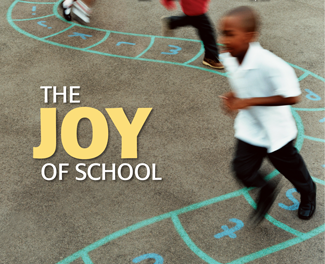
Recess will be vital to helping children, especially those from communities under stress, heal after a difficult spring and summer.
I have spent the past several years writing about the importance of elementary school recess for children’s healthy development and the ways that it improves students’ attentiveness, behavior, and learning as well as the overall school climate (London, 2019a). Today, with the global pandemic and the abrupt closing of schools to reinforce shelter-in-place orders, safe and inclusive play remains essential. Children, teachers, and parents alike have experienced a form of collective trauma and distress, and as schools reopen, students and adults alike will need space for healing before we can expect children to be ready to seriously engage in learning. Offering recess during this time (and always) is imperative for children’s healing and positive development.
Social isolation and disruption of daily routines has affected nearly everyone to some degree, but the economic hardships and increased rates of infection and death have hit low-income areas and people of color, particularly Black families, the hardest. These communities are now also reeling from “the pandemic within a pandemic” (Stolberg, 2020) — civil unrest and calls for justice amidst the ongoing police violence toward Black people. Separated from their peers, teachers, counselors, and other caring adults at school, children in these communities are less able to access the important supports that schools often provide in mitigating the harmful effects of tragedy.
As I wrote in my Kappan article “The Right to Play” (2019b), there has long existed an opportunity gap in access to recess, with neighborhood schools that serve Black and Latinx students, as well as those in urban and low-income areas, offering the least, if any, recess. Yet recess and play can help children recover, and this is the moment for schools to ensure their reopening plans include this key element for supporting not only students’ physical health, but also their social and emotional health.
The accumulated adverse experiences for children of this time away from school are likely to affect their reentry to school when school buildings reopen. Because stress affects students’ thinking and reasoning (Vogel & Schwabe, 2016), we might expect them to come back to school more agitated, withdrawn, energetic, or aggressive, and they may have less capacity to self-regulate and collaborate with one another. Schoolwide healing will be essential to help children regain the losses in social, emotional, and academic learning that are likely to have happened as a result of schools moving to remote instruction. Opportunities to play socialize, rest, and reenergize can improve students’ mood, well-being, school engagement, behavior, learning, focus, attendance, and overall school climate (Hyndman & Wyver, 2020; London et al., 2015).
The Global Recess Alliance, of which I am a founding member, is a collective of health and education professionals who call for recess as a restorative space when schools reopen. Rather than eliminate recess for fears of virus spread or to recoup learning loss, schools can offer this time and use it productively by following some straightforward and evidence-based principles and key precautions (Global Recess Alliance, 2020):
- Offer recess daily for children when they are physically present at school, outdoors if possible.
- Count recess as instructional time so that recess does not need to be cut to reach the required number of instructional minutes, and also so that adding recess does not extend the school day (see, for example, Clark, 2020).
- Advise recess staff so they are prepared to support students who may be more energetic, aggressive, or withdrawn, or who have less capacity to self-regulate, resolve their own conflicts, and figure out how to play together.
- Maintain disinfecting practices for equipment and do not allow students to bring equipment from home.
- Add handwashing stations and model their use.
- Limit the number of children at recess at one time and create different play areas for activities to further reduce their interactions.
- Avoid structured or sedentary activities — like watching movies or videos — that do not provide students free choice and peer interactions.
- Given the many physical, social, and emotional benefits of recess, do not withhold recess as a consequence for missed schoolwork or misbehavior.
When schools reopen after months of remote learning, including recess during the elementary school day should be a priority in all schools — but especially in schools where children typically have less access to recess. This will help to advance children’s healing and learning through play and outdoor time, and prepare them for the important learning that awaits during the school year.
References
Clark, E. (2020, January 8). Utah public schools to count recess as instructional time. ABC4.
Global Recess Alliance. (2020, June 1). School reopening? Make sure children have daily time for recess. https://globalrecessalliance.org/recess-statement/
Hyndman, B.P. & Wyver, S. (2020, April 2). Outdoor recreation within the school setting: A physiological and psychological exploration. Intech Open.
London, R.A. (2019a). Rethinking recess: Creating safe and inclusive playtime for all children in school. Cambridge, MA: Harvard University Press.
London, R.A. (2019b). The right to play: Eliminating the opportunity gap in elementary school recess. Phi Delta Kappan, 101 (3), 48-52.
London, R.A., Westrich, L., Stokes-Guinan, K., & McLaughlin, M. (2015). Playing fair: The contribution of high-functioning recess to overall school climate in low-income elementary schools. Journal of School Health, 85 (1), 53-60.
Stolberg, S.G. (2020, June 7). ‘Pandemic within a pandemic’: Coronavirus and police brutality roil Black communities. The New York Times.
Vogel, S. & Schwabe, L. (2016). Learning and memory under stress: Implications for the classroom. Science of Learning, 1 (16011).
ABOUT THE AUTHOR

Rebecca A. London
Rebecca A. London is an associate professor of sociology at the University of California, Santa Cruz. She is the author of Rethinking Recess: Creating Safe and Inclusive Playtime for All Children in School.