How to define, advocate for, and improve the teaching profession have been key questions across the decades.
Questions about professionalism in teaching inevitably begin with the question of what we mean by “profession,” exactly, and this question has been asked in the pages of Kappan since the 1930s, when Don Rogers (“Growing professionalism in education,” June 1930) observed how the work of teachers was changing. Contrasting a one-room schoolhouse in Cook County, Illinois, with a modern elementary school in Chicago, he noted that the Chicago school had higher professional standards and teachers were expected to use new research-based teaching methods. And, because of this, teachers were gaining skills and status:
While educators have been improving their field of work they have also been improving themselves. It has not been just a little coterie of geniuses which has effected the changes in education. Thousands have participated in the research studies. The entire teaching personnel is fast becoming professionalized. (p. 4)
Teachers united
For some Kappan authors, increased professionalism involved coming together to improve the profession by setting minimum standards in such areas as salary, benefits, class sizes, and available teaching resources. In April 1952, Willard Spalding (“Set minimum standards for teaching!”) encouraged teachers to unite within their unions:
Just suppose, I tell myself, that the teachers of this nation, through organizations like the Division of Classroom Teachers of the National Education Association or the American Federation of Teachers, really became a powerful professional group. I wonder what would happen if the teachers said, and meant it, “We are a profession. We are trained to help the young to learn. If we are to use our knowledge and our professional skill effectively certain minimum conditions must exist. Unless these do exist, the school will not be approved by us. If it is not approved, after adequate notice to the Board of Education, then no member of the profession will work in it!” (p. 387)
But were unions effective in establishing and enforcing minimum working conditions, as Spalding hoped they would be?
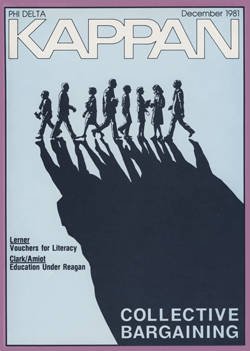
The December 1981 Kappan focused on union efforts at collective bargaining, and the picture painted by Myron Lieberman (“Teacher bargaining: An autopsy”) was grim. Lieberman suggested that the kind of advocacy that unions were required to do may in fact contradict democratic principles. As public employees, teachers were beholden to public opinion, but because unions negotiated to protect the interests of “idiosyncratic” teachers (including “slobs, homosexuals, or marginal performers,” p. 233) who may not even represent the mainstream of the profession, they risked losing the support of the public.
In the same issue, however, Albert Shanker (“After 20 years, Lieberman’s vision is failing”) of the American Federation of Teachers (AFT) contested Lieberman’s view that collective bargaining actually lessened public support of teachers. And Richard Wynn (“The relationship of collective bargaining and teacher salaries, 1960 to 1980”) shared his own research that showed collective bargaining didn’t seem to have much of an effect on teacher salaries.
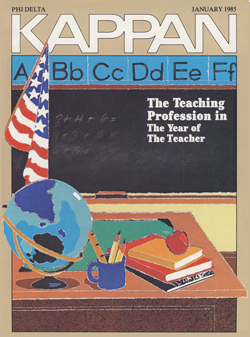
In January 1985, as part of a special issue on “The teaching profession in The Year of the Teacher,” Chester Finn (“Teacher unions and school quality: Potential allies or inevitable foes?”) looked at how and why unions were taking an interest not just in teachers’ working conditions, but also in school quality:
Because working conditions, prosperity, and the status of a profession are inextricably linked to the quality of the work that its members perform, teacher unions have generally displayed some interest in the scope, reputation, and efficacy of public education. However, displaying such interest is easier than wielding direct influence over educational practice.
Like other public employees — but unlike most professionals — teachers do not set the essential policies or make the key decisions affecting the organizations in which they work. Public schools are government agencies, and teachers are civil servants, organizationally subordinate to other civil servants and to elected and appointed policy makers. Thus teacher unions have found it advantageous to attend to more than the traditional union triumvirate of “wages, hours, and working conditions” — if only because the perceived quality of public education bears heavily on the willingness of the public to invest in it and to trust the judgment of the professionals working in it. (p. 332)
In his article, Finn drew a contrast between the AFT and the National Education Association (NEA). Under Shanker, Finn said, the AFT appeared more open than the NEA to ideas suggested by the “excellence movement,” which sought to improve schools by improving teacher quality through merit pay, career ladders, and similar reforms.
Mary Hatwood Futrell (“Chester Finn and quality education”) of the NEA took issue with some of Finn’s assertions and stated that:
As teachers, we want U.S. schools to be as strong as they can be. Teachers welcome change, but they also want a say in the change process. Most state political and education officials recognize this fact. They understand that teachers — the men and women on education’s front lines — are brimming with ideas for improving education, and they’re eager to work with teachers in pursuit of that aim. (p. 339)
Also in that issue, Lieberman (“Teacher unions and educational quality: Folklore by Finn”) took Finn to task for “avoid[ing] negative conclusions about the role of teacher unions by failing to raise hard questions and by according as much weight to unrealistic speculation favorable to unions as he accords to hard data that are unfavorable” (p. 341). Citing their declining membership numbers and reliance on membership requirements, Lieberman questioned how much influence unions were likely to have in the future. He also echoed his concern from the 1981 article that the collective bargaining work of unions was undemocratic, stating his view that, “Unfortunately, what’s good for teachers isn’t necessarily what’s good for the country” (p. 343).
More than 20 years later, Richard Kahlenberg reflected on the work of teacher unions and, specifically, Shanker, in an article (“Albert Shanker and the future of teacher unions,” June 2008) that drew on his work on Tough Liberal, a biography of Shanker published in 2007. He urged unions to bear in mind some of Shanker’s key principles, such as:
the need to look for reasonable compromises that recognize the legitimate arguments of opponents. Rather than oppose all forms of merit pay and tenure reform, for example, Shanker acknowledged that some teachers are better than others. He backed “peer review” to fire bad teachers and the National Board to reward excellent ones. (p. 720)
Defining teacher quality
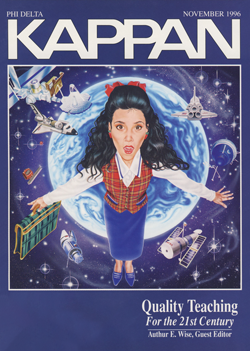
In his own November 1996 article (“Quality assurance: What must be done to strengthen the teaching profession”), Shanker stated that:
If teaching is to become a true profession, we must establish high standards for entry into teacher training programs and deliver high-quality preservice education to prospective practitioners. We must set and maintain high and rigorous standards for entry into the profession and evaluate practitioners according to those standards. We must provide support for weak teachers and, when necessary, counsel poor teachers out of the profession. (p. 220)
However, this agenda is complicated by how difficult it is to define teacher quality and predict who will succeed in the classroom. For example, in “The distribution of academic ability in the teaching force: Policy implications” (September 1982), Victor Vance and Phillip Schlechty argued that improving the teaching profession would likely depend on recruiting and retaining teachers with stronger academic backgrounds (although they believed that research was needed to understand the connection between academic ability and teacher success). However, not everyone accepted the premise that academic ability is the most important indicator of who is best suited to the classroom, as Vance and Schlechty acknowledged:
[W]e have been challenged by critics to defend our use of measures of academic ability as a gauge of teacher quality. In addition to the usual questions about the validity of such measures, many critics have suggested that individuals who score well on measures of academic ability may not possess other characteristics that are important to teaching — empathy, patience, personal warmth, and so on. (p 22)
More recently, Bruce Torff (“Getting it wrong on threats to teacher quality,” December 2005) pointed out that a focus on content knowledge as a primary predictor of teaching talent was giving oxygen to the movement to loosen certification requirements so that college graduates could enter teaching without having acquired sufficient pedagogical knowledge. In a survey of principals, Torff and a colleague found that “the most common causes of teacher ineffectiveness cited were deficiencies in three ‘in-class’ teaching skills that are central to teachers’ interactions with students — classroom-management skills, ability to establish rapport with students, and lesson-implementation skills” (p. 304). That is, teachers’ interpersonal skills appear to matter at least as much as their academic content knowledge.
For Randy Hitz, this lack of clarity about what sort of professional knowledge is necessary to teaching was in itself a threat to teachers’ professional status. In June 2008 (“Can the teaching profession be trusted?”), he wrote that:
We are at a crossroads as a profession. Either we will become trustworthy by uniting around consensus standards for teachers, or we will give in to the forces that believe teaching is not and should not be a profession that governs itself as do other mature professions. (p. 747)
Now, almost 12 years later, we’re still at that crossroads — or perhaps we’ve passed through it and circled back. Certainly, this issue of Kappan shows that we still have questions as to what knowledge and skills are most essential to teacher quality. Are standardized test scores good predictors of effectiveness in the classroom? Do those tests focus on the right kinds of knowledge? What do teachers really need to know and be able to do to be successful members of the profession? And how can they work together to make the changes that are needed?
ABOUT THE AUTHOR

Teresa Preston
Teresa Preston is an editorial consultant and the former editor-in-chief of Phi Delta Kappan and director of publications for PDK International, Arlington, VA.
Visit their website at: https://prestoneditorial.com/