Gender-conscious teaching can help all students dismantle stereotypes and grow without the restrictions that come from bias.
In the 1990s, a number of scholarly and popular publications raised concerns about the challenges girls were facing both in and out of school. For example, in their well-known book Failing at Fairness (1994), researchers Myra and David Sadker revealed persistent biases against girls by many educators, as well as the widespread under-recognition of learning disabilities among girls and the fact that girls were performing relatively poorly on standardized tests despite having higher grades than boys. Meanwhile, Peggy Orenstein’s best-selling book Schoolgirls (1994) highlighted the extent to which girls were suffering from sexual harassment at school, and Mary Pipher’s Reviving Ophelia (1994) brought awareness to teenage girls’ high rates of depression and frequent struggles with self-doubt.
Today, some people may wonder whether we still need to be talking about how girls are doing in school. After all, we now see evidence of their success all around us. Girls are enrolling and graduating from college in record numbers (DiPrete & Buchmann, 2013). They now make up the majority of enrollments in medical schools and law schools. More and more women are succeeding as politicians, activists, business leaders, and on and on.
The idea that girls are doing just fine in school is not uncommon, nor is it new. Nearly two decades ago, scholar Christina Hoff Sommers (2000) made headlines with a passionate plea in The Atlantic for more attention to be paid to the plight of boys. It was a mistake, she argued, to direct so much attention and resources to supporting girls. Actually, she went on, in her provocatively titled book The War Against Boys (2001), it was boys who warranted far more concern. The author Peg Tyre added fuel to the fire with The Trouble with Boys (2008), touting studies that showed, for example, that boys were being disciplined and expelled from schools in much greater numbers than girls. The school environment had become feminized, she argued, and boys were being penalized for behaving in naturally masculine ways. Meanwhile, girls were earning higher grades, and their rates of college attendance were growing much faster.
One might ask, then, who has it worse in the nation’s schools, boys or girls? Which is it? If one is winning, the other group must be losing, right?
To the contrary, we argue that it makes little sense to pit one population against the other, as though boys and girls were locked in a competition to determine who is more deserving of attention and support from policy makers and educators. Is it worse to be sexually harassed at school or unfairly suspended? If greater number of girls than boys go to college every year, does that mean we’re in the midst of a boy crisis? Or, since women make up less than 5% of Fortune 500 CEOs, should the girl crisis get top billing? We reject such questions. Educational equity is not a zero-sum game.
As we turn our attention to the state of girls’ education, then, please keep in mind that we have no desire to downplay the challenges faced by boys in general, much less to deny the very acute challenges faced by boys of color in particular.
The state of girls’ education
When we look at how girls and women are faring in 2018, we see that they continue to face a number of challenges, despite their higher grade point averages (GPA’s) and lower dropout rates. For example, while girls matriculate to college in higher numbers than boys, their course-taking patterns remain highly skewed. Girls take fewer STEM courses in high school, and by the time they get to college, this tendency accelerates. In fact, although the number of women who hold undergraduate degrees is nearly equal to that of men, they only make up 30% of the degree holders in STEM fields. Additionally, women who are STEM degree holders are less likely to pursue a career in a STEM-focused occupation; the majority of those who do hold them pursue careers in education or health care with few branching out into other fields (Noonan, 2017).
Ongoing, and often invisible, instances of bias may steer girls and women out of fields they may have otherwise pursued and, ultimately, rob society of the potential contributions of those who have been unfairly kept down or pushed aside.
Much of this discrepancy may be the result of persistent bias against women and girls in the classroom and beyond. David and Myra Sadker’s research studying teacher-student interactions in coed classrooms reveals that girls often receive less attention from their teacher, hear more comments about their appearance than about their academic skills, and often receive less and lower-quality feedback than boys (Sadker & Sadker, 1994; Sadker & Zittleman, 2009). Research also shows that, beyond school, women are unfairly penalized for their gender when being evaluated by prospective employers (Moss-Racusin et al., 2012; Quadlin, 2018) and that male college students tend to overestimate the performance of their male peers while underestimating the GPA’s of female students in college courses (Grunspan et al., 2016).
These types of biases seem to affect all women, but certain groups face additional challenges and stereotyping. For example, studies find that teacher biases around gender often intersect with their biases related to race (Crenshaw, Ocen, & Nanda, 2015), socioeconomic status (Gorski, 2017), or sexual orientation (Payne & Smith, 2011). These findings remind us of the limitations of using broad statistics about how girls and boys are doing. We always should ask: Which boys? Which girls? In which schools? No one, we hope, would argue that all girls are having unqualified success in school. When we dig deeper into the data, we see that girls of color, girls with special needs, girls from lower-income families, girls who do not speak English as a first language, and many other marginalized groups tend to struggle more in schools than upper-middle-class White girls. What’s more, a recent Stanford University study (Reardon et al., 2018) reveals that in the most affluent school districts, girls continue to lag behind boys in math on standardized tests, even as math ability as a whole across the country has largely equalized across boys and girls. There are many hypotheses, but few clear answers as to why boys in the most affluent districts are continuing to achieve higher scores than their White female peers or why Latino and Black boys across the country are achieving lower scores than Latino and Black girls. What is irrefutable, however, is that gender continues to exert great influence on student academic achievement.
In response to biases against them, many girls and women internalize negative beliefs and exhibit what Claude Steele and Josh Aronson (1995) describe as stereotype threat — a self-fulfilling prophecy in which girls underperform in situations where their awareness of a negative stereotype about girls is activated (Spencer, Steele, & Quinn, 1999). Ongoing, and often invisible, instances of bias may also steer girls and women out of fields they may have otherwise pursued (including, in many cases, ones leading to more lucrative careers) and, ultimately, rob society of the potential contributions of those who have been unfairly kept down or pushed aside.
In light of the challenges girls and women continue to face, we set out to study girls’ learning in school, focusing specifically on what girls and their teachers think are the most motivating and engaging kinds of lessons and how gender is relevant to girls in the classroom. Our qualitative study drew mostly on open-ended survey responses of nearly 1,400 girls in grades 6-12 and 550 of their teachers, located in 14 girls’ schools across the country (Kuriloff, Andrus, & Jacobs, 2017). These schools were both public and independent, and the girls were 56% White, 14% Latino, 12% Black, and 4% Asian American, with smaller numbers of Asian/Pacific Islander, Middle Eastern American, Afro-Caribbean, and American Indian students. Parents’ educational achievement skewed high, with 63% of students reporting that a parent had a graduate or professional degree and another 26.5% reporting a parent with a college degree.
Interestingly, when we compared our findings with those from a similar study of boys (Reichert & Hawley, 2010a, 2010b), we discovered that, in general, the students and their teachers all tended to describe the same types of lessons. Both girls and boys find active learning engaging and are motivated by hands-on lessons, group projects, class discussions and debate, opportunities for performance, chances to be creative, and large-scale multimodal projects. They are most likely to be fully engaged by caring teachers who set high standards and provide ample ways to meet them. These findings are in accord with a large body of literature showing that girls and boys do not have appreciably different brains or categorically different ways of learning (e.g., Eliot, 2010; Hyde, 2005).
Gender consciousness
The fact that girls and boys tend to find the same types of lessons motivating, engaging, and effective does not mean that gender is irrelevant in the classroom. Gender plays a role in how students think of themselves, how they view history, and how they choose partners for projects. It affects their relationships, permeates their social lives, and looms over their expectations about careers and college. To teach in a way that allows girls and, indeed, all students to be fully engaged and empowered in the classroom, teachers must provide a learning environment that eliminates gender bias, dismantles stereotypes, and removes barriers to students’ involvement in what have historically been viewed as gendered academic subjects and occupations. We have found that adopting a position of active gender consciousness helps teachers do this.
Incorporating gender consciousness is possible in every classroom, though it will look different depending on the grade level and subject matter taught as well as the gender composition of the class. Teachers can begin simply by acknowledging that gender is a crucial identity that affects students’ lives, but that should not limit their participation in the classroom or the possibilities for their futures. They must also acknowledge that stereotyping and harassment exist and that it is critical to challenge their existence by bringing them out in the open and addressing them. Offering opportunities to all students without making assumptions about what their abilities or interests are is one important way to address common stereotypes. For example, in a physics classroom with a lab component, teachers can assign student groups and require that students rotate through different roles (e.g., note taker, supply organizer, construction lead, and calculations lead). The same rotation practice may be applied when students are doing history projects, or enacting plays in English. By providing the opportunity for each student to participate in a different role, the teacher can help ensure that students, both boys and girls, who are quieter, less confident of their abilities in the subject, less socially engaged with their peers, or otherwise typically marginalized in group work have chances to participate.
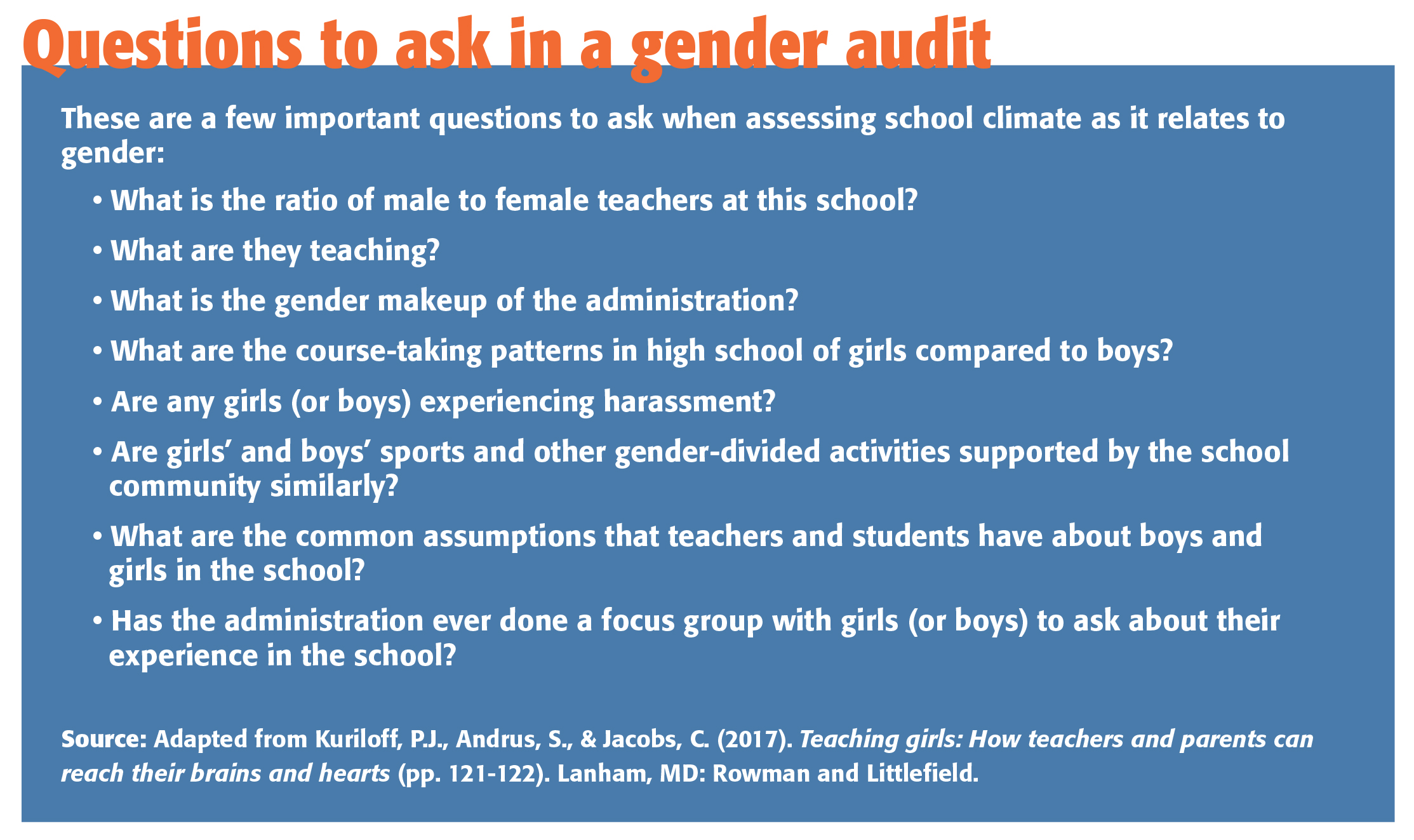
When adopting a stance of gender consciousness, a gender audit can help teachers and other school leaders evaluate the state of affairs for all students. Teachers and administrators should consider periodically using surveys, focus groups, and data analysis to evaluate student attitudes, participation patterns, and feelings of acceptance, among other indicators (see “Questions to ask in a gender audit”). If schools find gendered patterns of exclusion or harassment, they may wish to conduct more intensive school climate assessments focused on gendered experiences and interactions or create a task force to examine patterns of bias and harassment and identify ways to disrupt them. For example, if girls tend to be silenced during classroom discussion, teachers may be able to disrupt this pattern by setting up classroom activities in a different way, pausing to allow many students to raise their hands (as opposed to responding to the first student to volunteer), rearranging desks, or using interactive technology that allows students to ask and answer questions anonymously.
Because students value relevance in what they are studying, it is important to closely examine curriculum content to ensure that it can be made relevant to all students. Girls in our study described how meaningful and engaging it was to learn about real-world connections between the lesson content and their own lives. They valued opportunities to have choice in what and how they studied and were drawn in by lessons that asked them to incorporate their own backgrounds, families, or interests. They wanted to learn about how girls and women are situated in the world and how that affects them personally. The power of incorporating these kinds of relevant topics can be palpable. What stood out for us in our study was the way that the girls’ personal gender identity was such a strong force in motivating their classroom engagement and success.
While teachers need not ask students to reflect on their gender identity every day, there will be frequent opportunities for teachers to help students think about how their genders have shaped their lives or what their lives as girls (or boys or students with non-binary identities) may have been like had they lived in a different time or place. In addition, there are many occasions when teachers can make direct references to the contributions of people of different genders and the relevance of gender to the content. Teachers can also continuously reflect on gendered patterns of participation in the classroom to determine whether any students are being silenced or excluded. These strategies serve the larger goal of creating an inclusive, unbiased, and supportive classroom that upends stereotypes. Again, though, it is important, while engaging in these practices, always to remember that students have multiple social identities. Racial, ethnic, and social backgrounds interact with an individual’s gender, and all these identities should be recognized and respected.
Teachers can promote relevance both in the material they select (e.g., works of literature by authors from a large variety of backgrounds, information on scientific achievements of individuals who aren’t all White men) and also by allowing their students to meaningfully integrate their own experiences. Two good ways to accomplish this are by allowing students choice in projects and topics of study and providing opportunities for students to reflect on identity and meaning both in writing and in classroom discussions. We found dozens of examples of these types of lessons or projects in our studies. Girls wrote about learning about the legislative process by designing a bill to address a concern they had about their community and then taking a field trip to their state house. They debated sensitive and complex ethical and moral debates related to current events around the globe. Girls described learning activities that required them to interview family members, creatively teach information to their classmates, and conduct science experiments on products found in their homes. All of these examples reveal ways that teachers can connect students to the material they are learning, as well as to the world outside of the school walls.
Creating a gender-conscious school and classroom is not a onetime event, but rather a teaching philosophy that permeates classrooms and school communities. By promoting an active gender consciousness, teachers can create an environment that consistently acknowledges the power of gender in our lives and allows students to discover how their gender identity affects them and their learning. A spirit of gender consciousness helps teachers and students recognize and dismantle internal and external stereotypes and biases, acknowledges that there are innumerable ways to “do gender,” and allows students to learn and grow without restriction. Our hope is that all schools will encourage students of all genders to follow their own pursuits, permit their curiosity to develop, and grow wherever it takes them.
References
Crenshaw, K.W., Ocen, P., & Nanda, J. (2015). Black girls matter: Pushed out, overpoliced and underprotected. New York: African American Policy Forum (AAPF) & Center for Intersectionality and Social Policy Studies.
DiPrete, T.A. & Buchmann, C. (2013). The rise of women: The growing gender gap in education and what it means for American schools. New York, NY: Russell Sage Foundation.
Eliot, L. (2010). Pink brain, blue brain. London, UK: Oneworld Publications.
Gorski, P.C. (2017). Reaching and teaching students in poverty: Strategies for erasing the opportunity gap. New York, NY: Teachers College Press.
Grunspan, D.Z., Eddy, S.L., Brownell, S.E., Wiggins, B.L., Crowe, A.J., & Goodreau, S.M. (2016). Males under-estimate academic performance of their female peers in undergraduate biology classrooms. PLoS One, 11 (2), e0148405.
Hyde, J.S. (2005). The gender similarities hypothesis. American Psychologist, 60 (6), 581-592.
Kuriloff, P.K., Andrus, S.H., & Jacobs, C.E. (2017). Teaching girls: How teachers and parents can reach their brains and hearts. Lanham, MD: Rowman & Littlefield.
Moss-Racusin, C.A., Dovidio, J.F., Brescoll, V.L., Graham, M.J., & Handelsman, J. (2012). Science faculty’s subtle gender biases favor male students. Proceedings of the National Academy of Sciences, 109 (41), 16474-16479.
Noonan, R. (2017). Women in STEM: 2017 update. ESA Issue Brief #06-17. Washington, DC: U.S. Department of Commerce, Economics and Statistics Administration.
Orenstein, P. (1994). Schoolgirls: Young women, self-esteem, and the confidence gap. New York, NY: Anchor.
Payne, E.C. & Smith, M. (2011). The reduction of stigma in schools: A new professional development model for empowering educators to support LGBTQ students. Journal of LGBT Youth, 8 (2), 174-200.
Pipher, M. (1994). Reviving Ophelia. New York, NY: Penguin.
Quadlin, N. (2018). The mark of a woman’s record: Gender and academic performance in hiring. American Sociological Review, 83 (2), 331-360.
Reardon, S.F., Kalogrides, D., Fahle, E.M., Podolsky, A., & Zárate, R.C. (2018). The relationship between test item format and gender achievement gaps on math and ELA tests in fourth and eighth grades. Educational Researcher, 45 (5), 284-294.
Reichert, M. & Hawley, R. (2010a). Reaching boys: An international study of effective teaching practices. Phi Delta Kappan, 91 (4), 35-40.
Reichert, M. & Hawley, R. (2010b). Reaching boys, teaching boys: Strategies that work—and why. San Francisco, CA: John Wiley and Sons.
Sadker, M. & Sadker, D. (1994). Failing at fairness: How our schools cheat girls. New York, NY: Touchstone.
Sadker, D. & Zittleman, K.R. (2009). Still failing at fairness: How gender bias cheats girls and boys in school and what we can do about it. New York, NY: Simon and Schuster.
Sommers, C.H. (2000, May). The war against boys. The Atlantic.
Sommers, C.H. (2001). The war against boys: How misguided feminism is harming our young men. New York, NY: Simon and Schuster.
Spencer, S.J., Steele, C.M., & Quinn, D.M. (1999). Stereotype threat and women’s math performance. Journal of experimental social psychology, 35 (1), 4-28.
Steele, C.M. & Aronson, J. (1995). Stereotype threat and the intellectual test performance of African Americans. Journal of personality and social psychology, 69 (5), 797.
Tyre, P. (2008). The trouble with boys: A surprising report card on our sons, their problems at school, and what parents and educators must do. New York, NY: Random House.
Citation: Andrus, S., Jacobs, C., & Kuriloff, P. (2018). Miles to go: The continuing quest for gender equity in the classroom. Phi Delta Kappan, 100 (2), 46-50.
ABOUT THE AUTHORS

Shannon Andrus
SHANNON ANDRUS is a researcher, speaker, and consultant for Teaching Girls Well Consulting . She is a coauthor of Teaching Girls: How Teachers and Parents Can Reach Their Brains and Hearts .
Charlotte E. Jacobs
CHARLOTTE JACOBS is the associate director of the Independent School Teaching Residency Program. She is a coauthor of Teaching Girls: How Teachers and Parents Can Reach Their Brains and Hearts .
Peter Kuriloff
PETER KURILOFF is a professor at the University of Pennsylvania Graduate School of Education. He is a coauthor of Teaching Girls: How Teachers and Parents Can Reach Their Brains and Hearts .