
For teacher activist groups, the professional is political and the political is professional.
Ever since the 1990s — when the accountability movement entered into a loose coalition with the movement for school choice and market-driven reform — U.S. teachers have been all but shut out of federal, state, and local educational decision making. Increasingly, their expertise has been questioned and their voices dismissed. They’ve been scapegoated by reformers, put under surveillance in the classroom, and told to follow scripted lessons (Kumashiro, 2012). And in the meantime, as the influence of testing company lobbyists, billionaire philanthropists, and for-profit providers has grown, the strength of the unions (historically teachers’ most powerful advocates) has declined.
Teachers in the U.S. never have enjoyed truly professional status, but rarely have they been excluded so deliberately from important decisions about policy and practice. As a result, reformers’ plans have often been in direct opposition to what teachers know about quality education. It is no surprise, then, that the reforms of the last few decades have failed to deliver what they promised.
This state of affairs has not gone uncontested, however. In many parts of the country, groups of teacher activists — often in collaboration with parents, students, and community members — have organized themselves into a sort of countermovement, dedicated to challenging policies and practices that hurt their students, impede their teaching, and undermine their profession (Picower, 2012).
Who are these activist teachers and what do they stand for? How do they organize? And to what extent have they been able to influence public debates about school reform? These questions guided my recent research into the landscape of teacher activism in the United States. In late summer through early winter 2017, I conducted a qualitative content analysis of teacher activist group mission statements, vision statements, self-descriptions, news and updates, recent actions, and other information available through their websites and social media accounts. Since fall 2017, I have been conducting an in-depth review of the scholarly literature on teacher activist groups. What I found can help inform advocacy by and for teachers at a time when the balance of power in educational policy making appears to be shifting toward local control.
What are teacher activist groups?
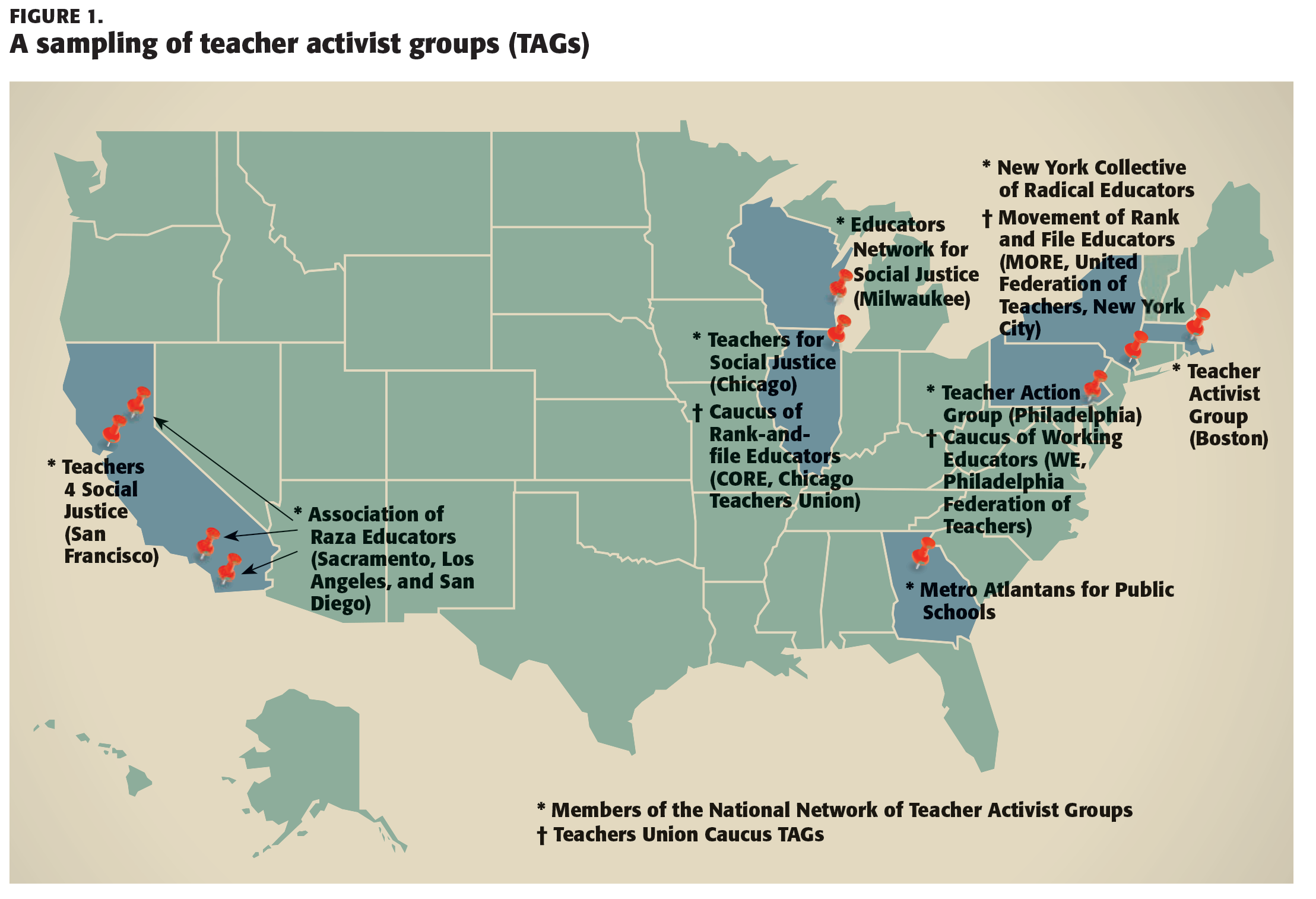
Teacher activist groups (TAGs) are not new, but they have proliferated over the last 25 years. Although several prominent groups — such as Teachers 4 Social Justice (San Francisco) and the Association of Raza Educators (Sacramento, Los Angeles, and San Diego) — formed in the 1990s and are still active today, many more have formed since the turn of the 21st century. The majority are located in large cities, and they include teachers and their allies who meet semi-regularly to engage in joint inquiry into questions of pedagogy and policy, knowledge and resource sharing through conferences and curriculum fairs, and organizing to advocate for their students and schools.
Various TAGs, including the New York Collective of Radical Educators, Teacher Action Group (Philadelphia), Teachers for Social Justice (Chicago), and several others, are organized locally but linked by a nationwide coalition called the National Network of Teacher Activist Groups (see Figure 1). These TAGs tend to be intergenerational and diverse in terms of race, ethnicity, gender, and sexual orientation. Depending on the group, many or most participating teachers work in urban schools. Most groups are primarily made up of teachers, but some also include social workers, counselors, and other school personnel. TAGs tend toward collaborative leadership among one or two dozen highly active members, but many more individuals, often numbering in the hundreds, participate in TAG activities like conferences, inquiry groups, and collective actions. TAG activity waxes and wanes through both annual planned activities (study groups, conferences, etc.) and more spontaneous collective responses to issues of concern.
Another type of TAG links educators across the country, primarily through social media, to share information and organize to contest policies threatening their schools, students, and profession. The Badass Teachers Association, for example, is a national network that formed in direct response to what members see as deeply misguided policies and anti-teacher underpinnings of the prevailing education reform movement (Naison, 2014). The group has more than 37,000 followers on Twitter (@BadassTeachersA) and more than 45,000 on Facebook.
Although the TAGs I explored are highly supportive of teachers unions, many of them formed independently of organized labor, and their members often want more engaged and active participation in contests over educational issues than their unions can offer them. They tend to see TAGs and unions as playing different and complementary roles.
However, a small number of teacher activist collectives, notably the Caucus of Rank-and-file Educators (CORE) in Chicago and the Caucus of Working Educators (WE) in Philadelphia, developed within and through their unions. In addition to engaging in inquiry and organizing, teachers in these groups seek to reform their unions in the direction of greater social movement unionism, which is a more democratic, mobilized, and activist approach than their unions have pursued in recent years (Weiner, 2012).
What do teacher activist groups want?
TAGs have varying histories, structures, local contexts, and approaches to their work, but they share a desire to challenge what they see as an ill-conceived, corporate-minded approach to education reform. Everything from high-stakes assessments of students and teachers, to school closings and takeovers, to harsh student disciplinary policies has been a target of TAG consciousness-raising, organizing, and action (Picower, 2012).
Part and parcel of this resistance is a call for greater teacher voice in policy making at local, state, and federal levels, drawing upon practitioners’ wealth of knowledge about what is needed for excellent and more equitable education. Yet, most TAGs have also reached out beyond the teaching profession, advocating more broadly for democratic governance of schools. For example, most TAGs build alliances with parent groups, youth groups, and community organizers to work toward specific goals, such as establishing democratically elected governance of school districts or ending military recruitment in local high schools.
Another widespread goal of TAGs is the development of school practices that value diversity and promote equity and justice. The majority of these groups are explicitly anti-racist, anti-sexist, anti-heterosexist, and anti-xenophobic. They advocate for high-quality educational practice that draws from students’ lives and invites them to raise questions about the world around them. Different groups use different terms — including culturally relevant pedagogy, critical pedagogy, and progressive education — but all appear to be calling for rich curriculum and challenging pedagogy that engage youth actively and meaningfully in learning in a way that empowers and liberates them.
What do teacher activist groups do?
Like other social movement organizations, TAGs organize, attempt to raise consciousness about issues of concern, and engage in collective actions, including rallies, protests, lawsuits, letter-writing campaigns, speaking at public meetings and on talk radio, and so forth. These actions are intended to inform and influence state and federal legislators, local decision makers (such as school boards), and administrators and teachers. To promote specific goals related to educational and social justice, TAGs often act in coalition with other organizations and organizers, allies in government and higher education, parents and community members, and student groups.
In addition to organizing, TAG members also generate and share knowledge to improve their professional practice. By sponsoring conferences, workshops, guest speakers, study groups, book clubs, curriculum fairs, and the like, many TAGs provide opportunities for teacher activists to develop and share approaches to classroom practice within broader conversations about educational justice. A recent conference sponsored by the New York Collective of Radical Educators, for example, engaged well over 1,000 participants in a keynote presentation on the criminalization of Black girls in schools, youth open-mic poetry, community-building events, and dozens of workshops on wide-ranging topics linked to the TAG’s mission. In addition, some TAGs develop and share free resource guides on topics explored within the group.
Many TAGs also organize Inquiry to Action Groups (ItAGs) to conduct shared inquiry on topics relevant to the TAG mission and then take action based on their findings. Recent ItAG topics of several TAGs have included Islamophobia and religious diversity, anti-LGBTQ bullying, environmental justice, African diaspora cultural arts, and support of undocumented students, among many others. Shared inquiry through ItAGs and related inquiry groups is among the most consistent ways in which TAG members work together to generate knowledge and mobilize for action.
When teachers inclined to advocacy and activism do not have a local TAG, social media provides opportunities for them to communicate with like-minded educators.
For TAGs with geographically dispersed members, this sort of shared inquiry is not usually possible. Yet social media platforms like Facebook and Twitter serve as forums to raise awareness of proposed education legislation, calls to action around urgent issues, political candidacies to watch, new educational research or books of interest, and other relevant education news. In addition to fostering information sharing, these social media networks also organize actions. For example, the Badass Teachers Association recently facilitated donations to the West Virginia teachers strike fund and anti-gun violence letters to representatives directly through their social media. When teachers inclined to advocacy and activism do not have a local TAG, social media provides opportunities for them to communicate with like-minded educators about their shared interests and commitments.
Is TAG activism professional or political?
Early in my exploration of TAGs, I was struck by teacher activists’ dual focus — that their activities are directed at both the classroom and the statehouse and that their goals are both professional and political.
On one hand, teacher activists bring professional knowledge to bear on their advocacy for better learning environments for their students. Arguing that quality education for their students means much more than what can be measured by standardized tests, many advocate holistic approaches to education that emphasize inquiry, engagement, critical thinking, and creativity. Several of these groups have called for more developmentally appropriate practice, more resources for students with disabilities, an end to high-cost and low-value mandated assessments, and so forth. In multiple venues, they resist and speak out against the myriad policies and practices that impede what they view as high-quality education. This fight is professional.
On the other hand, teacher activists also challenge institutional racism, sexism, heterosexism, and xenophobia as it touches schools and students. They advocate for immigrant youth, both documented and undocumented. They protest educational policies that disproportionally disadvantage youth in poverty. And they frequently join forces with other movements for progressive causes that matter to their communities. In the last few months, for example, a number of TAGs have participated in the Week of Action for Black Lives, advocacy for those affected by the Deferred Action for Childhood Arrivals (DACA) program, and the growing anti-gun violence movement. This fight is political.
As I learned more about TAGs, I soon realized that most teacher activists see the separation of the professional and political as a false dichotomy. For many TAG members, the professional is political and the political is professional. They are indistinguishable. Justice is required for educational excellence. Excellence is required for justice.
Although policy makers argue that they, too, are committed to equity and excellence and that these ideas have been guiding policy since No Child Left Behind, TAGs conceptualize these terms and their implications differently from most high-profile reformers. Among innumerable differences is their view that teachers are not technicians whose job is to implement policy but are professionals whose influence must transcend the classroom and shape the institution and the field.
Are teacher activist groups having an impact?
A growing body of research has examined contemporary teacher activism, but it hasn’t yet provided evidence that TAGs and other activists are having widespread influence beyond the classroom. Some, in fact, would argue that TAGs have played a limited role so far, especially when stacked up against the major reform movements of the last quarter-century.
Beyond the chilly climate for teacher voice in general, TAGs’ influence may be limited for other reasons, too. While TAGs appear to be growing, teacher activists represent only a small fraction of U.S. teachers (Picower, 2012). For every one or two dozen leaders and highly active members of a TAG, there may be hundreds who participate in TAG activities and actions. This number is multiplied again when we look at social media followers: Some geographically based groups have several thousand followers, and some national groups have tens of thousands. Yet these numbers represent only a tiny proportion of the 3.2 million teachers nationwide.
The most active TAGs are located in major cities that, relative to the rest of the country, have strong histories of organizing for progressive causes.
Participation in TAGs is also restricted by geography. The most active TAGs are located in major cities that, relative to the rest of the country, have strong histories of organizing for progressive causes. Although social media is making it easier for teachers outside large cities to participate in TAGs — the Badass Teachers Association, for example, boasts a group for every state in the country — geographical limits mean that many teachers cannot actively participate in regular in-person meetings and events. Finally, perhaps more than anything else, the progressive politics of TAGs not only limits their geographical reach but also may serve to limit their numbers generally (Quinn & Carl, 2015).
These concerns noted, the climate for teacher advocacy and engagement may be warming. Teacher activists have joined with other movements and activist organizations to score important victories. For instance, the opt-out movement has seen educators, parents, and youth organize in significant numbers to oppose standardized testing in ways that have been difficult for policy makers and legislators to ignore. When an unprecedented 20-21% of students opted out of standardized tests in New York in 2015 and 2016, state leadership and policy changes (albeit limited ones) soon followed (Wang, 2017).
To be sure, it is at the local level that we can find the most direct evidence of TAG power. For example, a coalition of community groups recently wrested control of the School District of Philadelphia from the state some 16 years after its takeover, and the district will soon be led by a local school board. In New York, teacher activists working in coalition with students and parents have brought restorative justice programs into schools. In Milwaukee, Wis., the Educators Network for Social Justice created a task force of teachers, parents, and community members that successfully convinced the school district to withdraw a major textbook contract. And in California, the Association of Raza Educators won the fight for ethnic studies requirements in multiple school districts.
These kinds of gains are important, but the influence of TAGs should not be seen as limited to policy and structural change. Although the day-to-day work of teacher activists with their students, colleagues, and communities may be impossible to measure, what they bring to their classrooms and schools through their inquiry activities, activism and commitments cannot be underestimated. The knowledge that results from TAG-led professional development, working in coalitions, and organizing for change profoundly informs teaching, mentoring, and leadership in schools, communities, and other professional contexts.
The extent to which public opinion and school reform movements begin to reflect the understandings and goals that guide TAGs remains to be seen. As with any other social movement, TAGs will need to continue to grow their members and alliances, and successfully frame and promote their vision for multiple constituencies. With tides beginning to shift in the education policy arena, the time may be right for this work.
A voice for the future?
Many have pointed to ESSA as evidence that the decades-long era of strong federal influence over schooling is coming to an end. In the next few years, many communities will be engaging in deliberations and debates about the future of their schools with a wider range of voices than in recent years. In some of these communities, teachers (and teacher activists) will have a seat at the table.
My research has convinced me that teacher activists should not only have a seat at the table but also be among the leaders of the next era of American public schooling. The professional knowledge developed through TAGs has several advantages over other sources of knowledge for school reform. As classroom teachers, teacher activists have experiential and professional knowledge about how the policies of recent years have affected their students and their own ability to teach. In addition, many teacher activists have gained knowledge by engaging in inquiry to solve problems and address significant issues.
These teachers also understand that excellence in education cannot be accomplished through technical changes at the school or classroom level. Because poverty, institutional racism, and other forms of injustice fundamentally affect the lives of students and the functioning of schools, improving schooling requires improving society. Participation in activism both inside and outside schools provides teacher activists with a unique and valuable perspective on creating social change.
Beyond their professional knowledge, teacher activists demonstrate the commitments to youth, communities, and public education that we want to see among our future education leaders. Adding organizing and action to their already busy and stressful full-time work suggests a level of dedication that belies the notion, sometimes implicit in reformers’ arguments, that teachers don’t care about the education of their students. Indeed, teacher activists not only model care and commitment, they also model community responsiveness — an understanding that strong schools are built with rather than in spite of their students’ communities. This democratic ethos, which has been sorely missing in the era of market-driven reform, promises a more encouraging path forward.
Like many social movements of the present and the past, TAGs are organizing to demand that the U.S. lives up to its expressed commitment to democracy and that public education once again be understood as central to this goal.
References
Kumashiro, K.K. (2012). Bad teacher! How blaming teachers distorts the bigger picture. New York, NY: Teachers College Press.
Naison, M. (2014). Badass teachers unite! Writing on education, history, and youth activism. Chicago, IL: Haymarket Books
Picower, B. (2012). Practice what you teach: Social justice education in the classroom and the streets. New York, NY: Routledge.
Quinn, R. & Carl, N.M. (2015). Teacher activist organizations and the development of professional agency. Teachers and Teaching, 21 (6), 745–758.
Wang, Y. (2017). The social networks and paradoxes of the opt-out movement amid the Common Core State Standards implementation: The case of New York. Education Policy Analysis Archives, 25 (34), 1–27.
Weiner, L. (2012). The future of our schools: Teachers unions and social justice. Chicago, IL: Haymarket Books.
Citation: Niesz, T. (2018). Teacher activist groups: What are their missions? How influential are they? Phi Delta Kappan 99 (8), 25-29.
ABOUT THE AUTHOR

Tricia Niesz
TRICIA NIESZ is an associate professor in the School of Foundations, Leadership, and Administration at Kent State University in Kent, Ohio.