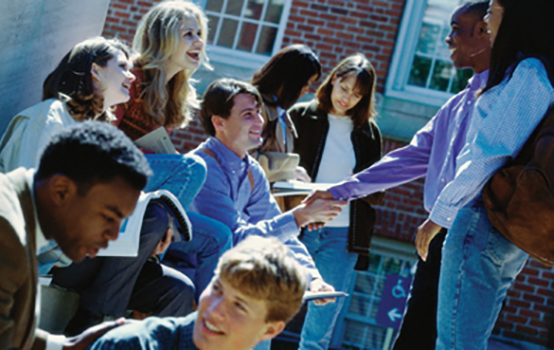
Philadelphia’s G.W. Carver High School of Engineering and Science has created an environment that mirrors the culture and expectations of college.
“This year, our schoolwide focus is to transform our school into a college prep school,” my principal stated to open our first faculty meeting of the 2008-09 school year. I was entering my fourth year of teaching, my second year at this small urban charter high school. She continued: “Our expectation will continue to be that every student attends college after graduation, and we must do more to prepare them.” She discussed her belief in the ability of our students to achieve and the skill of our faculty to enhance our culture of learning. Her tone was not to admonish us for our past efforts but instead to provide a clearer beacon for our future work. I was inspired by her message.
But as details unfolded about her plans, my optimism quickly faded. The administration’s first move was to implement a schoolwide uniform policy that required students to wear collared shirts. How, I asked, would this further the school’s mission to prepare these young people for college? The policy would ensure that they “dress like college students,” I was told.
“Some of the students at my college wore pajama pants every day,” I replied. The administration did not appreciate my input.
When teachers asked how our new mission would shape our academic program, the administration gave few details. Thinking back once again to my own college experience, I asked, “Can I give out a syllabus, lay out all of the assignments, and tell my 12th-grade students that attendance will not factor into their grade as long as they pass the assignments — just like in a ‘real’ college class?” My question was dismissed. During class time, I was told, I was legally responsible for the whereabouts of my students.
Our strategy is to provide a high school education that feels very much like higher education.
Eventually it dawned on me that we had very different ideas about what it means to prepare students to succeed in higher education. My administrators wanted to make high school more rigorous, so that students would be ready to make the leap to college; I wanted to make high school more like college, so that students wouldn’t have to make a leap at all.
When high school feels like college
For the past four years, I have been the principal of George Washington Carver High School of Engineering and Science (Carver E&S), a magnet school in Philadelphia with a specialization in STEM disciplines. From its inception 37 years ago, the school’s mission has revolved around college matriculation for its students. But as I tell prospective families, “We are not a college prep school; we are a college success school. Anyone can prepare students to go to college. We will make sure that your child belongs there.” Parents always nod their heads and smile, but this promise is hollow without programs to back it up.
While Carver E&S is a special admissions school with criteria for enrollment, our demographics reflect the rich diversity of Philadelphia. Our 900 students come from 42 different ZIP codes, and 67% of our students aim to become first-generation college graduates. Like many urban schools, we operate with limited resources. In addition to recent reductions in faculty, administration, and support staff, our counseling office has also suffered. We have two full-time counselors to serve the social-emotional needs of our student body, while also leading the college process for all of our seniors. Nonetheless, each year, 100% of our graduates are accepted to a two- or four-year program, with 90% choosing to attend.
Nationally, the most recent data from the National Clearinghouse on college completion reveal that just over half (54%) of students beginning postsecondary education in 2010 completed a degree program in six years. And for African-American males — the largest demographic group in my school, comprising nearly 45% of our student body — the six-year college completion rate is only 35% (Shapiro et al., 2017). For us, these statistics really hit home, heightening the urgency of our efforts to ensure that all of our students become truly college-ready.
Our strategy is to provide a high school education that feels very much like higher education, so that by the time they graduate and enroll in college, our students will have already become familiar with — and will have already succeeded at navigating — the sorts of demands, norms, and expectations that they’ll face on a typical campus.
In redesigning our program over the past four years, we have decided to emulate three aspects of the college experience in particular. First, we emphasize student choice, creating a culture where students take the lead in course selection. Second, we focus on equity, ensuring that all of our students have opportunities to take courses and participate in activities that meet their needs and interests. Third, we pay close attention to the pace of our school. It is no secret that high school students — especially our highest achievers — are stretched too thin, often with negative consequences. We try to reinforce the importance of slowing down and taking the time to dig deeply into issues, as one might be asked to do in college.
Collectively, these three focal areas complement one another and provide the framework for us to organize all aspects of our school in a cohesive fashion.
In past years, before we redesigned our program, our students would be provided with “one-pagers” that highlighted the courses they could take at each grade level. Instead of having a chance to plan a comprehensive sequence of classes, they could only make their selections for the given year. Further, some students would find that they had been placed into AP classes, while others were placed into “seminars” (remedial classes, in effect). It was a fragmented and opaque system that made it hard for students to define a multiyear course of study, offered them few meaningful electives, and forced them to make quick decisions with little academic advising.
We decided to revamp the process by emphasizing choice, putting students in the position to make informed course selections, based on consideration of their own passions, skills, interests, and career goals. We expanded our AP offerings, too — my first year at the school, we offered six; now we offer 15, including at least one in every core content area. Also, to help students plan their course choices over their four years, we provide them with much clearer information about prerequisites — for instance, if students are interested in psychology, then they are encouraged to take Intro to Psychology in 10th grade and AP Psychology in 11th grade, perhaps supplementing the course with AP Statistics in 11th or 12th grade. In short, we’ve redesigned the course selection process along the lines of what students will encounter in college, where they must take 200-level courses before 300-level courses and round out their majors with related courses from other departments.
To ensure that students are making truly informed choices, we developed a robust course selection book, prepared by our department chairs, that includes class descriptions and recommended course sequences. We also reorganized course pathways for specific focus areas (e.g., biomed, engineering, or computer science), so students can see the larger scope based on their interest. To share this information, we hold grade level assemblies, special presentations for different classes, and extended office hours for academic advising. Finally, to ensure that parents and guardians are included in the process, we schedule a special evening meeting to explain the options.
So far, our efforts to promote greater student choice have paid off. According to our latest school survey, 97% of our students report that “my teachers have high expectations for me in school.” The number of students enrolled in AP courses has doubled, our AP scores are improving, and while our passing rate has grown only incrementally, the number of students receiving a 1 on an AP test (the lowest score on a scale of 1-5) has dropped by more than 40% over the past three years.
In short, since redesigning our selection process with an emphasis on student choice, we’ve found that more students are taking rigorous course sequences, and they’re learning to select courses with a larger goal in mind, just as they will be expected to do in college.
A critical moment in our school redesign process occurred during a routine college information session, when a visiting representative from West Point offered his definition of leadership: “Leaders are not involved in eight to 10 clubs with minimal roles. Leaders engage in two to three clubs over time with proven impact in those clubs.” The comment struck a chord with us, prompting a review of our extracurricular offerings. Just as we found when we looked closely at our academic program, we saw that our electives were scattered and thin. They did little to tap into our students’ interests, access was unequal, and our top academic students were taking most of the leadership opportunities.
We decided not to water down our current offerings (such as our well-established robotics and chess teams) but, rather, to create more electives and clubs in an effort to be more inclusive. Younger students took the lead, launching a Green Team to promote recycling. Students created a dance team and initiated a Quiz Bowl (and the school’s team qualified for nationals this year). The computer science teacher started a Cyber-Patriot competitive team, and a business club began raising funds to be distributed to other clubs.
The next step was to seek new external partnerships. Over the past two years, we’ve created a range of new internship opportunities at sites ranging from college labs to local community organizations to the School District of Philadelphia’s Information Technology office. We also partnered with a local nonprofit organization that builds low-income houses — they’ve offered a series of workshops for engineering students to learn about carpentry, project management, and job safety. And we connected with a local university’s filmmaking course, giving our students a chance to learn about digital editing. Already, they’ve collaborated with graduate students to create an original 10-minute documentary, titled Bound, about our school and the journey to college.
To borrow a metaphor from Michael Fullan (2014), our goal is not to create a talent pipeline; we want our school to be a talent pool (p. 36), where each and every student has opportunities to take interesting and high-level courses, develop new interests, and take on leadership roles.
Another critical moment for me occurred in a meeting with the parents of a student who had struggled through his senior year. At one point, I found myself assuring them, “Your son will do better in college where he has the opportunity to focus more on what he wants to accomplish and not have so many courses to juggle.” Suddenly it hit me: Why should he have to wait until college to slow down and focus?
In college, students generally take four or five courses a semester. Often they have breaks between classes, and some days they have no scheduled classes at all. But in traditional high schools, we race students through the day. At Carver E&S, we were shuffling them from one class to the next (with the exception of a lunch period) from 7:50 in the morning until 2:54 in the afternoon, every day, with teachers expected to teach “bell-to-bell.”
This school year, we are piloting two initiatives meant to help students slow down and focus, without taking anything away from the rigor of our academic program. First, by altering our bell schedule, we’ve introduced a study hall period, providing time for students to work on projects, do their homework, and read. Second, we’ve partnered with a local after-school program to open a writing center, where students can access additional support during lunch and after school.
These are small, initial changes, but I expect them to play an important role in helping our students become more focused and self-directed, which will serve them well in higher education. As I often tell students, if you want to be productive and successful in college, you should adopt two habits in particular: One, study every day in a quiet place without distractions for one to two hours, and two, go to the writing center or math lab and ask a tutor to go over your work carefully and patiently with you.
We had very different ideas about what it means to prepare students to succeed in higher education.
An ongoing process
The vision that we’ve embraced at Carver E&S — making high school more like college, so that the transition to college will be an easy one — continues to develop over time, and our approach will likewise evolve. I subscribe to Fullan & Quinn’s (2016) definition of success as a process to “shape and reshape good ideas as they build capacity and ownership among participants” (p. 14). As such, I am encouraged by initial signs of progress — according to their anonymous responses to a school survey, 95% of our faculty believe that a strong sense of community has been established, and 85% of our students feel a strong sense of belonging at school.
The most important data will emerge once the students who’ve benefited from our new approach graduate and move on. Will they, in fact, succeed at higher rates, both in college and beyond?
But for now, we’ll continue to look for ways to promote student agency and engagement, offering experiences that echo what they will find in a college environment — especially chances to make informed choices, take advantage of opportunities, and work at a humane pace. We know that our students are not yet fully mature. They may not know how to proceed once we invite them to step outside their comfort zones, and they don’t always have the self-control to make good use of the opportunities we give them. But when our students take on too many activities, or take on an overly ambitious schedule, it creates an authentic moment for a conversation about prioritizing what is most important. In these instances, I tell myself, “These are good problems to have.” We want our students to self-advocate. We want them to push themselves. This is what will best prepare them for college success.
References
Fullan, M. (2014). The principal: Three keys to maximizing impact. San Francisco, CA: Jossey-Bass.
Fullan, M. & Quinn, J. (2016). Coherence: The right drivers in action for schools, districts, and systems. Thousand Oaks, CA: Corwin.
Shapiro, D., Dundar, A., Huie, F., Wakhungu, P., Yuan, X., Nathan, A., & Hwang, Y. (2017). A national view of student attainment rates by race and ethnicity, fall 2010 cohort. Signature Report No. 12b. Herndon, VA: National Student Clearinghouse Research Center.
Citation: Domers, T. (2017). Creating good problems: Redesigning high school for college success. Phi Delta Kappan 99 (3), 25-29.
ABOUT THE AUTHOR

Ted Domers
TED DOMERS is the principal of G.W. Carver High School of Engineering and Science, Philadelphia, Pa.