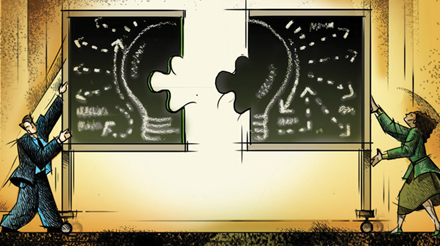
Ensuring that a teacher’s first lesson on a standard hits the right mark is essential for moving students toward mastery.
High-quality classroom instruction is paramount to student achievement. It strengthens their confidence, cuts down on the need for remediation, and increases opportunities to extend learning beyond mere proficiency. Quality instruction is what every parent hopes for his or her child, what every educator aspires to provide, and what every student needs.
In this article, we focus specifically on what constitutes high-quality initial instruction, by which we mean instruction that has been carefully planned to include research-based strategies and elements known to help students acquire new knowledge. For example, such strategies include chunking content into manageable pieces, putting students into pairs or small groups to help each other assimilate new material, providing graphic organizers to help students see patterns, and focusing lessons on key content to avoid wasting time on less important material.
Additionally, we suggest that teachers can support each other in providing effective initial instruction by engaging in collaborative conversations — within their existing professional learning communities — about how specific academic standards translate to classroom practices.
When lessons go wrong
Consider what happened in one 9th-grade algebra class that we observed recently. This particular school is high performing, as indicated by student test scores, graduation rates, and other common measures. Its teaching culture is extremely individualistic — rarely do teachers discuss their work, collaborate on lesson planning, or take concrete steps to ensure consistency in their instructional strategies, approaches to assessment, grading practices, or expectations for student performance.
The algebra teacher in question has taught for several years, she appears to have a solid grasp of her subject area, and her instruction seems to be effective for some of her students; those who pick up the material quickly tend to do well in the class. However, as we observed during her initial round of instruction on the year’s first unit of study, she struggles mightily to engage students who find mathematics difficult or who need more elaboration of critical content. Her pacing is too fast for them to keep up, and she gives them larger chunks of material than they can handle. Additionally, she teaches them new and more advanced content alongside the basic concepts that they haven’t yet mastered. Although students repeatedly make errors during class and in their homework, she forges ahead in the curriculum as planned. Though it is clear to us, as we observe the class, that her familiar strategies and resources are not working for many students, we never see her reach out to colleagues for new ideas, support, or advice.
When she has her students take their first test of the year, more than half of them fail miserably. The consequences are dramatic. Students are visibly frustrated, many of them saying that they are stressed out by the alarming pace of the class. Most tragically, some of them begin to doubt their ability to succeed in algebra or even to succeed in high school. While the teacher may have good intentions to reteach the material and offer students an opportunity to take the test again, the damage has already been done.
The teacher is frustrated as well. Frantically, she looks for new materials and activities and tries to find time to reteach and reassess over half of the class, even while continuing to introduce new content during regular class periods, to keep moving ahead with those students who passed the test. Without a small miracle, her challenges will only compound themselves throughout the rest of the course. Both she and her students will become more and more frustrated, and many of them will be left behind.
From standards to instruction
Collaboration is a nice buzzword, but it doesn’t actually play out very often in schools. For decades, researchers have found that teachers tend to work in isolation and rarely feel compelled to discuss what, how, or how well they teach (e.g., Goodlad, 1984). As Louis and colleagues put it in a major report to the Wallace Foundation, “[E]vidence also points to the continuing preference of many teachers to be ‘left alone’” (Louis et al., 2010, p. 91; DuFour & Marzano, 2011).
However, if teachers teach initial lessons without engaging in thoughtful, collaborative planning, then they can easily find themselves stuck in the downward spiral experienced in this algebra class. The best way to get instruction right the first time, we argue, is to begin by assessing new students’ current understanding of the material and to plan lessons and activities that can reach them at their various levels of proficiency. The most effective way for teachers to do this is to work in teams, joining with others who teach the same content and/or grade level to define a shared repertoire of initial instructional strategies.
Some teachers may suspect that this sort of collaboration would be a waste of valuable time, or perhaps an invasion of privacy. However, by making such efforts up front — and by taking advantage of their existing professional learning communities, which most schools already have in place — teachers can save enormous amounts of time, energy, and anguish down the road. If they are careful to plan initial instruction that can reach all of their students, then they will have to do much less reteaching and remediating later on, avoiding the struggles and frustrations that lead so many students to lose hope early on in the school year.
Perhaps the most useful place to begin is for teachers to create what we call a proficiency scale: Teams of teachers examine the curriculum standards for a given class, and they determine which content is most critical for students to learn and which chunks of that content can be taught and learned successfully in the allotted time. We’ve found that this activity provides a strong scaffold for productive, focused discussion among colleagues, while also giving them a chance to deepen their own understanding of the content and skills that they teach as well as giving them a reason to trade strategies for helping students grasp particular concepts.
To understand how this works in practice, consider how a team of 3rd-grade teachers might prepare lessons on a specific Common Core mathematics standard: The student will “use place value understanding to round whole numbers to the nearest 10 or 100” (NGA & CCSSO, 2010b, p. 24). To meet this standard, they’ll ask themselves, what specific kinds of knowledge and which skills are most critical for students to learn? What information is prerequisite, representing a below-proficiency level on a proficiency scale, what does the student need to master to be proficient, and what would they have to know and be able to do to be judged advanced?
For example, one of the teams that we observed decided that the following knowledge and skills should be considered prerequisite:
- The student recognizes or recalls specific vocabulary, such as nearest, place value, round, and whole number.
- The student knows place value of ones, tens, and hundreds.
- The student recognizes both numeric and expanded form of numbers.
Then they decided that this knowledge and skills would put a student at proficiency:
- The student understands that rounding numbers involves looking at the digits before the tens column (ones) to determine if a number rounds up or down.
- The student understands that rounding numbers involves looking at the digit before the hundreds column (tens) to determine if a number rounds up or down.
- The student explains that if a previous digit is 5 or greater, they round up. Conversely, if the digit is 4 or less, they round down.
They decided that advanced proficiency means that:
- The student independently applies place value understanding and rounding to the nearest 10 or 100 to real-world situations.
To agree on this sort of proficiency scale, teachers have to reach a shared and sophisticated understanding of the knowledge and skills contained in the academic standard. Once they reach agreement on the varied levels of understanding they will aim for in the classroom, they can go on to decide how best to provide initial instruction. This involves asking what activities, resources, and assignments can best support students who need more of the prerequisite knowledge and skills? What will serve students who are more advanced in their understanding?
Further, not only does this translate to more effective and differentiated instruction, but it also fosters greater consistency in expectations from teacher to teacher and course to course (Heflebower, Hoegh, & Warrick, 2014). As teachers work to define a proficiency scale, they also come to a clearer sense of how student learning progresses in the given subject area. In addition to enhancing initial instruction, the ability to match instructional planning to specific levels of proficiency also makes it easier to provide effective remediation and opportunities to extend learning to advanced levels. (See Figure 1 for a sample chart.)

Collaboration and its benefits
When initial instruction is thoughtful, well-planned, and aligned to the knowledge and skills in the academic standards, students are more likely to achieve proficiency the first time. When students gain confidence in their abilities and when they feel a greater sense of self-efficacy, they tend to improve their academic performance, often dramatically (Schunk & Pajares, 2009; Marzano & Pickering, 2011; Multon, Brown, & Lent, 1991). Further, benefits abound for teachers as well. For one, providing better initial instruction means fewer students will be reteaching and retesting. Further, teachers have a great deal to learn from one another, and collaborative discussions often reinvigorate them, giving them fresh ideas about ways to teach what may have been stale lessons.
To ensure that teachers have thoughtful and productive discussions of initial instruction, we recommend that they use a specific, well-tested structure for collaboration: professional learning communities, a model that has been studied and refined over the last two decades (DuFour & Eaker, 1998; DuFour, DuFour, & Eaker, 2008; DuFour et al., 2010; DuFour & Marzano, 2011; Marzano et al., 2016).
Educators participating in PLCs often ground their discussions in a number of critical questions about student achievement, including:
- What is it that we want students to know?
- How will we know if our students are learning?
- How will we respond when students do not learn?
- How will we enrich and extend learning for students who are proficient?
- How will we increase our instructional competence?
- How will we coordinate our efforts as a school?
When teachers engage in deep, thoughtful planning of initial instruction with their colleagues — and when guided by such specific questions about learning goals, assessments, reteaching, professional development, and school improvement — they tend to see real improvements in teaching and learning. As DuFour and Marzano (2011) have put it, “We do not . . . believe that the problems of public schools have been caused by the unwillingness of educators to work hard or because they are disinterested in the well-being of their students. The problem, instead, is that they have lacked the collective capacity to promote learning for all students in the existing structures and cultures of the systems in which they work” (p. 15).
References
DuFour, R., DuFour, R., & Eaker, R. (2008). Revisiting professional learning communities at work: New insights for improving schools. Bloomington, IN: Solution Tree Press.
DuFour, R., DuFour, R., Eaker, R., & Many, T. (2010). Learning by doing: A handbook for professional learning communities at work (2nd ed.). Bloomington, IN: Solution Tree Press.
DuFour, R. & Eaker, R. (1998). Professional learning communities at work: Best practices for enhancing student achievement. Bloomington, IN: Solution Tree Press.
DuFour, R. & Marzano, R.J. (2011). Leaders of learning: How district, school, and classroom leaders improve student achievement. Bloomington, IN: Solution Tree Press.
Goodlad, J. (1984). A place called school: Prospects for the future. New York, NY: McGraw-Hill.
Heflebower, T., Hoegh, J.K., & Warrick, P. (2014). A school leader’s guide to standards-based grading. Bloomington, IN: Marzano Research.
Louis, K.S., Leithwood, K., Wahlstrom, K., Anderson, S., Michlin, M., Mascall, B., et al. (2010). Learning from leadership: Investigating the links to improved student learning. Final report of research. St. Paul, MN: University of Minnesota, Center for Applied Research and Educational Improvement & Toronto: University of Toronto, Ontario Institute for Studies in Education.
Marzano, R.J., Heflebower, T., Hoegh, J.K., Warrick, P., Grift, G. (with Hecker, L. & Wills, J.). (2016). Collaborative teams that transform schools. Bloomington, IN: Marzano Research.
Marzano, R.J. & Pickering, D.J. (with Heflebower, T.). (2011). The highly engaged classroom. Bloomington, IN: Marzano Research.
Multon, K., Brown, S., & Lent, R. (1991). Relation of self-efficacy beliefs to academic outcomes: A meta-analytic investigation. Journal of Counseling Psychology, 38 (1), 30-38.
National Governors Association (NGA) Center for Best Practices & Council of Chief State School Officers (CCSSO). (2010). Common core state standards for mathematics. Washington, DC: Authors.
Schunk, D.H. & Pajares, F. (2009). Self-efficacy theory. In K.R. Wentzel & A. Wigfield (Eds.), Handbook of motivation at school (pp. 35-54). New York, NY: Routledge.
Originally published in March 2017 Phi Delta Kappan 98 (6), 58-62. © 2017 Phi Delta Kappa International. All rights reserved.
ABOUT THE AUTHORS

Tammy Heflebower
TAMMY HEFLEBOWER is the senior scholar with Marzano Research, Centennial, Colo.
Jan Hoegh
JAN HOEGH is associate vice president of Marzano Research, Centennial, Colo.
Phil Warrick
PHIL WARRICK is associate vice president of Marzano Research, Centennial, Colo.