
A new assessment designed to evaluate teacher candidates is showing that it also can be valuable in helping improve preparation programs and offering guidance to school districts about induction of new teachers.
We are in an era of transformation in the preparation, induction, and assessment of prospective teachers. States are establishing new policies that incentivize greater choice in preparing new teachers, establishing new standards for teaching, and turning toward greater use of performance-based assessments before licensing prospective teachers. Deborah Ball’s Teaching Works organization captures this move to competency-based assessment well in its astute observation that “Great teachers aren’t born; they are taught.”
We appear to have come a long way in overcoming the pernicious perspective of George Bernard Shaw’s infamous quote, “He who can, does. He who cannot, teaches.” But paradoxes remain. There is a perception that other professions are more difficult, complex, and take years of preparation. Still, some policy makers question why preparing teachers takes so much time, and they question fast-track alternatives or lower standards that can ease the pathway into teaching. Such approaches can result in hiring underprepared teachers who often serve children with the most challenging learning needs.
Historically, states have the legislative authority and moral and ethical responsibility to set standards for professional practice that significantly affects the public welfare. This is particularly true in fields like medicine, architecture, and teaching, where lack of regulation can do significant harm.
The tension between local and state control is at the heart of the debate about whether and how states should assess teaching quality as teachers are licensed and as colleges of education are accredited to do that work. On one hand, vocal groups of faculty claim that colleges and universities are best positioned to assess a prospective teacher’s competence because faculty engage and evaluate the candidate throughout their program, and the expert judgment of faculty should be determinant. On the other hand, letting each institution independently recommend prospective teachers for licensure can lead to mixed and possibly weak and squishy standards of practice that aren’t uniform, equitable, or comparable across institutions. In effect, this leaves the judgment about a prospective teacher’s competence to local districts to exercise independent judgments when they hire teachers.
Letting each institution independently recommend prospective teachers for licensure can lead to mixed and possibly weak and squishy standards of practice that aren’t uniform, equitable, or comparable across institutions.
Still others question whether assessments should drive the design and evaluation of teacher education programs, whether high-stakes assessment by its very presence corrupts the system, and whether externally developed performance assessments can authentically measure the teaching skills and abilities that teachers need to be ready to teach on Day One (Cochran-Smith, Piazza, & Powers, 2013).
High-stakes accountability is disruptive by nature, and no matter how passionate the debate, the stakes remain high for parents/guardians and their children. Dewey said it best: “What I want for my child I want for every child.”
We believe states should be responsible for establishing performance standards that ensure that new teachers are well-prepared, competent, and ready to teach.
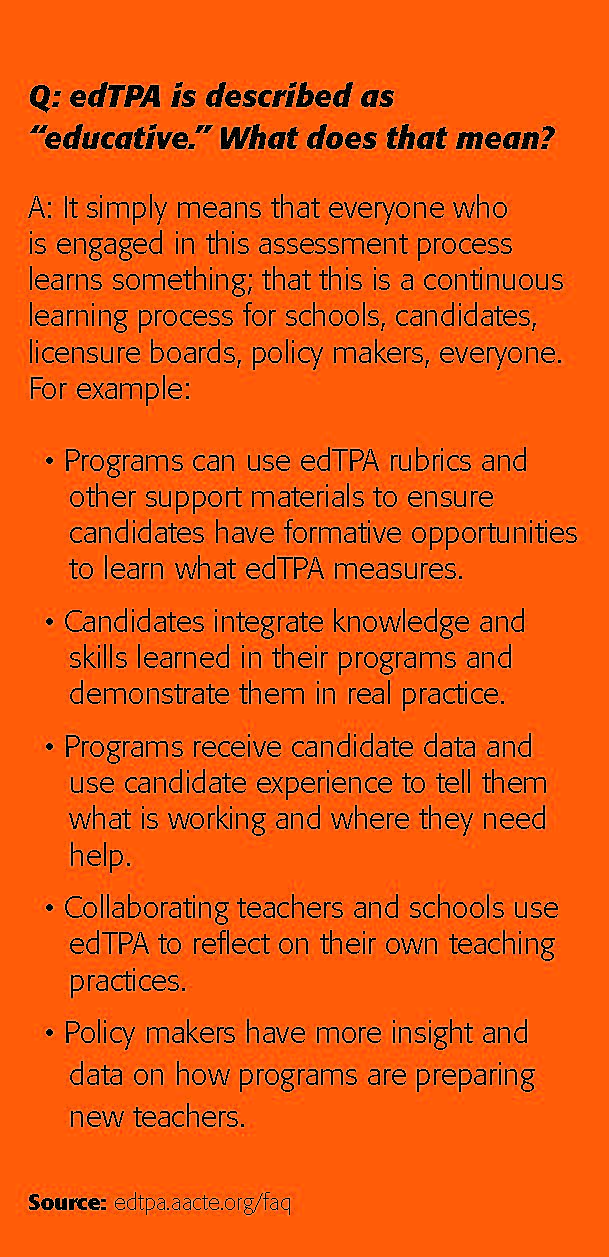
This is why the Stanford Center for Assessment, Learning, and Equity (SCALE) developed edTPA™ — a performance-based, subject-specific assessment and support system that teacher preparation programs throughout the U.S. can use to emphasize, measure, and support the skills and knowledge teacher candidates will need. In this assessment, aspiring teachers prepare a portfolio of materials during their student teaching clinical experience, which includes unedited video recordings of themselves at work in a real classroom. This portfolio is scored by highly trained educators. The assessment allows teacher candidates to:
- Demonstrate readiness to teach through lesson plans designed to support their students’ strengths and needs;
- Engage real students in ambitious learning; and
- Analyze whether their students are learning and adjust their instruction to become more effective.
Since it became operational in 2014, over 54,000 students have taken edTPA. Among the nearly 800 campuses using edTPA in 40 states, some use the assessment in the absence of policy, others are using it for local evaluation or state/national accreditation, and many others are implementing edTPA under high-stakes conditions as the result of regulatory requirements. Regardless of how the assessment is initiated, faculty and their P-12 partners must decide how they will approach edTPA. Will they resist implementation? Will they simply comply with implementation? Or will they embrace implementation as an opportunity to learn more about how to prepare classroom-ready beginning teachers?
We’ve learned that educators are implementing edTPA more frequently when states have endorsed policies that support the work. Faculty have discovered that edTPA is an opportunity for them to learn and to invigorate their programs for teacher candidates. And cooperating teachers in P-12 school districts also have discovered how to learn more about effectively guiding aspiring candidates through their student teaching experiences.
Snapshots of several locations using edTPA demonstrate how the assessment has been used in practice.
Case #1 — Deep engagement with candidate work through local evaluation — University of Maryland, College Park
UMD College Park (UMD) adopted edTPA during its pilot phase in spite of limited interest by Maryland policy makers and no policy plans. UMD’s leadership team, including Assistant Dean Kathleen Angeletti, formed a consortium with Towson and Morgan State universities to try edTPA with their students.
UMD used evidence collected through edTPA during its Middle States accreditation review, and candidates have been able to use its results to fulfill the summative teaching portfolio required by the Maryland State Department of Education before licensure. Reviewers from the National Council for Accreditation of Teacher Education (NCATE) also touted edTPA’s evidence as an important contributor to UMD’s successful accreditation in 2012.
Since 2013-14, UMD has reviewed about 300 portfolios each year. Reviewing candidate portfolios and data has informed faculty thinking about curriculum and how they provide induction support with P-12 partners.
Local portfolio evaluators are positive about the assessment. One P-12 partner said, “When I first started evaluating, it made me reflect more on my teaching style and strategies. When you have been doing things as long as I have, you get complacent, and seeing the energy and creativity that some of the students had was very impressive.”
Another said, “As a teacher leader, the edTPA process has led me to see how and what teacher candidates are being prepared with when they are leaving institutes of higher learning. Knowing what first-year teachers know how to do helps me with the mentoring that I am providing them. It also has made me look back on my own practice when I was in the classroom and ask myself the hard questions.”
Case #2 — Strategic leadership and support infrastructure — Illinois State University, Normal, Ill.
Illinois State University was exploring edTPA for four years before the state required using edTPA as a measure of readiness for licensure. Because teacher education is a very large program (over 750 candidates each year) in a publicly funded institution, ISU leadership needed centralized support for strategic, cross-campus faculty engagement, and a financial and logistical infrastructure.
The education dean funded a full-time edTPA coordinator position to provide support and professional development to faculty and program leaders. The ISU provost supported official scoring for portfolios submitted from programs campuswide during the last two years of the pilot so faculty would have data to review and inform potential curricular changes. Lastly, the provost convened an edTPA work group of education and arts and sciences program leaders, director of teacher education, and the edTPA coordinator to discuss and solve problems or concerns as candidates and faculty experienced the assessment.
Faculty across the institution have been engaged in this work because of strategic attention to a support and communication infrastructure. Because edTPA is subject-specific, faculty discovered they could use the assessment to improve their preparation of teacher candidates. For example, while teacher candidates in the health education program struggled early in the pilot of edTPA, the faculty saw the strengths of the assessment. “What we are doing in edTPA aligns with good public health practices, which look at what outcomes we want and how we get there,” commented Adrian Lyde, assistant professor of health sciences.
Commenting on ISU’s experience with edTPA, Amee Adkins, associate dean, said, “Teacher education continues to be a prominent function at ISU, representing nearly 25% of the campus footprint. We are grateful for the wisdom of central administration that recognized if things don’t go well in teacher education, then things don’t go well for ISU. The institution allocated its resources appropriately, especially noteworthy in this era of dwindling state funding for higher education.”
Case #3 — Affirming program conceptual framework with multiple measures — University of Tennessee, Knoxville
Tennessee is best described as a state where policy follows practice. The University of Tennessee Knoxville (UTK) campus, Vanderbilt University, and six Tennessee Board of Regents campuses were all voluntary early adopters of edTPA without state policy in 2011. In 2014, the Tennessee Board of Regent campuses began requiring teacher education programs to use a teacher performance assessment before students could graduate; a short time later and after pressure from campus leaders, the Tennessee Department of Education allowed teacher candidates to use the edTPA instead of the existing standardized test of pedagogy — one current measure required for licensure.
Throughout this time, UTK Associate Dean Susan Benner and Data Coordinator Bill Wishart supplied faculty and P-12 mentors with information and support. They invited faculty and P-12 mentors to review and critique edTPA handbooks and rubrics, and they celebrated early candidate participation along the way. They also kept talking with faculty and supported them through overview sessions and formal scoring training, enabling them to attend the edTPA National Implementation Conference, and by organizing orientations for candidates, mentors, principals, and faculty.
UTK created a dedicated Blackboard site for faculty and another for candidates, mentors, and principals to provide easy access to handbooks, rubrics, and implementation procedures. They communicated frequently with P-12 partners about candidate performance while in the program and how edTPA constructs are aligned with teacher evaluation rubrics used in induction and beyond.
Tennessee is one of the few states that systematically uses value-added evaluations to assess teacher effectiveness and link back to preparation programs. Benner and Wishart (2015) have shown that edTPA scores predict candidates’ ratings of teacher effectiveness as measured by the state valued-added composite score that combines students’ performance data and classroom observations. UTK faculty have used VAM in combination with edTPA to inform their program design. UTK gave edTPA data summaries to faculty and used candidate performance information to revise programs and refine existing assignments while maintaining the program vision. At UTK, edTPA is not the focus in coursework. Rather teacher candidates plan around essential questions, incorporate academic language as a major focus of lesson planning, and deepen their use of community mapping to understand student strengths/challenges, culture, and community effect on learning.
“Bottom line, I would say that for us edTPA is about making a good program better,” Wishart said.
Case #4 — Integrating local assessment and edTPA: Deepening knowledge of teaching and learning — Niagara University, New York
Within the New York policy mandate, Niagara University embraced edTPA as a source of evidence supporting the program’s longstanding commitment to continuous improvement.
The College of Education at Niagara University was among the first institutions in New York to receive accreditation from NCATE. Because of its border location, the program has been educating future teachers for service in Canada for more than three decades in compliance with expectations of the Ontario Ministry of Education and the Ontario College of Teachers. The quest for continuous program improvement, coupled with the rigorous standards of these accrediting agencies, has compelled Niagara to focus on outcomes evaluation using signature assessments within programs as well as outside measures such as state certification examinations.
When New York announced in 2012 that it would begin requiring edTPA for teacher certification in 2014, Niagara reviewed its curricula to ensure alignment between program expectations, existing assignments, and edTPA. Faculty saw edTPA as a way to prepare candidates with the knowledge, skills, and academic language required to strengthen class performance and to be more successful during student teaching. After reviewing the curriculum, faculty revised signature assessments for specific courses. One revision emphasized understanding students in ways that mirror edTPA’s context and commentary requirements. Candidates who are doing student teaching now provide nuanced information about students in the class — including prior academic learning, prerequisite skills, personal, cultural, and community assets — and they summarize the required or needed supports, accommodations, or modifications for students with special learning needs. This revision was fully consistent with program values and the overall goal to demonstrate readiness to teach in New York and Ontario.
“Faculty needed to undertake a more comprehensive look at the student teaching component of our programs based on the expectations of edTPA,” said Chandra Foote, interim dean. “We were able to eliminate redundancies and superfluous assignments and focus the work of our teacher candidates. We also collaborated with our school partners to explore the new student teaching expectations and worked together to overcome potential obstacles that candidates might face as they attempted to complete edTPA. We feel that this essential clinical component now holds more value for our faculty, candidates, and field partners.”
As Niagara gears up for an upcoming self-study and site visit for accreditation, they will use edTPA evidence as a central part of the multiple measures system informing their continuous improvement.
Case #5 — Distributed leadership and data-driven program improvement — East Carolina University, North Carolina
East Carolina University (ECU) has been leading grassroots implementation of edTPA in North Carolina since the early pilot years even though the state does not require teacher candidates to take the assessment.
ECU is a large, public teacher preparation institution that has engaged faculty across content areas as an advisory group to prepare to implement edTPA. Having such a broad swath of faculty involved gave them clout as a decision-making body for edTPA implementation. Together, the team drove implementation of edTPA from pilot to full implementation over three years.
ECU’s annual edTPA Data Summit is an example of how the implementation support team worked with faculty to use data from the assessment to evaluate programs, including outcomes, challenges, and implications. During the first program-specific data summit, for example, middle-grades faculty found that edTPA mean averages on Rubrics 12 (quality of candidate feedback) and 13 (students use of feedback) were significantly lower than the mean averages for their candidates on other edTPA rubrics and below the state and national mean averages for these two rubrics. When they investigated this, faculty discovered that faculty were not successfully teaching specific skills for giving and using feedback nor were they modeling those skills effectively for students. As a result, faculty added explicit coursework about giving and using feedback to three curriculum classes and identified ways to intentionally model and use feedback with candidates within assignments. These changes resulted in candidates’ receiving edTPA mean scores above the state and national edTPA averages. Although improving the edTPA results was a good benefit, more important was that faculty recognized that a desired component of good teaching practice was not as strong as they wanted and took necessary steps to change that.
Closing
In their work, Peck and colleagues (2014) argue for common assessment in teacher preparation that informs practice. “TPAs can provide motivation and direction for continuous program improvement efforts, contribute to the development of a common and concrete language of practice, and accelerate the professionalization of teaching,” they wrote.
Former NEA President Dennis Van Roekel (2013) put it more simply: “My barber has to prove that he is prepared to be a barber and earn a license before he is allowed to cut hair, yet some states and districts allow individuals to be in charge of classrooms and student learning before proving that they should be there. Every student deserves to be a ‘professionally ready’ teacher.” A recent PDK poll on education (PDK International, 2015) reinforces this perspective — 95% of respondents believe the quality of the teacher is the most important factor in improving school performance.
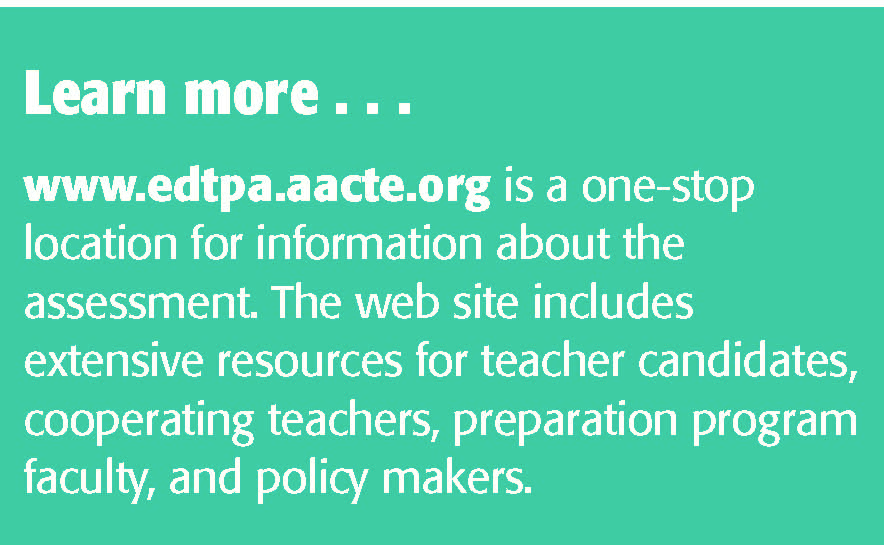
In this article, we argued that any assessment system used to license beginning teachers has a professional responsibility both to support continuous improvement and to set equitable standards to ensure that candidates are ready to teach. American Association of Colleges for Teacher Education, in partnership with SCALE, has championed the development of edTPA’s instructional and implementation resources to support the high-stakes use of portfolio assessment to license prospective teachers. Seeing licensure assessment as a way to both support teacher education and to assess teacher candidates is more than an edTPA program feature; it is a turning point in assessment design.
References
Benner, S. & Wishart, W. (2015). Teacher preparation program impact on student learning: Correlations between edTPA and VAM levels of effectiveness. Paper presented at the annual meeting of the American Association of Colleges for Teacher Education, Atlanta, Ga.
Cochran-Smith, M., Piazza P., & Powers, C. (2013). The politics of accountability: Assessing teacher education in the United States. The Education Forum, 77 (1), 6-27.
PDK International. (2015, September). Testing doesn’t measure up for Americans. 47th annual PDK/Gallup poll of the public’s attitudes toward the public schools. Phi Delta Kappan, 97 (1), K1-K32. www.pdkpoll.org
Peck, C.A., Singer-Gabella, M., Sloan, T., & Lin, S. (2014). Driving blind: Why we need standardized performance assessment in teacher education. Journal of Curriculum and Instruction, 8 (1), 8-30.
Van Roekel, D. (2013). Profession-ready educators. NEA policy brief. Washington, DC: National Education Association. www.nea.org/assets/docs/Profession-Ready-Teachers.pdf
Citation: Pecheone, R.L. & Whittaker, A. (2016). Well-prepared teachers inspire student learning. Phi Delta Kappan, 97 (7), 8-13.
R&D appears in each issue of Kappan with the assistance of the Deans Alliance, which is composed of the deans of the education schools/colleges at the following universities: George Washington University, Harvard University, Michigan State University, Northwestern University, Stanford University, Teachers College Columbia University, University of California, Berkeley, University of California, Los Angeles, University of Colorado, University of Michigan, University of Pennsylvania, and University of Wisconsin.
ABOUT THE AUTHORS

Andrea Whittaker
ANDREA WHITTAKER is director of teacher performance assessment at Stanford University Graduate School of Education, Stanford, Calif.
Raymond L. Pecheone
RAYMOND L. PECHEONE is a professor of practice at Stanford University and executive director of Stanford Center for Assessment, Learning, and Equity .