
Over the past 15 years, England has carried out a three-stage effort that shored up school leadership ranks, an area that traditionally has been remarkably thin in the U.S.
The flat structure of American schools is ill-suited for meeting today’s demands to improve education. Even with unprecedented pressure to raise performance, America’s schools remain organized much as they were a century ago — with a single principal presiding over a largely egg-crated faculty. Is this structure sufficient to build the capacity of teachers at each grade level and in each content area to meet today’s higher expectations?
Historically, American schools have addressed this instructional support deficit with a patchwork of poorly defined roles and responsibilities — underused department chairs, fitful coaching models, and informal teacher leaders who generally lack the training and authority to influence the practice of their peers. How exactly do these roles fit into contemporary schools’ strategies for improving teaching and learning? How can we more systematically build the capacity of school leaders to engage with and overcome the challenges of continuous school improvement?
One place to look for fresh ideas about leadership development is England. Over the past 15 years, educational reformers in England have made several important revisions in how schools organize leadership, develop leaders, and integrate leadership into the larger educational infrastructure. American policy makers and reformers can learn much from these experiences.
This article examines the evolution of the educational leadership development system in England. It is based on an in-depth examination of that leadership development system described in a research report from the Consortium for Policy Research in Education, Building a Lattice for School Leadership: The Top-to-Bottom Rethinking of Leadership Development in England and What It Might Mean for American Education (2014). The research report was based upon a year of research on school leadership in England that included extensive background research, site visits to schools and leadership programs, and over 20 interviews with government officials, teachers, school leaders, university researchers, union officials, and both for-profit and nonprofit school leadership program developers and providers.
England’s evolution
England is a small nation packed with many schools. The country is geographically the size of Alabama but publicly funds about 20,000 schools — equivalent to the number of public schools in California and Texas combined.
The story of England’s leadership system refinement begins in 2000 with the development of a set of clear roles and responsibilities for school leaders at multiple levels of a school, including head teachers (i.e. principals), senior leaders, and middle leaders. Particularly striking from the U.S. perspective is the set of explicit responsibilities for middle leaders to oversee and be accountable for teaching, learning, and student behavior in subject areas or grade levels within a school. This approach is distinctively different from the American model of teacher leadership. A refined school leadership structure adds depth to the instructional support for teachers and moves both support and responsibility for instructional improvement closer to the classroom. The multiple-level leadership structure also creates pathways for teachers to become leaders and for leaders to develop and refine their skills across their professional careers.
A refined school leadership structure adds depth to the instructional support for teachers and moves both support and responsibility for instructional improvement closer to the classroom.
In 2000, to establish a school leadership development system, England’s government charged a quasi-governmental organization — the National College of School Leadership — with defining the knowledge and skills necessary to lead at each of the three levels of school leadership and with developing a high-quality curriculum to build the capacity of leaders to competently perform at each level. The curriculum that effort yielded brought together a rich set of blended learning experiences to culminate in an assessment for a nationally accredited certification for each leadership level. Tens of thousands of school leaders have received national certification.
More recently, the Cameron government has shifted to a more decentralized emphasis by facilitating school networks to enable lateral school exchanges led by high-performing schools. Because these school-level networks are closer to particular problems of practice, they are more grounded and responsive to the specific challenges and needs of participating schools. This combination of vertical leadership development and lateral school network support constitutes what I call the “lattice for school leadership.”
Additionally, school leadership and effective teaching are central elements integrated into the national school inspection process, the cornerstone of the nation’s school accountability system. By incorporating school leadership and instructional practice explicitly into school performance judgments, the essential role of these elements is reinforced and serve as an outline for what schools should focus on that goes beyond test performance.
Leadership development phases
England’s efforts to develop school leaders over the past 15 years have occurred roughly in three overlapping phases that largely align with the eras of the Blair (1997-07) and Cameron (2007-present) governments. The first two phases were concerted efforts to develop a centralized strategy to specify leadership pathways in schools and to develop a system to build the capacity of leaders to follow these pathways. The third, more recent phase has taken a more decentralized approach to laterally build leadership capacity.
Phase 1 (2000-04): Define roles, develop curriculum
National College of School Leadership develops a framework of knowledge and skills for school leadership at different levels of a school, including:
- Head teachers (similar to principals in the U.S.);
- Senior leaders (similar to assistant or vice principals in the U.S., but with clearer schoolwide responsibilities); and
- Middle leaders (teachers responsible for developing teachers at a grade level, grade range (i.e., K-2, 3-5), or subject area, and accountable for their performance).
Based on the framework of knowledge and skills at each of these levels, the National College developed an associated curriculum, which combines theory and practice — face-to-face sessions and online mixed-media assignments, and adds projects designed to connect out-of-school learning and in-school work that focuses on:
- Instructional leadership: leading and improving teaching;
- Operational management: managing school systems and processes; and
- Strategic leadership: working with people, coaching, and leading change.
Phase 2 (2004-12): Integrating leadership system into incentive structures
National qualifications were developed for head teachers, senior leaders, and middle leaders; their requirements include a portfolio to be developed while participating in a leadership curriculum; incentives are attached to a certification of leadership preparation earned through the program.
Leadership is integrated into the nation’s school accountability system. Rather than relying primarily on a test-based accountability system, England refined its school-inspection system to focus not just on the outcomes of education but the processes that produce student outcomes. The system emphasizes four elements: student behavior and discipline, quality of teaching, leadership and management, and student outcomes.
Phase 3 (2012-present): Expanding providers, fostering school networks
- Increasing movement of schools away from local authorities (akin to school districts in U.S.) and toward local academies, which are similar to U.S. charter schools.
- Shifting emphasis toward a school-led system in which schools, not the central government, lead capacity building and search for innovation in the system.
- Expands the market of school leadership development providers by initially licensing National College curriculum to 33 qualified providers and preparing to move the curriculum into the public domain. The qualified providers included university programs and for-profit and nonprofit organizations that demonstrated their capability to maintain quality in delivering the leadership curriculum.
- Increased focus on government-stimulated networks of schools led by high-performing schools; the objectives are to organize professional learning experiences for members, build local capacity, and promote cross-school learning.
School leadership lattice
The concept of a lattice for school leadership calls for careful integration of both formal and network learning opportunities for leaders at multiple levels of a system. It features a centrally developed, high-quality leadership development program combined with lateral social networks to support schools and school leaders.

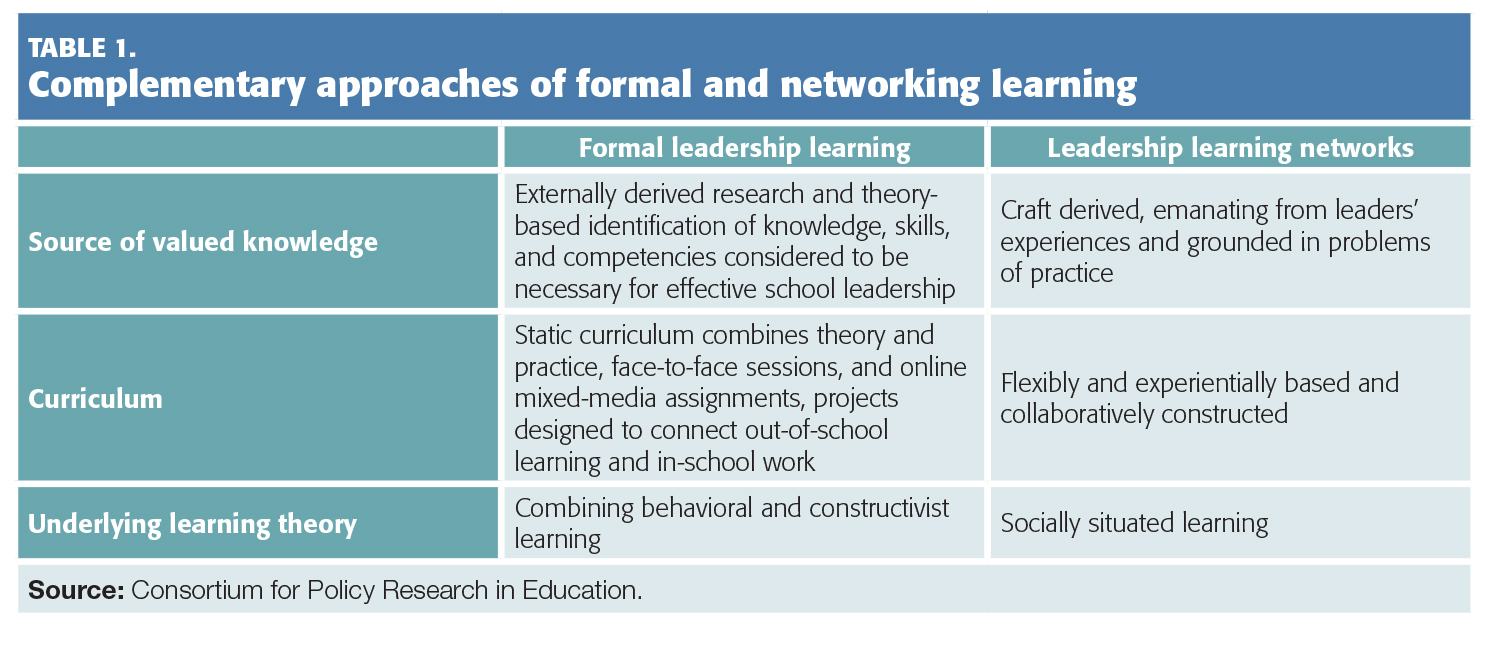
The first set of more formal learning experiences builds educational leaders’ capacities to enact a defined set of knowledge, skills, and competencies at multiple school levels through a high-quality curriculum that combines theory and practice within a set of blended learning experiences.
The second set of experiences include developing robust networks of schools and school leaders who collaborate on problems of leadership practice emanating from actual school need, grounding learning in the challenges of educator practice, and making development more localized, ongoing, and sustained.
These complementary elements of leadership development are carefully enmeshed in a system that provides clear responsibilities for multiple levels of leadership within schools, incentives for identifying and grooming leadership within schools, pathways for leadership progression, and certification for leader attainments. All of these elements are supported by an accountability structure that emphasizes the contribution of school leadership and teaching to school improvement.
As shown in Table 1, a distinct advantage of the integration of formal and network learning opportunities represented by the lattice approach is that they complement each other by tapping different knowledge sources, curricular approaches, and learning theories. More formal professional development provides an invaluable introduction to research-based and theoretical knowledge and is founded on a set of knowledge, skills, and competencies that experts have determined are needed by educational leaders to meet high job performance expectations. The nature of formal professional development, however, is that it is often disconnected from the current challenges facing practitioners. By contrast, leadership learning networks are able to focus on pressing problems of practice that take advantage of opportunities for grounded collaboration and socially situated learning. At their best, these two forms of learning deepen and reinforce each other.
The concept of a lattice of school leadership also challenges educational leaders and policy makers to hold multiple, sometimes competing, conceptions of professional learning in their heads. Such a system combines centralized and decentralized structures, formal and social learning approaches, and multiple system actors.
Implications for educators
Almost every study of school improvement — anecdotal or systemic — cites the importance of leadership, yet we tend to think of effective leadership as an individual trait rather than a product of a design principle. The story of England’s leadership development system is an instructive case of how to use the levers of policy to create a vision for school leadership; expand and formalize leadership pathways within schools; formulate models to build leadership capacity; attend to incentives to stimulate demand; and carefully push on the right pressure points to constructively focus schools on the important role of leadership in the improvement of teaching and learning. In taking these steps, the English have enmeshed school leadership into the core processes of school improvement.
The nature of formal professional development is that it is often disconnected from the current challenges facing practitioners.
It is worthwhile for American educators to consider the following key components of England’s leadership system and their implications for U.S. education policy:
#1. Formalizing multiple leadership positions within a school beyond the principal to include senior and middle-level leaders, which:
-
- Formally distributes leadership responsibilities;
- Helps to better support and monitor instructional improvement efforts; and
- Creates career development pathways for school professionals;
#2. Identifying a broadly recognized set of leadership competencies targeted to each of the leadership levels, which creates a clear set of knowledge and skills necessary for different leadership positions;
#3. Developing formal and network learning opportunities that allow for learning to be expert- and peer-led, structured and flexibly organized, and focus on both classical knowledge and the craft skills and experience that come from addressing situated problems of practice;
#4. Creating widely recognized certifications for school leaders aligned with the leadership competencies and professional learning experiences that serve as incentives for leadership progression;
#5. Integrating the leadership function into the broader accountability system to provide appropriately targeted pressure on school leaders to advance their leadership competencies and to promote the role of leadership in school improvement.
Finally, it is worth noting that identifying sensible ideas is a far cry from successfully incorporating them into a different culture with its own unique education system. Each of these ideas has serious implications for the current system of private, university, and public leadership development providers as well as the incentive and accountability structures that surround schools and nudges the priorities and behaviors of school leaders. While it is important that these ideas enter the policy debate, the hard thinking, planning, and resource allocation that would need to occur for any of them to be fruitfully incorporated into American education should not be underestimated. Even so, they are worthwhile to bolster the educational leadership system that is so integral to improving educational performance.
Reference
Supovitz, J. (2014). Building a lattice for school leadership: The top-to-bottom rethinking of leadership development in England and what it might mean for American education. Research Report (#RR-83). Philadelphia, PA: University of Pennsylvania, Consortium for Policy Research in Education. http://bit.ly/1KatKPh
Citation: Supovitz, J. (2015). School leadership lessons from England. Phi Delta Kappan, 97 (3), 38-41.
ABOUT THE AUTHOR

Jonathan Supovitz
JONATHAN SUPOVITZ is a professor of policy and leadership in the Graduate School of Education at the University of Pennsylvania and codirector of the Consortium for Policy Research in Education, Philadelphia, Pa.