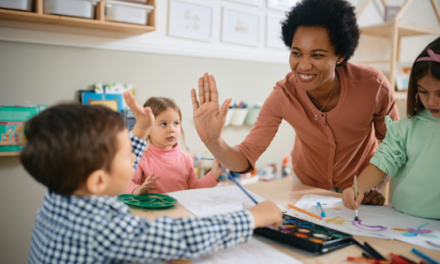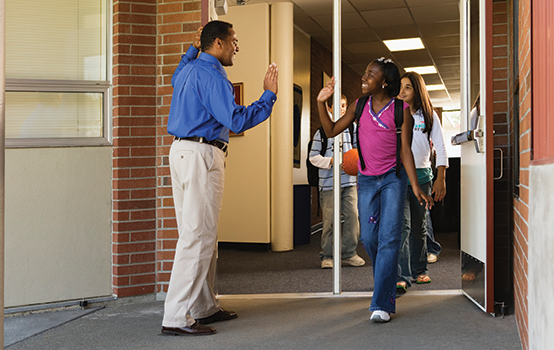
Teachers must create caring communities for the adolescents in their classrooms.
Adolescents need to feel cared for if they are to succeed in school (Noddings, 2005). Yet care is often dismissed as a warm and fuzzy extra. The care we speak of consists of a sense of support and connection, is an integral aspect of a relationship, and is predicated on action (Chaskin & Rauner, 1995; Ellerbrock & Kiefer, 2010; Hayes, Ryan, & Zseller, 1994). Personal experiences and beliefs influence our perception of care; in this way, teachers may believe their actions are caring, but students may not interpret them as expressions of care. Caring acts must be recognized as caring for care to truly occur. Caring relationships are reciprocal. Students receive care from educators and complete the caring relationship by showing care toward educators and others (Noddings, 2005). Through establishing caring relationships with students, teachers cultivate classroom communities that propagate care and promote academic success.
When students face challenges outside of school that interfere with their ability to focus on academics, a caring classroom community can provide emotional support and help students focus in the classroom. Laura, a high school English teacher, experienced this firsthand when a third of the students in her 10th-grade class wore T-shirts with the face of a local gang member on the day before his murder trial began. Many of these teenagers were kin of the accused and also gang members. If she mentioned their shirts, Laura knew the ensuing conversation would result in the loss of the day’s lesson. But, if she ignored the shirts, she knew she would send a message of indifference to students’ lives outside of school. Laura decided the lesson could wait and opened a discussion about the trial. For the next hour, students did not talk about guilt or innocence but about life choices and supporting someone they loved. They recounted playing with the accused when they were children, wondered about his baby daughter’s future, and worried over his grandmother’s impenetrable sadness. During an open and honest conversation, they asked each other questions and shared similar stories. When the bell rang, the class — more than 20 students, along with the teacher — embraced in a messy pile of a group hug. The next day, students asked to spend time writing about the previous day’s discussion. They wrote nonstop for 30 minutes. These unplanned events in Laura’s classroom illustrate how she and her students cared for one another and how creating a caring community emboldened students to openly share their thoughts and feelings.
Caring classroom communities provide emotional support and help students focus on learning.
Caring classrooms in secondary schools
A classroom that serves as a community of care is a “place where students and teachers care about and support each other, where individuals’ needs are satisfied within a group setting, and where members feel a sense of belonging and identification with the group” (Ellerbrock & Kiefer, 2010, p. 396). Students in caring classroom communities enjoy school, are motivated to learn, possess strong conflict resolution skills, and develop an ethic of care, which can help them become more empathetic and contribute to the classroom community. Ultimately, addressing the need for care fosters healthy adolescent development and supports student success in school. Fostering a caring classroom community begins on the first day of school and continues throughout the school year.
A caring educator:
- Establishes a safe and academic-focused classroom culture;
- Creates shared norms and values;
- Promotes open and honest communication;
- Makes time for everyone to get to know one another;
- Facilitates mutual respect;
- Encourages reciprocal care and mutual responsibility;
- Demands academic excellence from each student; and
- Uses student-centered cooperative group structures.
Establishing a safe and academic-focused classroom culture
A caring educator supports the physical, psychological, and emotional safety of each student in an effort to cultivate a classroom culture where all students feel free to take academic risks. For example, Mike, a middle-school educator, believes negative attitudes and negative comments threaten a safe and academic-focused environment. Therefore, everyone in Mike’s classroom — students and educator — agree to ban negative comments. They discuss how such comments could be hurtful even when joking around. Mike found starting with a positive environment laid solid groundwork for nurturing a community of care throughout the school year.
Creating shared norms and values
Caring educators establish norms and values with students, allowing all to become stakeholders in the classroom. In her high school classrooms and in her secondary educator preparation courses, Cheryl and her students have a method for adhering to a classroom code of conduct. First, each student describes an ideal classroom environment. All ideas are discussed until the class comes to consensus. Then, students confer on the principles needed to achieve the ideal classroom (e.g., I will listen and not interrupt others). This exercise culminates in a written code of conduct that all students sign and agree to uphold. Cheryl also uses guidelines for classroom communication. Students preview a media clip of a nonconstructive dialogue and brainstorm the principles necessary for constructive dialogue (e.g., strive to understand another’s point of view). From these principles, students create a set of statements that serve as the communication guidelines for the duration of the course. An example is “I will suspend my beliefs to listen to the perspectives of others.”
Promoting open and honest communication
Open and honest communication is essential for creating a caring classroom community. Such communication may require some vulnerability by the educator. When the educator opens up to students, the entire class benefits, and students are more likely to reciprocate. For example, in Bridget’s middle school classroom, students ignored her advice following one-on-one writing conferences and, when working with peers, hesitated to suggest changes. This resulted in ineffective educator and peer editing sessions. Bridget started sharing her writing with students during conferences, asking for feedback on her writing in exchange for feedback she gave to students. Students didn’t hold back. They told her exactly what they felt needed improvement in her writing. Working together as colearners, students were more receptive to Bridget’s ideas for improving their writing. The quality of successive drafts by students and Bridget improved due to the honesty and reciprocity of the conferences. Peer-editing sessions also improved as students became more confident about their ability to write and provide constructive feedback. By opening herself to criticism from students, Bridget fostered caring relationships as well as writing skills.
Making time for everyone to get to know one another
Taking time to get to know one another is critical to establishing a caring community. Cheryl spends the first days of school establishing relationships with and among her students. By using various activities and protocols, her primary agenda is to foster a sense of community. In one activity, she and her students create a trifold display representing their past, present, and future with a key describing each word or image. In class, trifolds are shared, and Cheryl reviews each before they are put on the front of students’ notebooks. This allows all students to share a few aspects of who they are while simultaneously learning about classmates.
Students in caring classroom communities enjoy school, are motivated to learn, possess strong conflict resolution skills, and develop an ethic of care.
Similarly, Jennifer and her high school students create “All About Me” presentations. First, Jennifer models what the presentation should look like by creating and presenting one about herself. Then, students create and present their own to the class. Presentations include biographical information, personal favorites, pictures, and fun facts students want to share about themselves. These presentations allow students to practice presenting in front of their classmates and help the class learn about their teacher and peers.
Facilitating mutual respect
Caring educators facilitate mutual respect in their classrooms, first by holding an asset-oriented view toward every student, where the educator believes each student is special and has something valuable to contribute. Inspired by the novel 13 Reasons Why by Jay Asher (2007), Jennifer and her students engage in a weekly activity she calls “Someone Noticed Notes.” Jennifer introduces the activity by reading an excerpt of the novel. The class discusses care and respect and how they can encourage both in their classroom. Jennifer and her students then personalize paper bag “mailboxes” and, each week, students write a positive note to another student or to Jennifer and put the note in the person’s bag. Jennifer writes notes to several students every week. Sometimes, the notes are as simple as saying hello, congratulations on doing well during a sports event or activity, or welcome back after an absence. Jennifer writes a congratulatory note to every student who earned an A at the end of each grading period. At the beginning of the week, everyone checks their bags, an activity that quickly becomes a favorite among students. The notes help foster mutual respect and strengthen a sense of community, as students are encouraged to write positive notes to their peers.
Encouraging reciprocal care and mutual responsibility
In caring classroom communities, care is reciprocal; those who care ultimately are also cared for. For example, when Laura experienced an excruciating migraine at school one day, she slumped over her desk in agony. With a shortage of adults in the building, no one was available to take over her class. Laura wasn’t sure she could peel herself off her desktop to teach and worried about what to do. That’s where the care she had cultivated in her classroom community came into play: Despite their history as a challenging group, Laura’s students assumed complete responsibility for the classroom. The first students who entered the room noticed Laura’s obvious distress and immediately took charge. One boy turned down the lights and met classmates at the door, whispering to all students to enter quietly. A girl deduced the lesson from the information written on the front board and led her peers through it in whispers. The actions of Laura’s students, typically the receivers of her care, demonstrated care toward her physical well-being as well as a sense of responsibility toward teaching and learning in the classroom.
Demanding academic excellence from each student
In caring communities, educators demand academic excellence from every student. Letting students know they’re capable of high academic achievement and expecting them to achieve fosters confidence in their academic abilities and is an essential part of a caring classroom community. As Corbett, Wilson, and Williams state, “If schoolwork is worth doing, then all children need to do it and do it well” (2002, p. 145). Corbett and colleagues also suggest expecting students to complete every assignment and produce high-quality work and that teachers check all students for understanding and provide extra help when needed. If an educator truly wishes to establish a caring classroom community, he or she won’t accept excuses for a lack of quality work. Bridget demanded academic excellence from her middle school students by requiring those who did not meet her expectations to revise and resubmit assignments. She opened her classroom during lunch for students to work on assignments and receive assistance. Students who failed to revise and resubmit work were required to attend lunch sessions. To ensure participation, Bridget located students in the cafeteria and, with the support of her administration, escorted them back to her classroom to eat lunch while completing assignments.
Using student-centered cooperative group structures
Educators also can foster a caring classroom community by using cooperative group structures, where students work in small groups to accomplish shared goals, each with their specific contribution (Johnson & Johnson, 1999). In her high school classroom, Jennifer uses peer-editing groups where students first edit their own paper focusing on a particular aspect of writing (e.g., point of view, word choice), then switch papers and repeat the process with a peer’s text. After the editing session, each student’s paper is seen and commented on multiple times. In these groups, students work together on a shared goal: editing and strengthening their papers. Each member of the group is responsible for the group’s success; if one student fails to complete his or her task, each paper will lack editing in that area. Working toward a common goal fosters a sense of community and communicates care.
Final thoughts
Each class possesses varying needs requiring different manifestations of care. But regardless of specifics, all adolescents need to feel their teachers care for them. For educators, it is imperative students recognize and receive our care. As Noddings suggests, “No matter how hard educators try to care, if the caring is not received by students, the claim ‘they don’t care’ has some validity” (2005, p. 15). We urge secondary educators to return to the fundamental R in education — relationships. Through meaningful relationships grounded in genuine care, educators nurture a responsive classroom environment that can help set the foundation for student success.
References
Asher, J. (2007). Thirteen reasons why. New York, NY: Penguin Books.
Chaskin, R.J. & Rauner, D.M. (1995, May). Special section on youth and caring. Phi Delta Kappan, 76 (9), 665-719.
Corbett, H.D., Wilson, B.L., & Williams, B. (2002). Effort and excellence in urban classrooms: Expecting and getting success with all students. New York, NY: Teachers College Press.
Ellerbrock, C.R. & Kiefer, S.M. (2010). Creating a 9th-grade community of care. Journal of Educational Research, 103, 393-406.
Hayes, C.B., Ryan, A., & Zseller, E.B. (1994). The middle school child’s perceptions of caring teachers. American Journal of Education, 103, 1-19.
Johnson, D.W. & Johnson, R.T. (1999). Making cooperative learning work. Theory Into Practice, 38 (2), 67-73.
Noddings, N. (2005). The challenge to care in schools: An alternative approach to education (2nd ed.). New York, NY: Teachers College Press.
CITATION: Ellerbrock, C.R., Abbas, B., DiCicco, M., Denmon, J.M., Sabella, L.,& Hart, J. (2015). Relationships: The fundamental R in education. Phi Delta Kappan, 96 (8), 48-51.
ABOUT THE AUTHORS

Bridget Abbas
BRIDGET ABBAS is interim director of secondary literacy for the District of Columbia Public Schools and a doctoral candidate in education at the University of South Florida, Tampa, Fla.
Cheryl R. Ellerbrock
CHERYL R. ELLERBROCK is an assistant professor of middle grades and secondary general education in the College of Education at the University of South Florida, Tampa, Fla.
Jennifer Hart
JENNIFER HART is a Pasco eSchool course designer in Pasco County, Fla., and a doctoral student in education at the University of South Florida, Tampa, Fla.
Jennifer M. Denmon
JENNIFER M. DENMON is a middle-level English teacher in Gulfport, Fla., and a doctoral candidate in education at the University of South Florida, Tampa, Fla.
Laura Sabella
LAURA SABELLA is a former secondary language arts teacher and a doctoral candidate in English education at the University of South Florida, Tampa, Fla.
Michael Dicicco
MICHAEL DICICCO is an assistant professor of literacy education at Northern Kentucky University, Highland Heights, Ky.