
The Jehanabad school district lagged in student attendance and performance — until someone noticed that the problems were related. More effective teaching attracted and kept more students.
The school stood in the middle of rice fields in Jehanabad, India — a sea of green all around. Far away in the distance, you could see the village. Students sat in a circle on the floor in a classroom upstairs. They were learning to write words on their own. The teacher gave the children a letter in their native Hindi, then asked for volunteers to write a word on the blackboard that began with their letter. “Here is the letter ‘Ja.’ Let’s see who can write a word beginning with Ja.”
One boy jumped up and went to the board and wrote “jal” (water). Another one followed. He wrote “jag” (jug). Next was the letter “na.” A girl wrote “nadi” (river).
A bit later came the letter “aa.” One girl raised her hand, eager to write. She went to the blackboard and very slowly and shyly she tried to write something. The teacher could not figure out what she was trying to write. When he asked, the girl said, “aa-ee-ss-kream” (ice-cream). “Why don’t you write an easier word?” She shook her head at this suggestion, disagreeing. Softly, she said, “this is my favorite word with aa, and so I want to write it.”
The teacher’s eyes began to shine with pride when the little girl insisted on writing the difficult word. “Can you imagine,” he said, “10 days ago she could not even recognize letters!”
Revealing the problem
More 96% of the children who live in Jehanabad, a rural district of 1,000 primary schools in Bihar, are enrolled in school but attendance at the government schools was less than 70%. The Jehanabad schools provided midday meals, scholarships, and uniforms for students but children still did not seem to want to come to school every day. Some people blamed the teachers; others blamed parents. Children also got blamed for simply not paying attention. Whatever the cause, before an intervention began in September 2012, the schools seemed stuck.
The district administration acted quickly to change the practice from what is typical in Indian classrooms where the textbook reigns supreme.
District administrators contacted Pratham, a nonprofit education organization, to discuss what to do. We posited a theory of change. The Indian school system is organized according to age and grade and is built on a series of assumptions. Children are supposed to start school in Grade 1 when they are about 6 years old. Each year, they move into a higher grade, and, by age 14, they’re supposed to reach Grade 8. Each grade has academic expectations that assume that most children have mastered the content and skills expected of them in the previous grade. Given this background, the system expects teachers for each grade to teach from the textbooks specified for that grade. (The national government sets a broad curriculum framework for each grade; the states build their own curricula congruent with that framework and develop the textbooks.)
But, what if these assumptions that anchor the school system are not correct? To explore this question, Pratham brought together a group of almost 30 Cluster Resource Center Coordinators (CRCC) from the Jehanabad school district to discuss how children were doing in the district’s schools. In the Indian system, each CRCC is responsible for 10 to 15 schools. They provide academic leadership, support, and monitoring. In many places, the CRCCs have simply become data collectors, instruction-givers, and inspectors who are not involved directly in any teaching and learning.
With this group, we explored what they knew about learning in the district. We asked if children were in school. Were they learning? More specifically, we asked everyone to write down their estimates for attendance for an average day in school, how many children in Grades 3-5 could read fluently, and how many children could do simple subtraction problems with borrowing. After the discussion, we split into groups to visit schools. Using a simple reading tool, we checked to see how close our estimates were to reality.
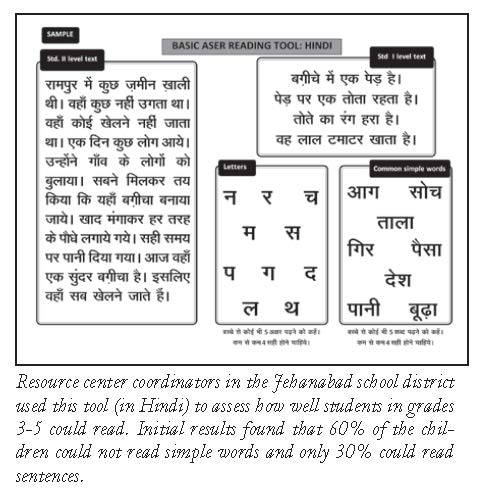 The school visits showed that the CRCCs’ estimate of attendance was about right but their estimates for learning were far off the mark: About 60% of children in Grades 3-5 could not read simple words, and only about 30% could read sentences. The ability to read grade-level textbooks didn’t seem to be even a remote possibility.
This exercise pointed to at least one reason the system was “stuck”: Mandatory textbooks were too difficult for most students. This meant children fell behind in early grades and lost interest in school. Children in Indian public schools cannot be held back, which meant teachers had classes where many children could not absorb what they were teaching. Given this situation, teachers often lose their motivation, and parents became disheartened from seeing their children making so little progress year after year. While the school went through the motions of teaching and learning, the children were not learning.
Starting with the basics
It was clear that we had to begin by teaching children where they were in order to bring them to where they needed to be. The district administration acted quickly to change the practice from what is typical in Indian classrooms where the textbook reigns supreme. Typically, the entire teaching-learning process is “chalk and talk” and geared to “completing the syllabus” and finishing the textbook rather than ensuring that children learn.
With the reforms, each Jehanabad school created a special 90-minute period during which students in grades 3, 4, and 5 were organized by reading ability rather than by grade. Teachers were assigned to groups rather than to grades. Working together, Pratham, the cluster coordinators, and district officials created simple texts — five- to eight-line stories in large font. Teachers did three or four daily activities — reading aloud together, talking about the story, letter and word games played in big and small groups — and encouraged children to write words and sentences.
The first visible result in the Jehanabad schools was an increase in student attendance. Before the change, many students left school after the midday meal; now almost all students remained through the special period, which was the last 90 minutes of the school day. Next, many children began to make progress. They moved from the beginner or letter level to reading words and then paragraphs and stories. Their progress energized teachers and parents. The intervention, which began in September 2012, ran for six months. By the end of the school year, more than 70% of children in grades 3 to 5 could read at least sentences, and some could fluently read stories, too. Fewer than 15% could not read words.
A cadre of leaders
Two or three key elements of the entire process stood out. First, getting an accurate picture of students’ skills and knowledge was very important. A simple reading assessment helped expose the gap between assumption and reality. The fact that everyone — teachers, CRCCs, and district administration — studied the assessments together was important. It helped us all recognize and own the problem.
Second, the CRCCs were a cadre of leaders who could mentor, support, and monitor teachers. The CRCCs tested the Pratham methodology for accelerated learning themselves by running their own practice classes for two weeks. Once they were able to see reading levels improve through their own work, they were convinced that the method worked and were willing to then lead their own teachers to adopt this “teaching to the right level” approach for all the schools under them. The CRCCs then trained teachers and provided on site, in school support to help teachers use this new approach.
Third, abandoning the traditional curriculum, syllabus, and textbooks was hugely beneficial. Starting from the basics was essential to building the right foundations. Having easy materials and simple methods to work with children at their level accelerated the process.
Jehanabad was not the only district to adopt this approach. Another largely rural district in Bihar, East Chamaparan, also experimented with a similar intervention. The experience and evidence of these districts prompted education leaders for the entire state of Bihar to adopt this reading improvement method for all 70,000 of its government-run schools for the 2013-14 school year.
CITATION: Banerji, R. (2014). GLOBAL VOICES INDIA: An intervention improves student reading. Phi Delta Kappan, 95 (6), 74-75.
ABOUT THE AUTHOR

Rukmini Banerji
RUKMINI BANERJI is director of the ASER Centre in New Delhi, India, and a senior member of the national leadership team for Pratham , a nonprofit organization in India working in education. Her work has included designing, implementing, and researching large-scale interventions for improving learing in primary schools. Banerji’s work appears in the book, Leading Educational Change .