
A program with a history of raising achievement of at-risk children builds local capacity, provides external support, and encourages networking among participating schools.
Never in the history of American education has the potential for evidence-based reform been as great. In education and other human service areas, evidence of effectiveness in rigorous evaluations is taking on increasing importance in policy and practice.
However, the success of any reform is not guaranteed. Changes will occur, but will these changes make a difference in the school success of large numbers of children? If reform is to produce results, we need major changes in the structure of professional development.
In 26 years of working with Success for All, a comprehensive reform program designed primarily for high-poverty elementary schools, we have learned a great deal about the process of change, about factors that support and inhibit school-level reform, and about ways of enlisting others in support of our efforts.
Success for All is an approach designed to restructure elementary schools serving many children considered at risk of school failure (Slavin et al., 2009b). It focuses tightly on elementary readings with a decided intent of helping schools start children with success and then build on that success throughout the elementary grades. Its hallmarks are:
- Prevention, including use of proven approaches to preschool, kindergarten, and beginning reading, and ongoing assessment of student progress;
- Early intervention, including tutoring for struggling readers;
- Use of innovative reading, writing and language arts curricula;
- Extensive professional development; and
- Parent involvement.
Extensive research comparing Success for All (SFA) to control schools has consistently shown that the program has substantial positive effects on student reading achievement throughout the elementary grades (Borman et al., 2007; Slavin et al., 2009a, b). A long-term follow-up study found that 8th graders who had attended SFA schools were reading significantly better than former control students and were far less likely to have been retained or assigned to special education (Borman & Hewes, 2003). A recent cost-benefit study estimated that Success for All returned $14.80 for every dollar invested in it over the student’s lifetime (Edovald, Bjornstad, & Ellis, 2012).
Success for All requires a positive vote of at least 80% of the professional staff before introducing the program into a school. This ensures that teachers had a free choice and that most of their colleagues support the program.
Success for All was first piloted in one Baltimore elementary school in the 1987-88 school year. Throughout the 1990s, the number of schools grew substantially each year, reaching 1,500 schools in 600 districts throughout 48 states in 2002. Opposition to comprehensive school reform from the Bush administration reduced the number of SFA schools in half, but the program is growing again today, assisted by a scale-up grant under the federal Investing in Innovation (i3) program.
Spreading the program
Success for All has several unique characteristics that have an important bearing on the strategies used in disseminating the program. First, while SFA is always adapted to each school’s needs and resources, common elements are present in each school. Schools vary in the number of tutors, staff time devoted to family support, and other features. Despite this variation, the integrity of the program must be maintained to produce the results we have found in our research.
Success for All requires substantial change in many aspects of curriculum and instruction. Professional development, for example, must occur over an extended time period. While the initial training lasts only three days for classroom teachers, many follow-up visits from Success for All coaches occur each year. Schools usually budget 26 person-days of training in the first implementation year, 15 in the second, 12 in the third, and five to eight in each subsequent year. Success for All requires schools to invest in tutors, a facilitator, materials, and extensive professional development. Because of the focus of the program and its cost, the program is primarily used in high-poverty schools with substantial Title I resources. Most SFA schools have never received funds beyond their usual Title I allocations so, in one sense, the program has no incremental costs, but many schools could not afford a credible version of the model without the Title I dollars.
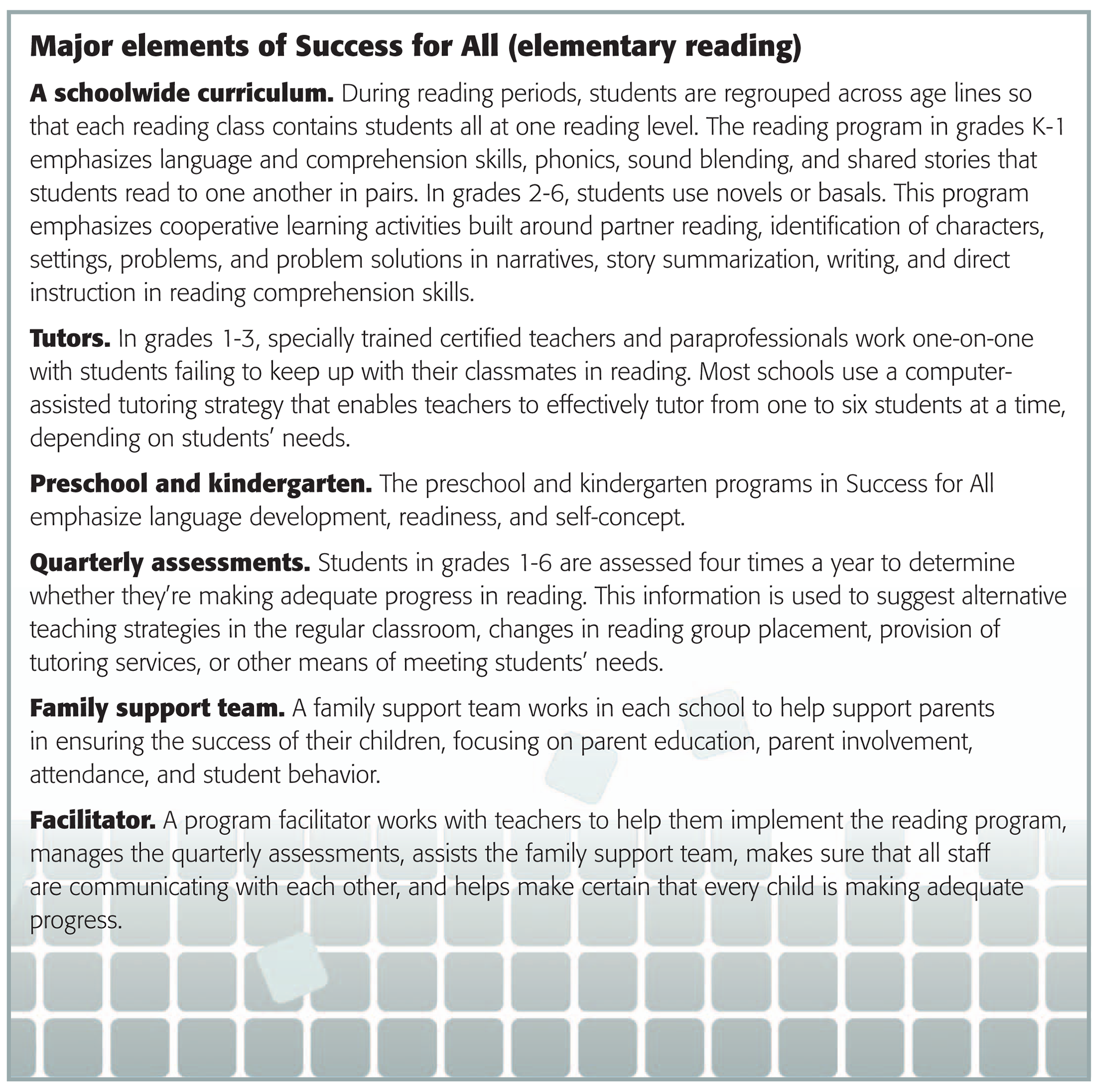
In spring 2013, our training staff consisted of about 100 full-time coaches. Almost all of our coaches are teachers; almost all have been building facilitators or teachers in Success for All schools. Coaches who work for SFA are organized in 16 areas of the U.S., each with a very experienced trainer as an area manager. The box below summarizes the main elements of the program.
Dissemination strategies
Schools learn about the Success for All program in a variety of ways. Articles in education journals, staff presentations, videos, pamphlets, and a book about the program are among the many ways information about SFA is disseminated. We encourage schools to send delegations to visit Success for All schools. We want teachers and principals to see SFA in practice and to imagine how these practices would work in their own schools. We then calculate a price for training and materials. At some point, we’ll make a presentation to the whole staff of each interested school.
Teacher endorsement
After opportunities to examine materials, visit other schools, and discuss among themselves, school staffs vote by secret ballot. We require a positive vote of at least 80% of the professional staff. This ensures that teachers had a free choice and that most of their colleagues support the program. Districts adopting SFA may use alternate means to ensure buy-in. We decided early on that this level of support was necessary to establish that a school staff is ready for major change.
Building facilitators
Once a school decides to adopt the program, we begin implementation by selecting a building facilitator, usually an experienced and respected teacher who is part of the school’s own staff. The facilitator and principal attend a weeklong training session held well in advance of training for the school staff. This gives the facilitators and principals time to work out issues of staffing, space, finances, ordering and storing materials, and so on. Facilitators may also visit other schools to see the program in action and get a firsthand view of what facilitators are expected to do. The initial training is typically done in August by the school’s lead coach and other staff from SFA or district coaches. Follow-up visits will be conducted by these same staff.
Coaches
Coaches work with the building facilitator and principal to jointly conduct an implementation review, visiting classes, interviewing teachers, family support members, tutors, and others, and review along with them the data on student performance, pacing, attendance, special education placements, and so on. Our coaches model ways of giving feedback to teachers, give the building facilitators advice on solving their problems, share perspectives on strengths and weaknesses of the program, and plan with the building facilitator and principal the goals for individual teachers and for general program implementation that the facilitator will follow up. Coaches meet with teachers to provide additional training on such issues as writing, pacing, or classroom management. They respond to questions and discuss issues that need further attention. Later, trainers write site reports summarizing what they’ve seen, noting promises made, issues to follow up, and ratings of the quality of implementation of each program element.
Regional project staff
The SFA network has established regional coaching sites staffed by trainers who are full-time employees of the SFA Foundation but continue to work in their home areas. Having regionally based staff allows us to hire the very best experienced coaches regardless of where they happen to be located. They reduce travel costs to local districts and increase the probability that our training staff will know about and be able to adapt to local circumstances and needs.
Networking
Building a supportive national network of SFA schools is one of the most important things we’re trying to do. One key strategy for building our network is to have an annual conference for experienced sites. At the annual conference, we provide valuable information on new developments and new ideas (most of which we have gotten directly from the schools we work with). We try to build connections between the experienced schools so they can share ideas on issues of common interest and build significant relationships with other schools pursuing similar objectives. We try to create an esprit de corps, a pride in what we’re all trying to do together, and an understanding and acceptance of the struggle needed to achieve the goal of success for every child. Each conference includes opportunities for participants to share perspectives on new or problematic program elements, and these feedback sessions inform our ongoing development and revision cycles.
To maintain over a long period of time, schools implementing innovations must be part of a national network of like-minded schools.
In addition to the national conferences, we have many other strategies for building an effective support network. Our newsletter, Success Story, is one example. Our training sessions and the manuals and materials we produce invariably use contributions from experienced SFA schools and reflect them back to all schools.
Lessons learned
Our experience with the national dissemination of Success for All has led us to several conclusions:
- Successful dissemination of a program as comprehensive and complex as Success for All requires a combination of two types of assistance to schools. One is a core of talented, dedicated coaches operating from the project’s home and/or regional training sites closely coordinated with the project headquarters. The second is a local and national network of schools willing and able to provide technical and emotional support to schools entering the network.
- Quality control is a constant concern. Whatever dissemination strategy we use, constantly checking on the quality of training, implementation, and outcomes is essential.
- To maintain SFA over a long period of time, schools implementing innovations must be part of a national network of like-minded schools. To survive the inevitable changes of superintendents, principals, teachers, and district policies, school staffs need to feel that there is a valued and important group beyond the confines of their district that cares about and supports what they’re doing.
Policy implications
Our experience disseminating Success for All has given us some degree of insight into how systemic issues, such as federal, state, and local policies, can promote or inhibit school-by-school reform, and have given us some ideas about how these policies might change to support what we and other school change networks are trying to do.
Substantial positive change in student learning can only come about on a broad scale when major changes occur in the daily interactions of teachers and students. Ideally, educators would have available a variety of curricula, instructional methods, professional development methods, and school organizational forms for each subject and grade level. Each of these must have been rigorously researched and evaluated against traditional practices and found to be effective on valid measures of student achievement. School staffs would be made aware of these effective alternatives and would have the time and resources to learn about them and ultimately make an informed choice among them.
School staffs would control significant resources for materials and professional development and would be able to invest them in the exploration process and in well-developed models supported by national training staffs and local support networks. These national programs would themselves be primarily supported by revenues from schools but would also have seed money for developing awareness and training materials, establishing national networks and regional training sites, and building qualified staffs of trainers and support personnel.
Federal and state policies would support the process of school-by-school change by developing and promulgating standards, assessments, and accountability mechanisms likely to encourage school staffs to explore alternative models for change and to invest in professional development. They would push existing resources such as Title I funds to the school level, with a clearly stated expectation that these funds are intended for whole-school reform. Some portion of school change funds would be provided on a competitive basis to schools, based on their willingness to engage in whole-school reform and allocate their own resources (especially Title I) to this purpose. Further, funds would be allocated to outstanding exemplars of school reform methods to compensate them for the costs of serving as demonstration sites, mentoring other schools in their local networks, and participating in local training and follow-up.
Conclusion
Our experience in the national dissemination of Success for All is instructive in many ways. We have discovered that far more schools are eager to make thoroughgoing changes in their instructional programs than we or other national training networks can possibly serve, as long as federal policies provide encouragement and support. For example, the federal Investing in Innovation (i3) initiative motivates schools to seek high-quality, intensive, and extensive professional development services to fundamentally transform themselves. The key limitation in making this change is the limited national capacity to provide schools with well-researched models backed by networks of trainers, demonstration schools, materials, and other requirements.
The focus of this article is on the ways we have tried to expand the capacity of our Success for All program to serve a rapidly expanding network of schools across the United States, and on the policy changes that would be needed to support our network and others in building our nation’s capacity for quality professional development. We’ve found that our network of schools and our own dedicated staff are the bedrock of a national dissemination strategy and that building on the strengths of this network is the most promising approach to scale-up. Federal, state, and other support to help establish and maintain professional development networks like ours, along with providing funds earmarked for professional development, are most likely to create conditions in which schools throughout the United States will focus their energy on exploring alternatives, seeking professional development appropriate to their needs, and then engaging in a long-term, thoughtful process of change that results in measurably improved achievement for all children.
References
Borman, G. & Hewes, G. (2003). Long-term effects and cost effectiveness of Success for All. Educational Evaluation and Policy Analysis, 24 (2), 243-266.
Borman, G.D., Slavin, R.E., Cheung, A., Chamberlain, A., Madden, N.A., & Chambers, B. (2007). Final reading outcomes of the national randomized field trial of Success for All. American Educational Research Journal, 44 (3), 701-731.
Edovald, T., Bjornstad, G., & Ellis, D. (2012). Investing in children: Early years and education. http://dartington.org.uk/wp-content/uploads/2012/11/IIC-Early-Years-and-Education-2-November-2012.pdf
Slavin, R.E., Lake, C., Chambers, B. Cheung, A., & Davis, S. (2009a). Effective reading programs for the elementary grades: A best-evidence synthesis. Review of Educational Research, 79 (4), 1391-1465.
Slavin, R.E., Madden, N.A., Chambers, B., & Haxby, B. (Eds.). (2009b). Two million children: Success for All. Thousand Oaks, CA: Corwin.
CITATION: Slavin, R.E. & Madden, N.A. (2013). Taking Success for All to scale. Phi Delta Kappan, 95 (3), 51-55.
ABOUT THE AUTHORS

Nancy A. Madden
NANCY A. MADDEN is president of the Success for All Foundation, Baltimore, Md.